
NBA Average Height by Season: 2025–26 Breakdown

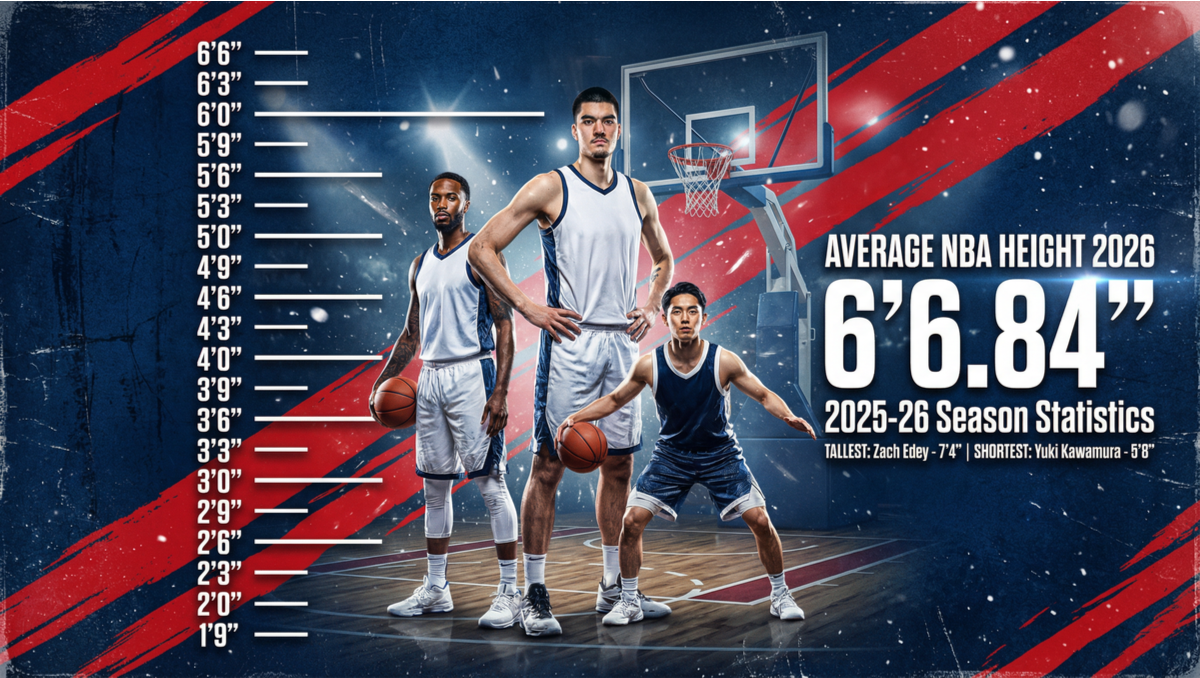
The National Basketball Association features athletes among the tallest competitors in professional sports, yet the perception that taller always means better is increasingly outdated. Entering the 2025–26 season, the average NBA height stands at 6 feet 6.84 inches (approximately 78.84 inches), the shortest average in 39 seasons. This shift reveals how modern basketball increasingly values versatility alongside size, making average NBA height statistics crucial for analyzing team composition and performance trends.
Whether you’re evaluating matchups for betting, studying rebounding potential, or understanding why smaller, more versatile rosters compete effectively, knowing the relationship between height and performance matters. This guide explores the critical metrics defining the current NBA landscape and how understanding average NBA height can enhance your strategic analysis.
- 01. How Tall is The Average NBA Player?
- 02. Tallest NBA Teams 2025–26: Roster Height Rankings
- 03. Shortest NBA Teams: Impact of Pace and Spacing
- 04. Does Average NBA Height Affect Winning Percentages?
- 05. Extreme Height Cases: The Tallest and Shortest Players
- 06. How Height Impacts the NBA Game: Defensive vs. Offensive Advantages
- 07. The Evolution of NBA Height: The Three-Point Revolution
- 08. 4 Key NBA Height Stats for Your Betting Strategy
- 09. The Bottom Line: Height + Skill = Winning Basketball
How Tall is The Average NBA Player?
The benchmark figure for the 2025–26 season sits at 6 feet 6.84 inches across all 30 teams and roughly 450 active players. To contextualize: the average American male stands approximately 5 feet 9.3 inches tall, making NBA players nearly 10 inches taller than the general population.
What’s remarkable is the consistency with variation. While the overall average height of NBA player hovers near 6 feet 6.84 inches, individual teams deviate by roughly 2 inches. This variation directly influences strategic decisions about matchups, defensive schemes, and offensive tempo. When analyzing games on top NBA sports betting sites, bettors should pay particular attention to how a team’s average height shifts when key players enter or exit lineups.
The average height masks important positional nuances. Point guards have reached their tallest average ever at 6 feet 2.4 inches, while centers, power forwards, shooting guards, and small forwards all register at their shortest since the early 1980s. This reflects modern emphasis on skilled, floor-spacing big men rather than traditional post-up centers.
Tallest NBA Teams 2025–26: Roster Height Rankings
Height provides structural advantages in rebounding, shot-blocking, and interior defense. Teams with bigger lineups control more possessions and dictate play near the rim. The rankings below highlight the NBA’s tallest rosters, pulled from Sigma Play’s complete tallest NBA teams ranking with full 2025–26 height data and team averages.
| Rank | Team Name | Total Players | Average Height | Average (inches) |
|---|---|---|---|---|
| 1 | Utah Jazz | 18 | 6’7.7″ | 79.72 |
| 3 | Atlanta Hawks | 18 | 6’7.6″ | 79.61 |
| 2 | Orlando Magic | 16 | 6’7.6″ | 79.56 |
| 4 | Houston Rockets | 11 | 6’7.2″ | 79.18 |
| 5 | Portland Trail Blazers | 15 | 6’7.1″ | 79.1 |
| 6 | New Orleans Pelicans | 18 | 6’7.0″ | 79 |
| 7 | Charlotte Hornets | 18 | 6’6.9″ | 78.89 |
| 8 | New York Knicks | 17 | 6’6.8″ | 78.82 |
| 9 | Brooklyn Nets | 18 | 6’6.8″ | 78.8 |
| 10 | Milwaukee Bucks | 17 | 6’6.8″ | 78.8 |
| 11 | Philadelphia 76ers | 18 | 6’6.8″ | 78.8 |
| 12 | San Antonio Spurs | 18 | 6’6.7″ | 78.72 |
| 13 | Los Angeles Lakers | 17 | 6’6.7″ | 78.71 |
| 14 | Denver Nuggets | 17 | 6’6.7″ | 78.7 |
| 15 | Minnesota Timberwolves | 15 | 6’6.7″ | 78.7 |
The Utah Jazz lead the league with a height-heavy lineup that supports aggressive interior defense and rebounding targets. Despite their height advantage, these teams’ success depends on perimeter defensive intensity and transition speed. The Lakers and Nuggets maintain height advantages while featuring some of the league’s most skilled scorers and playmakers, the gold standard formula.
Shortest NBA Teams: Impact of Pace and Spacing
Shorter teams trade interior size for spacing, shooting, and speed. These rosters push pace, stretch defenses with multiple three-point threats, and rely on quick decision-making over rim protection. The rankings below highlight the NBA’s shortest rosters, pulled from Sigma Play’s complete shortest NBA teams ranking with full 2025–26 height data and team averages.
| Rank | Team Name | Total Players | Average Height | Average (inches) |
|---|---|---|---|---|
| 1 | Golden State Warriors | 18 | 6’5.0″ | 77 |
| 2 | Chicago Bulls | 18 | 6’5.2″ | 77.22 |
| 3 | Dallas Mavericks | 17 | 6’5.6″ | 77.59 |
| 4 | Toronto Raptors | 17 | 6’5.8″ | 77.81 |
| 5 | Miami Heat | 16 | 6’5.8″ | 78.06 |
| 6 | Cleveland Cavaliers | 16 | 6’5.9″ | 77.94 |
| 7 | Boston Celtics | 17 | 6’6 | 78 |
| 8 | Indiana Pacers | 17 | 6’6.1″ | 78.1 |
| 9 | Detroit Pistons | 18 | 6’6.6″ | 78.6 |
| 10 | Los Angeles Clippers | 17 | 6’6.6″ | 78.6 |
| 11 | Sacramento Kings | 18 | 6’6.1″ | 78.06 |
| 12 | Memphis Grizzlies | 18 | 6’6.4″ | 78.39 |
| 13 | Oklahoma City Thunder | 17 | 6’6.6″ | 78.65 |
| 14 | Phoenix Suns | 17 | 6’6.6″ | 78.65 |
| 15 | Washington Wizards | 18 | 6’6.7″ | 78.67 |
The Warriors remain the league’s shortest roster, sacrificing interior height for perimeter shooting and floor spacing. Yet Stephen Curry has proven that shooting excellence and basketball intelligence overcome height deficiencies. However, recent playoff struggles suggest that when defensive intensity increases, the height disadvantage becomes pronounced against taller opponents.
The Mavericks shorter rosters with elite shot-makers, illustrating how transcendent talent compensates for roster-level height disadvantages. The Heat have consistently made deep playoff runs by emphasizing defensive versatility and three-point shooting.
For bettors, games between the shortest teams often produce higher-scoring affairs with a faster pace. When watching these matchups on a live betting sportsbook, monitor pace-of-play metrics and three-point volume; they’ll likely exceed seasonal averages. Regular-season matchups favor these squads; playoff series against taller, defensive-minded opponents test their viability.
Does Average NBA Height Affect Winning Percentages?
A counterintuitive finding: there is no statistically significant relationship between team average height and winning percentage since 2000. This doesn’t mean height is irrelevant, it’s necessary, but insufficient.
The shift emerged gradually with the three-point revolution. Starting in the mid-2010s, NBA offenses increasingly prioritized spacing, shooting efficiency, and perimeter-oriented play. Teams like the Golden State Warriors demonstrated that elite shooting and pace could sustain competitive rosters despite roster-level height disadvantages. However, the rise of smaller, skill-heavy rosters doesn’t mean height is irrelevant. This means height must be paired with shooting excellence and defensive versatility. Traditional tall rosters that lack perimeter skill have proven less successful than anticipated, while height-light rosters with elite shooters have thrived. Modern NBA success requires strategic height distribution: traditional bigs providing interior anchors combined with skilled, floor-spacing wings and guards capable of defensive versatility.
Teams compensated for reduced height with superior ball-handling, shooting accuracy, and faster pace. Modern NBA coaching adjusts schemes based on this height-to-skill trade-off. A team loses not because they’re shorter, but because they lack shooting volume to justify that personnel choice.
For bettors, this insight proves valuable: a shorter team with elite shooters often outperforms traditional tall lineups that can’t space the floor.
Extreme Height Cases: The Tallest and Shortest Players
The NBA’s height distribution creates fascinating outlier cases that often capture media attention while also revealing physical performance limits.
The Tallest: Zach Edey (7 feet 4 inches)
Zach Edey of the Memphis Grizzlies stands as the current tallest NBA player at 7 feet 4 inches. The Canadian rookie joined the league with rim-protection and post-scoring potential, though lateral mobility questions persist.
The Shortest: Yuki Kawamura (5 feet 8 inches)
At 5 feet 8 inches, Yuki Kawamura of the Chicago Bulls is currently the shortest NBA player. The Japanese guard relies on exceptional ball-handling, passing vision, and court awareness to overcome his stature.
For historical context, Muggsy Bogues remains the shortest player ever to appear in the NBA at 5 feet 3 inches, proving that exceptional quickness, court vision, and mental acuity could sustain an NBA career.
Why These Extremes Matter ?
How Height Impacts the NBA Game: Defensive vs. Offensive Advantages
Research into height’s actual performance impact reveals nuanced findings. A comprehensive statistical analysis found that height correlates strongly with defensive performance (0.51 correlation coefficient) but weakly with offensive performance (0.29 correlation coefficient). This distinction shapes how teams deploy taller and shorter personnel.
Defensive Impact: Height Delivers
Taller players enjoy measurable defensive advantages:
- Rebounding: Players 6 feet 10 inches and taller convert approximately 36.5% of contested rebounds, compared to roughly 20% for players 6 feet 4 inches and shorter.
- Shot-blocking: The reach advantage is undeniable as taller defenders contest shots from greater distances.
- Coverage: Taller perimeter defenders create space coverage more easily.
Offensive Impact: Skill Trumps Size
Offensively, height advantages prove less decisive:
- Three-point shooting: Height doesn’t significantly impact three-point accuracy.
- Ball-handling: Shorter players often possess superior body control and a lower center of gravity.
- Scoring versatility: Elite scorers like Stephen Curry (6 feet 3 inches) and Kyrie Irving (6 feet 2 inches) prove height isn’t essential.
The implication: A tall team with poor shooters underperforms against a shorter team with excellent shooters. Betting markets often misprice this dynamic, especially in regular-season matchups.
The Evolution of NBA Height: The Three-Point Revolution
The average NBA height declining to its 39-year low might initially suggest the league is shrinking. In reality, the league is evolving in position requirements and skill demands, with height becoming positionally specific rather than universally prized.
Historical Trends
The three-point line’s introduction in 1979 initially had minimal impact on playing style. Through the 2000s, the league maintained relative height consistency. The inflection point arrived in the mid-2010s with the Warriors’ dynasty and the subsequent proliferation of analytics-driven team building.
Key trend data:
- Point guards reached their highest average height ever (6 feet 2.4 inches), reflecting positional evolution toward taller, more defensively versatile guards.
- Centers and power forwards dropped to their shortest averages since the 1980s, with big men shifting toward perimeter-oriented skill sets.
- Power forwards increased three-point attempts 167% over the past decade; centers increased them 323%.
What This Means for the Game
Tall players today must shoot. Dirk Nowitzki pioneered this concept with his signature fadeaway jumper, revolutionizing expectations for seven-footers. Contemporary seven-footers like Victor Wembanyama (7 feet 3 inches, elite shooter) and Kristaps Porziņģis (7 feet 3 inches, deadly three-point range) exemplify the modern archetype: positional size combined with perimeter skill.
Shorter players today must defend versatilely. The era when six-foot guards could survive defensively by pure quickness has passed. Teams now demand on-ball and off-ball defensive competence, forcing shorter guards to develop the versatility traditionally associated with larger wings.
4 Key NBA Height Stats for Your Betting Strategy
Understanding how height translates to predictable game outcomes enhances betting analysis:
- Height and Rebounding Edge: Each additional inch of average roster height correlates with measurable rebounding rate advantages. When evaluating total rebound lines, consider whether teams are employing their regular rotation or if injuries have shifted their height composition.
- Height and Pace: Shorter rosters tend toward a faster pace (more possessions per 48 minutes). Games featuring two short teams often push above projected pace totals; tall-versus-short matchups see defensive-minded tall teams slowing the pace.
- Height and Interior Defense: Rebounding alone doesn’t capture interior presence. The combination of height and wingspan (reach) predicts shot-blocking rate, paint defense, and opponent effective field goal percentage in the paint.
- The Injury Wildcard: When a key tall player is injured, teams often shift to “small ball” lineups. These strategic pivots create temporary pace and shooting-efficiency bumps that can shift game scripts. Smart bettors monitor such rotational changes closely.
The Bottom Line: Height + Skill = Winning Basketball
The most important insight: Height remains a significant NBA advantage, but it’s no longer the dominant advantage. The modern NBA rewards teams that combine height advantages in specific positions (centers, power forwards) with perimeter skill across all positions. A team with a seven-foot center who can’t shoot will underperform against a team with a 6 feet 8 inches forward who can stretch the defense.
The declining average height masks this complexity. Instead of shorter or taller being universally better, successful teams employ positional height diversity: traditional bigs providing interior anchors, guards defending versatilely despite a more diminutive stature, and wings bridging both worlds.
When analyzing games for betting purposes, resist the temptation to assume taller teams automatically prevail. Instead, evaluate:
- Whether each team’s height aligns with their shooting capability
- Whether key height mismatches exist at critical positions
- Whether pace differences (often height-driven) match game script expectations
- Whether injuries have disrupted the normal height distribution
Understanding team composition, including average height, provides a competitive advantage in sports betting analysis. SiGMA Play’s comprehensive basketball betting guides equip you with the strategic knowledge professional bettors rely on.
Successful betting combines statistical literacy with strategic thinking. Height matters, just not in the way many casual observers assume.


