
Towards a new digital renaissance: Italy faces technological and cultural challenges

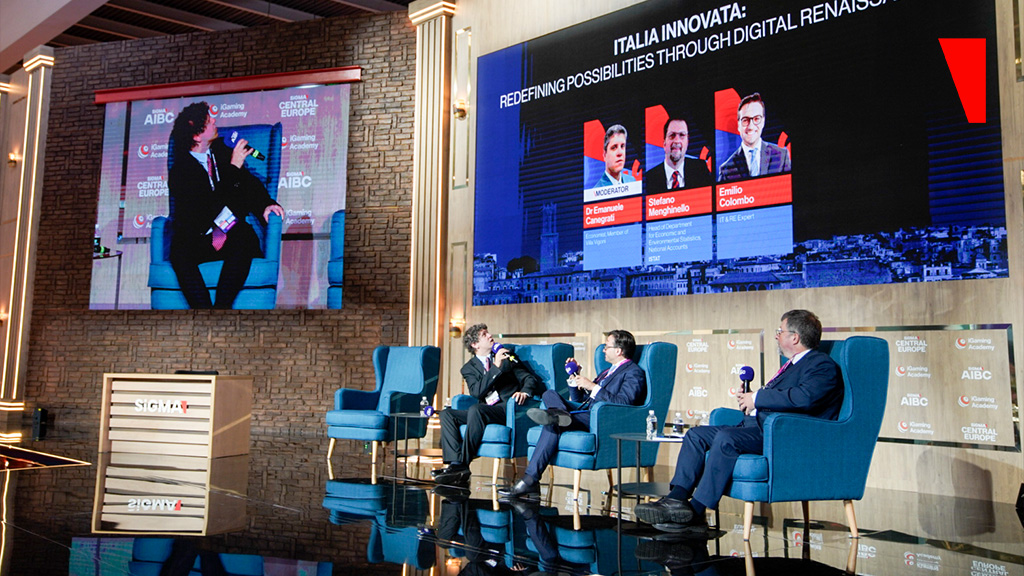
In a keynote taking place on the tech stage at SiGMA Central Europe’s Rome conference – The Regulatory Outlook for Europe’s Gambling Market: Expectations, Priorities and Challenges, panellists explored the idea of a “digital renaissance” in Italy. It opens up a profound question: can this country, a historical cradle of art and culture, also become a hub for technological innovation?
Dr. Emanuele Canegrati offers a comparison with the Renaissance of the 15th and 16th centuries: Italy – home to global artistic genius – could in the same way, become a benchmark for digital creativity.
This new renaissance would not be purely technological, but first and foremost cultural and social. Just as the historical Renaissance was not born solely from art but from a new way of thinking, today’s digital innovation must come from a deep transformation in our behaviours, values, and perception of progress.
From Blockchain to Tokenization: Technology as a Lever for Collective Value
Emilio Colombo’s contribution offered a concrete look at what it means to turn technology into a tool for social impact. After years of experience in international real estate markets, Colombo is now applying blockchain technology to create a digital identification system for Italian properties. The goal is to tokenize property “parcels,” making each asset traceable, transparent, and easily transferable.
This idea also opens new possibilities for cultural heritage, which is a topic deeply connected to Italian identity. In some parts of the world, such as Riyadh, tokenization is already used to redistribute value to citizens, allowing them to “own” a share of collective assets. If applied to Italy, this model could transform how we fund and manage cultural assets.
Colombo also speaks of a “new patronage”: the need to attract talent and capital toward projects that merge technology and culture. During the Renaissance, artists were supported by princes and merchants; today, we need investors and institutions who believe in the country’s digital and human potential.
Digital Culture and Technological Humanism
As noted by Stefano Menghinello from ISTAT, digitalization is not merely a technological process. It’s a cultural phenomenon that changes the way individuals and communities interact.
Technology today brings people closer, allows non-profit organizations to communicate more effectively, and promotes cooperation and data sharing. When used wisely, these shared data become collective knowledge.
Menghinello emphasizes that the key to this new Renaissance lies in integrating knowledge: we must move from “vertical” skills, which are tied to a single discipline, to “horizontal” ones that connect engineering, philosophy, social sciences, and art.
It is in this ability to blend different worlds that the essence of technological humanism resides. Only those who remain deeply human will be able to coexist with artificial intelligence, but not because AI is more intelligent, rather because it can never replicate the complexity of human thought.
The Digital Euro: A New Frontier?
In 2027, the European Central Bank could launch the digital euro, an official electronic currency that would radically change how we perceive payments. For Canegrati, the digital euro is the “backbone of the modern economy”: a challenge to cryptocurrencies and stablecoins, but also an opportunity to enhance inclusion and transparency.
The issue directly touches the concept of trust. Just as Renaissance artists and patrons built relationships based on reputation, blockchain and digital currencies can build trust through technology.
Menghinello added a broader economic vision: with growing geopolitical instability, European countries must strengthen internal growth. The digital euro could become a key driver to consolidate European economic integration and reduce dependence on external markets.
The Digital Renaissance as Cultural Transformation
As mentioned earlier, there can be no Renaissance without profound cultural transformation. Technology alone is not enough. We need a social shift that restores curiosity, experimentation, and knowledge to the center.
Colombo revisited the lesson of Leon Battista Alberti, the quintessential theorist of Renaissance architecture. Alberti described the three pillars of architecture as utilitas, firmitas, venustas – which roughly translate to utility, stability, and beauty respectively. Today, Colombo suggests adding a fourth: reditas, the value returned to the community.
This concept perfectly captures the spirit of the new digital Renaissance: combining technology, beauty, innovation, and social responsibility.
It’s not just about building new digital infrastructures. It’s about ensuring they create shared value, improve collective life, and give something back to society.
A Renaissance Driven by Talent, Not Algorithms
The dream of an Italian digital Renaissance is not out of reach, but it requires a systemic vision. The skills are there, creativity is part of the country’s DNA, but what often lacks is unified direction. We need innovation policies, adequate financial tools, and above all a cultural mindset that overcomes the fear of technology.
The digital Renaissance will not be about algorithms or blockchain alone, but about people and culture: young minds who can bridge arts and sciences, businesses that invest in knowledge, and institutions capable of showcasing Italian expertise to the world.
Highlights
- Italy can experience a new Renaissance, this time digital and cultural.
- The change must begin as a social transformation, not just a technological one.
- Blockchain can create collective value and transparency in cultural assets.
- A new form of patronage is needed to support talent and innovation.
- Digitalization is also culture: it connects people and generates shared knowledge.
- Future skills must be both vertical and horizontal.
- The digital euro represents the next major European economic revolution.
- Digital currencies can foster trust and inclusion.
- Technological humanism will be key to coexisting with AI.
- Reditas: technology must give value back to communities.
Final Quote
“Leon Battista Alberti used three paradigms to describe Renaissance architecture very clearly: Utilitas. Firmitas. Venustas. In my view, we should add a fourth paradigm, which I call Reditas.”
— Emilio Colombo
Disclaimer: The content presented on this page is strictly informational and intended for B2B purposes only. SiGMA Group is not responsible or liable for any business decisions, commercial agreements, or activities conducted by attendees, exhibitors, or third parties during or after the event. All participants are responsible for ensuring compliance with applicable laws and licensing requirements, including those of the Agenzia delle Dogane e dei Monopoli (ADM) in Italy. Our events are restricted to adults aged 18 and over.


