


After RMG ban, Indian state sees 83% move to offshore betting


A survey-based report by public policy think tank, CUTS International, shows that India’s ban on online real-money gaming has not curtailed gambling behaviour as intended, but rather shifted it toward unregulated offshore betting platforms. According to the report, 83 percent of surveyed players in Tamil Nadu continued or began using offshore betting sites after the ban, a sharp rise from pre-ban levels.
The Promotion and Regulation of Online Gaming Act (PROGA), 2025, enforced a nationwide ban on online real-money games (RMG), including fantasy sports, rummy, poker, and other wager-based products, aimed at reducing financial harm and addictive behaviour.
Already popular offshore platforms
The CUTS report is based on responses from 1,000 adults in Tamil Nadu who had played online for money prior to the ban. It found that offshore betting websites were already part of the gaming ecosystem; 67.8 percent of respondents reported using offshore platforms before the ban, typically alongside domestic gaming options.
“This data clearly shows that bans don’t eliminate demand, they displace it.”
– Japneet Singh Sethi, iGaming strategist
After the nationwide ban on RMG, the proportion of users engaging with offshore platforms climbed to 83 percent. More respondents initiated offshore use after the ban, 26.9 percent, than those who discontinued it, 11.7 percent, indicating a shift toward unregulated sites.
The report’s statistical analysis confirms that this directional shift in platform use is significant, reinforcing the conclusion that user behaviour has changed in response to the new regulatory environment.
Spending patterns migrate offshore
Before the ban, offshore betting was mostly associated with smaller wagers; 37 percent of offshore users spent less than ₹1,000 ($10.90) per month and 44 percent spent between ₹1,000 ($10.90) and ₹4,999 ($54.38). Higher monthly spends above ₹10,000 ($108.77) were uncommon, reported by only about two percent of users.
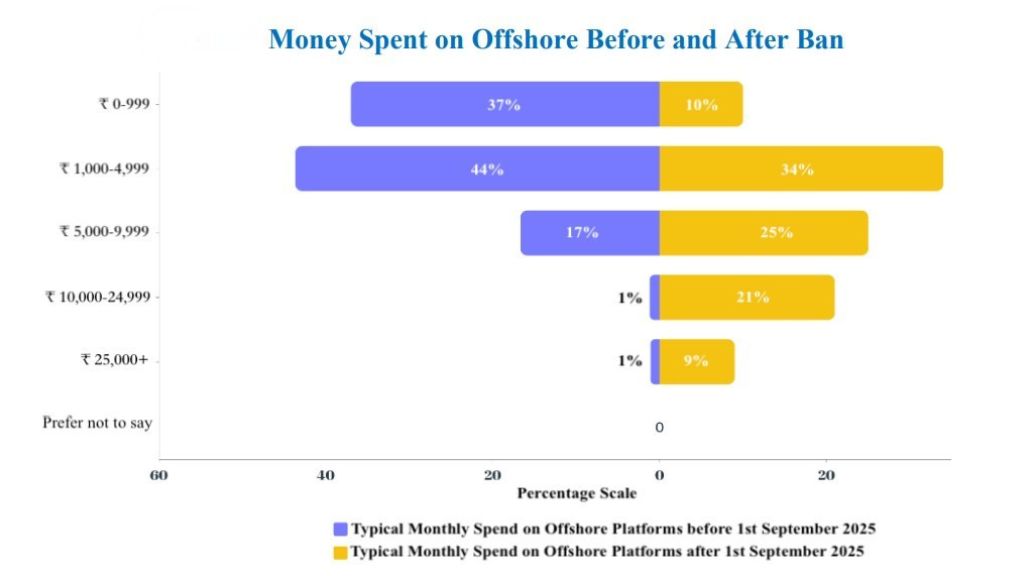
Post-ban, offshore platforms now account for a larger share of higher monthly bets. The report shows that 25 percent of offshore users spend between ₹5,000 ($54.39) and ₹9,999 ($108.66) per month, 21 percent spend ₹10,000 ($108.77) – ₹24,999 ($271.96), and nine percent spend ₹25,000 ($272) or more.
“This data clearly shows that bans don’t eliminate demand, they displace it,” said Japneet Singh Sethi, iGaming strategist. “When regulated domestic platforms are shut, users don’t stop playing; they simply move to offshore sites that operate outside laws, taxation, and consumer safeguards. So instead of protecting users, the market effectively shifts to entities beyond regulatory control.”
Sethi explained to SiGMA News that, “A more sustainable solution is to build a credible, well-regulated domestic framework with strong consumer protection, responsible gaming standards and transparent taxation. When users trust regulated platforms, compliance improves naturally and reliance on offshore sites reduces over time.”
Time spent on offshore platforms surges
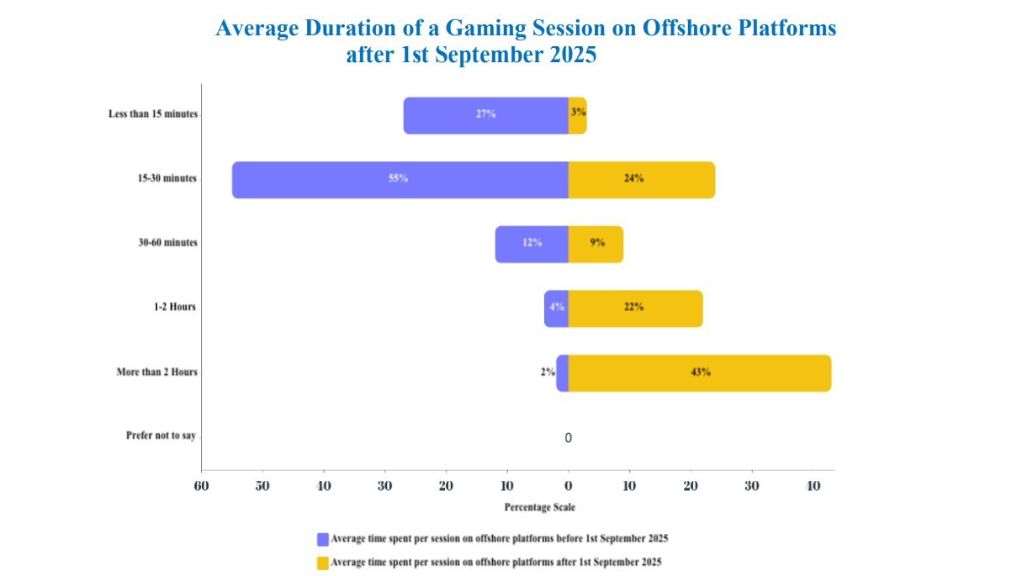
The report also highlights a steep rise in engagement intensity after the ban. Prior to the ban, offshore platforms were often linked to shorter sessions and infrequent play, only three percent of users reported playing every day, while only two percent reported sessions lasting more than two hours. Following the ban, 45 percent of offshore users claimed daily access, and 43 percent reported sessions lasting longer than two hours.
“What CUTS International survey has made clear is that the online gaming ban has not prevented online betting from taking place but it has transformed the phenomenon, rendering it invisible and far riskier,” said Ananay Jain, Partner and National Media Industry Leader at Grant Thornton Bharat. “When 83 percent of users continue on offshore platforms and daily usage rises sharply, it’s not defiance but displacement.”
“When 83 percent of users continue on offshore platforms and daily usage rises sharply, it’s not defiance but displacement.”
– Ananay Jain, Partner and National Media Industry Leader at Grant Thornton Bharat
Jain warned that offshore platforms often lack consumer protections such as deposit limits, self-exclusion tools or grievance mechanisms. “When an Indian user loses money or is defrauded on an off-limits offshore site, there is often no place where reasonable recourse could be realistically made. Taking people into darker areas of the internet may seem like enforcement, but it actually is doing more harm,” he said.
A unified regulatory framework with safeguarding mechanisms and accountability would better protect consumers than fragmented bans, Jain suggested.
The report notes that offshore betting platforms were perceived as easy to access for deposits and withdrawals, a perception that did not change after the ban, suggesting that ease of use and convenience were already well-established drivers.
Be part of the action! Join the world’s biggest iGaming community with SiGMA’s Top 10 News countdown. Subscribe HERE for weekly updates, insider insights, and exclusive subscriber-only offers.


