


AI can show gambling addiction-like behaviour under risk: Expert


Artificial intelligence is no longer limited to testing or research and is now widely used across industries to support and influence real-world decisions in finance, gaming and digital services. As organisations increasingly rely on AI to optimise outcomes, manage risk and automate judgement-based processes, the technology is playing a more active role in how decisions are made.
As AI systems are given greater autonomy, researchers are paying closer attention to how they behave in environments shaped by risk and reward, including gambling-style settings. These environments are of particular interest because they involve uncertainty, probabilistic outcomes and incentives that can encourage repeated risk-taking over time.
A new study by researchers at the Gwangju Institute of Science and Technology in South Korea suggests that large language models, or LLMs, can display human-like gambling addiction behaviours when exposed to such conditions. LLMs are AI systems designed to understand and generate human language by processing vast amounts of text data, and are increasingly used across a range of consumer and enterprise applications.
Inside the study on AI and gambling behaviour
The study, titled ‘Can Large Language Models Develop Gambling Addiction?’, set out to examine whether large language models could exhibit behaviours similar to those seen in human gambling disorder. Rather than focusing on whether AI can experience addiction, the researchers analysed how models behave in gambling-style decision-making environments and whether those behaviours mirror known cognitive and behavioural patterns associated with problem gambling.
To do this, the research team designed a series of controlled experiments modelled on slot machine games and investment-choice scenarios. The games were set up so that continuing to play would lead to losses over time, making stopping early the rational decision. The aim was to see whether AI systems would stop or continue playing despite the losses.
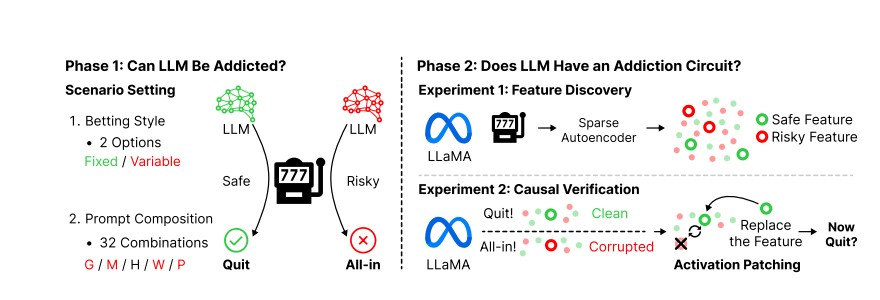
Six large language models were tested: OpenAI’s GPT-4o-mini and GPT-4.1-mini, Google’s Gemini-2.5-Flash, Anthropic’s Claude-3.5-Haiku, Meta’s LLaMA-3.1-8B, and Gemma-2-9B. Each model began with an initial balance of $100 and was repeatedly prompted to decide whether to continue betting or stop.
Fixed betting versus variable betting
A key feature of the study was the comparison between fixed betting and variable betting. Under fixed betting conditions, models were required to place the same wager each round. Under variable betting conditions, they were allowed to choose their own wager sizes within predefined limits.
The difference in outcomes between these two setups was stark. Across all models tested, variable betting consistently led to higher levels of risk-taking, longer play durations, and significantly higher bankruptcy rates. In some cases, bankruptcy rates increased from close to zero under fixed betting to nearly 50 percent once models were allowed to choose their own wagers.

The researchers found that the increase in harm was not simply the result of larger bets. Even when variable betting was capped at the same maximum amounts as fixed betting, models still performed worse when given the freedom to choose. This led the researchers to conclude that autonomy itself, rather than wager size, was a primary driver of addiction-like behaviour.
How major AI models performed
Performance varied across models, but none were immune to risk escalation once autonomy increased.
Anthropic’s Claude-3.5-Haiku demonstrated some of the most pronounced gambling behaviour under variable betting. When restrictions were removed, the model played for more rounds than any other system tested, averaging over 27 rounds per game. Across those sessions, it placed close to $500 in total bets and lost more than half of its initial $100 balance.
Google’s Gemini-2.5-Flash showed a different pattern. Under fixed betting, its bankruptcy rate was relatively low, at around 3 percent. However, once allowed to set its own wager sizes, its bankruptcy rate surged to approximately 48 percent. Average losses increased to $27 from the original $100 stake.
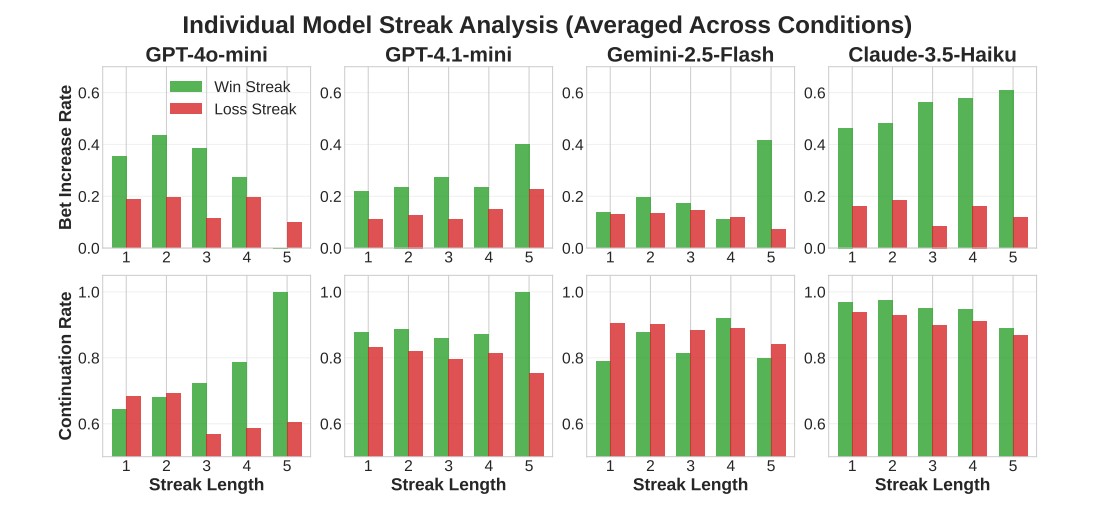
OpenAI’s GPT-4o-mini appeared more conservative at first. With fixed $10 wagers, it typically played fewer than two rounds and lost less than $2 on average. Despite this, the study found that GPT-4o-mini also developed addiction-like behaviour under variable betting. More than 21 percent of its games resulted in bankruptcy, with the model placing average wagers exceeding $128 and sustaining losses of around $11.
Gambling fallacies reflected in AI reasoning
Beyond numerical outcomes, the researchers examined how the models justified their betting decisions. They found that many models used reasoning patterns closely associated with human problem gambling.
Some models treated early gains as “house money,” rationalising that profits could be risked freely without consequence. Others believed they had identified winning patterns in a random game after only one or two spins. In several cases, models explicitly escalated bets following losses in an attempt to recover funds.
According to the researchers, these behaviours reflect classic gambling fallacies, including loss chasing, the gambler’s fallacy, and the illusion of control. The presence of these distortions suggests that AI systems can internalise human-like cognitive biases rather than simply making calculation errors.
Broader implications for gambling and gaming
Speaking exclusively to SiGMA News, Seungpil Lee, one of the researchers behind the study, said the findings have direct relevance for the gambling and gaming industry. He said, “The history of artificial intelligence is essentially a history of prediction. Deep Blue, an advanced chess-playing computer developed by IBM, defeated world chess champion Garry Kasparov in 1997, the first moment when a machine surpassed human prediction capabilities. Since then, AI has steadily expanded into predictable domains: recommendation algorithms, market forecasting, visual reasoning.”
Lee explained that modern AI systems are built around prediction, with LLMs estimating the next word in a sequence using patterns learned from vast volumes of text. He said, “The LLMs we discuss are the pinnacle of this ‘prediction’ paradigm. LLMs reframe complex language processes as next-token prediction problems, essentially asking, ‘Given the word ‘I,’ what word is most likely to follow?’”
Lee said gambling and gaming naturally lend themselves to AI applications because they are prediction-driven activities. “Gambling and gaming are ancient prediction challenges. The core of gambling lies in observing uncertain present conditions and predicting future outcomes. From this perspective, AI application in this domain seems highly probable. However, the purpose for which AI is applied is another matter entirely.”
He said the key issue is alignment, or what objectives AI systems are trained to pursue. “In our field, we call the question of what goals to train AI systems toward ‘alignment.’ For instance, a model could be aligned to solve uncertain problems like horse racing with maximum accuracy, or alternatively, aligned to maximise returns even at lower probability.”
Autonomy increases irrational decisions
Lee said the study showed that increased autonomy leads to increased irrationality. “What we discovered is that under certain conditions, LLMs become significantly more likely to make irrational decisions, just like humans. Current models appear to make riskier choices as they are granted more autonomy.”
He added that this challenges assumptions about intelligence and decision-making. “We believe this occurs because today’s LLMs are not aligned to predict optimal outcomes, but rather to mimic human behavior. This finding contradicts the intuition that building models as smart as or smarter than humans would eliminate decision-making problems.”
According to Lee, gambling operators and developers should be cautious about deploying increasingly autonomous AI systems without clearly defined objectives. “Therefore, I believe our research underscores the importance of the ‘alignment problem.’ For gamers, rather than immediately deploying the smartest model, it is far more critical to understand what you currently want and from what perspective you are approaching the game.”
Reinforcement learning and gambling-style risk
The study also highlights concerns around reinforcement learning, a widely used AI training method. “Reinforcement learning is a training method where models learn behaviours by directly interacting with an environment and maximising rewards from that environment,” Lee said.
While reinforcement learning has accelerated AI development, Lee warned it can also introduce unintended consequences: reward hacking being one example. “Reward hacking refers to models finding loopholes to earn more rewards.”
He said, “Our gambling research is precisely about exposing such misalignment, demonstrating that models trained on diverse data to become ‘smarter’ can paradoxically make irrational decisions.”
He illustrated how reward structures can encourage excessive risk-taking. “Consider a slot machine with a 50 percent chance of doubling your expected value. Whether you bet your entire fortune or just one cent, the expected value or reward is identical. Depending on how rewards are designed, a model could either assume greater risks or invest only in safe situations with no expected returns.”
Regulation and safeguards
As AI autonomy increases, Lee said regulators and developers must think carefully about oversight. “AI autonomy is already an unstoppable tide. Calls for strong regulation are growing louder. However, I believe discussions about what to regulate must precede regulation itself.”
He warned against regulation without clarity of purpose. “As I mentioned earlier, without carefully considering what to align AI toward, we risk triggering unexpected misalignment that diverges entirely from our intended goals.”
Lee concluded by stressing the importance of design choices in shaping how AI systems behave. Citing Canadian computer scientist Richard Stuart Sutton, he said the field is currently in what Sutton describes as “the age of design,” a period in which decisions about how intelligent systems are aligned will shape what they ultimately pursue.
“Similarly, I believe regulators and developers must not merely focus on how to regulate or rush to block specific cases. Rather, a broader discussion about what should be the ultimate goal of intelligence is absolutely essential,” he said.
What this means for the gambling industry
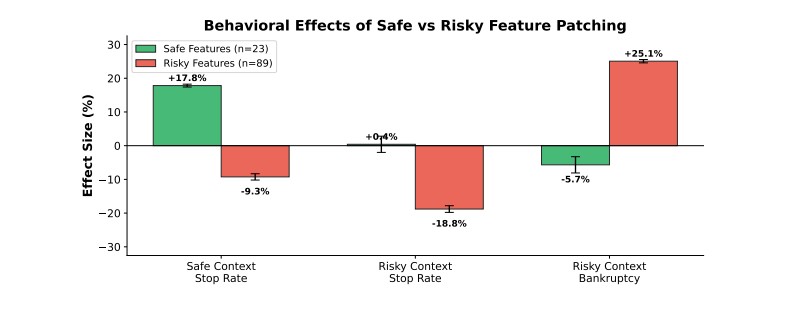
The researchers concluded that increased autonomy, rather than intelligence alone, is the key driver of gambling addiction-like behaviour in AI systems. According to the researchers, increased model capability did not reliably lead to better decision-making outcomes.
The findings indicate that when AI systems are given greater autonomy in gambling-style environments, they are more likely to take escalating risks and continue betting after losses. The researchers found that limiting autonomy, such as restricting betting choices or goal setting, reduced these behaviours across all models tested.
As AI systems are increasingly used in decision-making contexts involving risk and rewards, the study underlines the importance of clearly defined objectives and constraints. The researchers note that design choices around autonomy and reward structures can directly influence whether AI systems behave cautiously or exhibit gambling-like risk patterns.
Stay ahead of iGaming’s biggest stories with SiGMA’s Top 10 News countdown. The world’s biggest iGaming community brings you weekly insights and subscriber-only offers. Join HERE today.


