



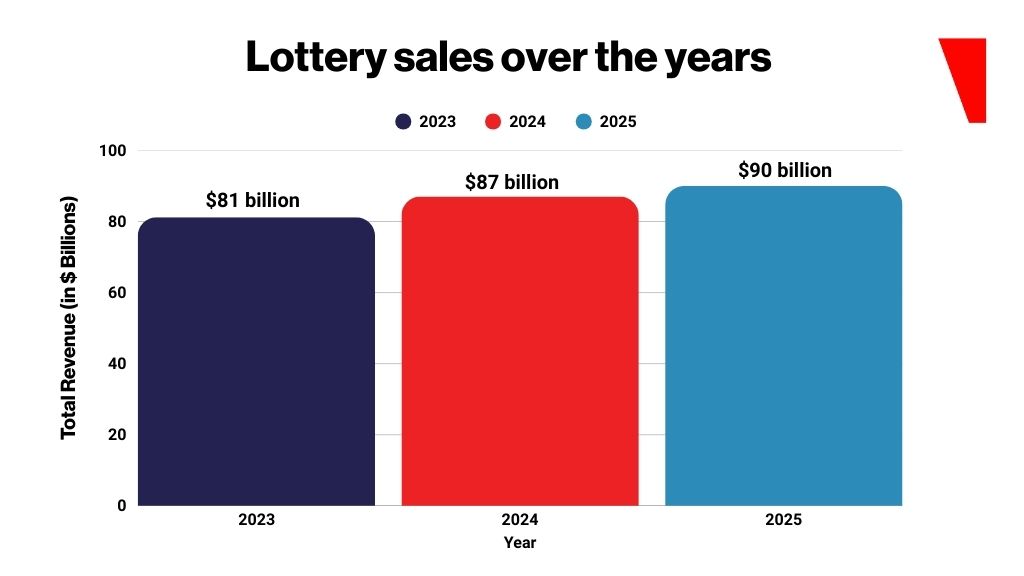
China sold close to 628 billion yuan (approximately $90 billion) worth of lottery tickets in 2025, as the country’s state-run lottery system continues to grow even as the wider economy faces pressure from slowing growth and prolonged trade tensions.
Figures released by the Ministry of Finance show total lottery sales rose 0.7 percent year on year, a modest increase but notable given the size of China’s lottery market, which is already among the largest globally. Officials said the proceeds remain an important source of funding for social welfare programmes and the sports sector.
Welfare lottery sales, which support public assistance and community projects, reached 208.58 billion yuan ($29.8 billion) last year, up 0.3 percent from the previous year. Sports lottery sales rose more strongly, climbing 0.9 percent to 419.39 billion yuan ($60.2 billion), cementing sport-based betting as the dominant segment of the market.
Rapid surge since the pandemic
However, the digital lottery sales fell 9.7 percent to 150.19 billion yuan ($21.5 billion), while traditional lottery sales dropped 15.2 percent to 233.33 billion yuan ($33.3 billion). In contrast, open lottery sales rose 4.8 percent to 103.40 billion yuan ($14.8 billion), and token-based sales increased 2.8 percent to 36.58 billion yuan ($5.2 billion). Regional trends varied, with growth in provinces such as Hebei, Henan, and Xinjiang, but declines in Guangdong, Zhejiang, and Yunnan, highlighting the need for strengthened distribution, regulation, and market oversight.
Sports lottery products now account for roughly two-thirds of total lottery revenue, driven largely by football betting and other major sporting events, according to official estimates. That said, momentum has shown signs of cooling at times. Sales in December 2025 fell 9.1 percent year on year to 52.35 billion yuan, suggesting seasonal volatility and possible softening demand toward the end of the year.
Official data also indicates that China has more than 300 million registered lottery players. Public interest has been boosted by a series of high-profile wins, including a 680 million yuan ($97.8 million) jackpot claimed in Guizhou province last year, the largest single payout in the country’s lottery history.
The rebound since the pandemic has been notable. In 2023, China’s lottery ticket sales climbed to 579.7 billion yuan ($81.2 billion), a 36.5 percent increase year on year, as consumer activity recovered following prolonged COVID-19 restrictions. Growth continued in 2024, when full-year lottery sales reached 623.5 billion yuan ($87 billion), marking a 7.6 percent annual increase, according to figures released by the Ministry of Finance.
Factors behind growth
However, monetary profit is not the only reason behind Chinese lottery sales. Cultural factors continue to play a major role in lottery participation. Belief in luck and fortune remains common, and for many people, buying a ticket is seen less as gambling and more as a small act of hope, a chance, however remote, that things might change.
The way lotteries are sold has also evolved. To appeal to younger consumers, operators have moved beyond traditional kiosks. In some cities, lottery tickets are now sold alongside coffee and desserts, with modern interiors and internet slogans turning what was once a functional purchase into a casual, social habit.
Still, regulators remain cautious. Authorities have repeatedly warned about the risks of market saturation, gambling addiction, and fraud, calling for tighter oversight and stronger responsible-gaming measures. Some analysts also question whether official figures capture the full scale of lottery-related activity, arguing that actual demand could be higher than reported. What is clear, however, is that the lottery boom has become a noticeable feature of China’s post-pandemic economic landscape.
Stay in the loop and join the biggest iGaming Community in the world with SiGMA’s Top 10 news countdown. Subscribe HERE for weekly updates from the world’s iGaming authority and exclusive subscriber-only offers.


