
Senegal’s national lottery implements 20% tax on player winnings

The Senegalese National Lottery (LONASE) has officially implemented a new 20% tax on player winnings, marking a shift in Senegal’s gaming landscape. The tax law took effect on 1 November 2025 for physical retail outlets and will extend to digital platforms around mid-November, under Law No. 17/2025.
Implementation of the new tax
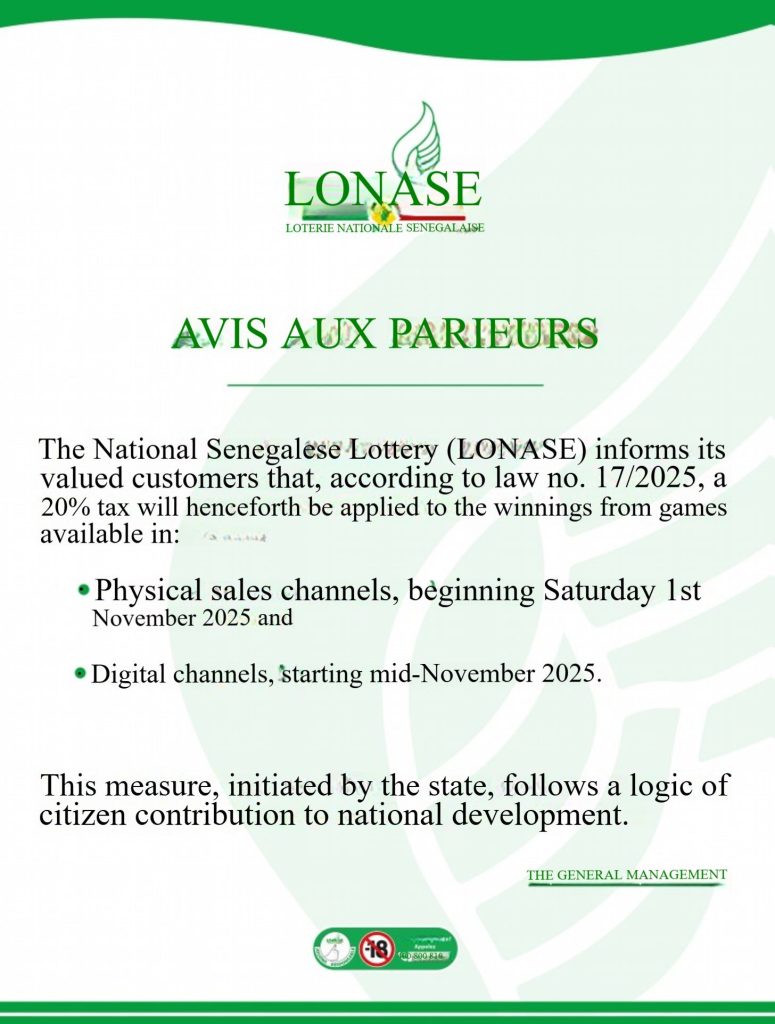
In a notice to players, LONASE confirmed the rollout of the measure. “The Senegalese National Lottery (LONASE) informs its valued customers that, in accordance with Law No. 17/2025, a 20% tax will now be applied to winnings from games sold on the physical sales network, starting Saturday, 1 November 2025, and on the digital channel, starting in mid-November 2025.”
This law now automatically taxes all winnings from retail shops and digital platforms. Bettors will not need to make any additional declarations or payments, as the tax is deducted directly at payout.
Civic contribution or player penalty
According to a report by Senenews, “This 20% tax will be levied on the total amount won, after the bet has been validated. For example, a player who wins CFA100,000 (€152) from a winning bet will only receive CFA80,000 (€122), the remaining CFA20,000 (€30) being paid to the Treasury as a tax on winnings.”
This new policy is part of a government initiative to raise national revenue and strengthen public finances. However, players have expressed mixed reactions. The Senenews report added: “Presented as a ‘civic contribution to national development’, this decision, initiated by the government, is already provoking strong reactions among bettors.”
Some players see the measure as an unfair reduction of their potential earnings, while others view it as a patriotic contribution to support national growth.
Broader economic context
The 20% tax forms part of a bigger economic framework embedded in Prime Minister Ousmane Sonko’s economic and social recovery plan (PRES) for Senegal. Under the same draft law No. 17/2025, the government has proposed additional measures that could reshape the gambling landscape.
The draft law also seeks to require operators to contribute 20% of their share of prize pools to the state. This proposal, however, remains under legislative review and has not yet been enacted.
The government’s objective through these reforms is to improve traceability, encourage digital transactions, and advance financial modernisation within the gaming sector. By standardising the gambling ecosystem, authorities hope to enhance transparency and ensure that gaming revenues contribute to national development projects.
LONASE’s continued role
Despite the newly implemented tax, LONASE remains at the forefront of Senegal’s gaming industry. The authority has long supported social, educational, and sports programmes. The proposal states that the extra funds generated will improve such community programmes.
Although the move is subject to debate, it could serve to ensure a stable market in the industry because it means that there is more accountability. Others believe that increased taxes could deter casual gamblers.
Shaping the future of Senegal’s gaming sector
The Senegalese gambling market keeps growing, with LONASE at the forefront in both retail and online gambling. The taxes mark a turning point in how the Senegalese government manages gambling revenue.
Although some bettors feel penalised, the government insists the reform reflects a shared responsibility toward nation-building. As the 20% tax becomes fully operational, its impact on betting volumes, player behaviour, and national revenue collection will become clearer in the coming months.
For now, Senegal’s players must adjust to a new reality – where every winning ticket also contributes directly to the Treasury, symbolising both a civic duty and a cost of play.
The fuse is lit. Colombo leads the charge in the future of iGaming. SiGMA South Asia, 30 Nov – 02 Dec 2025, where new markets ignite new horizons. Are you in?


