


14,000 games, 500 operators - and just 10 titles dominating Brazil

The Brazilian online casino market has become one of the most competitive environments in the world, both in terms of game volume and the number of operators competing for players’ attention. Analysing data from Blask, a company specialising in iGaming analytics, there are currently around 14,000 titles distributed across more than 500 active operators, all competing for visibility within digital casino lobbies. Blask says this scenario has created an ecosystem in which the scarcest resource is no longer the number of available games, but rather player attention. In other words, the challenge has shifted from expanding game libraries to securing strategic placement within platforms and achieving genuine relevance with audiences.
The analysis presented by Blask is built precisely on this premise: understanding not only which games are available, but which games truly capture player interest. To do this, the study compares two fundamental elements of the Brazilian market – how operators organise their lobbies and how players search for games. Visibility and demand do not always move in the same direction.

How Blask measures market behaviour
To map how the market actually functions, Blask developed a methodology based on direct data collection from operators. As explained in the company’s report, automated systems analyse hundreds of online casino websites daily, capturing screenshots of lobbies and category pages. Using computer vision technology, Blask automatically identifies each game displayed by matching visual elements against a database containing more than 30,000 registered game logos. Each title is then assigned an exact lobby position, allowing the company to precisely measure the level of exposure granted by operators.
Blask’s analysis relies on three core metrics. By combining these three layers of data, the company can directly compare what operators promote with what players actively search for, something rarely achievable through traditional catalogue or distribution metrics alone.
- Blask Index – a proprietary indicator measuring real-time market demand based on player search data. The company describes it as a “thermometer” of audience interest within each country.
- Game Visibility Rank (GVR) – a metric indicating a game’s average position within casino lobbies. The lower the number, the higher the visibility. A game ranked first appears immediately to players, while higher numbers indicate reduced prominence.
- Share of Interest (SoI) – the percentage of player attention captured by each game within the market. According to Blask, this metric converts search behaviour into a measurable interest share, revealing which titles truly dominate player attention.
Key finding:
Visibility does not equal demand. Based on its analysis, Blask identifies one of the most significant patterns within the Brazilian market: a clear misalignment between exposure and player interest. The report states that games frequently placed in prominent lobby positions are not always those generating the highest levels of organic demand. This phenomenon is particularly evident in the crash games category.
While certain titles dominate distribution and appear across a large number of operators, other (less promoted) games generate significantly higher search volumes among players. Blask says this contrast demonstrates that Brazilian player preference is not determined solely by platform positioning.
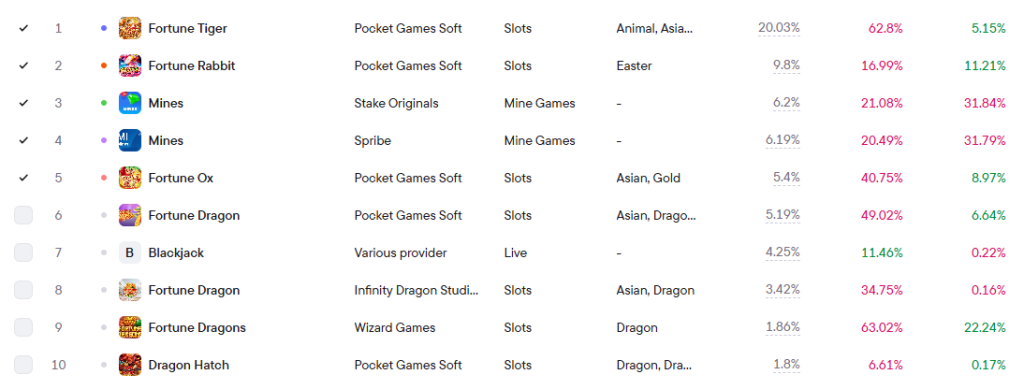
The study also highlights a strong concentration of attention within the market. Blask’s data shows that a single game, Fortune Tiger, captures approximately 30% of total player interest. Furthermore, the ten most popular titles account for nearly two-thirds of overall market attention, leaving hundreds of other games competing for a comparatively small share of interest.
Another key finding is the imbalance between categories. Although slots represent roughly 85% of the available catalogue, smaller categories, particularly crash games, generate a disproportionately high level of player interest. An analysis of Blask data suggests that success in Brazil is increasingly linked to understanding player behaviour rather than simply expanding supply.
The evolution of player interest in Brazil
By analysing search behaviour over time, Blask identifies significant shifts in how Brazilian players distribute their attention across games and categories. The company’s data shows only 515 games register measurable demand within the national market, despite the existence of thousands of available titles.
Slots account for around 89% of games with measurable interest, yet historical search trends show that leadership in attention is far from static. The report reveals that JetX led player interest in 2022, followed by a temporary rise in Blackjack searches in early 2023. Later, Fortune Tiger experienced rapid growth in popularity and went on to dominate Share of Interest within Brazil.
Blask’s time-series analysis also points to a gradual expansion of the so-called “long tail”, suggesting that while blockbuster titles continue to concentrate attention, players are gradually beginning to explore a wider range of games.
The games that truly dominate player interest
When analysing overall Share of Interest rankings, the concentration of attention becomes even more apparent. Fortune Tiger alone accounts for nearly 30% of total interest, an unusually high figure even in mature markets. The ranking also highlights two Mines titles and classic live casino games, such as Blackjack, among the most searched games.
A particularly notable insight is the presence of JetX as the only crash game among the top five titles by interest. Blask also observes that widely distributed flagship titles from major providers, including Pragmatic Play, appear further down the interest rankings, reinforcing the conclusion that wide distribution does not necessarily translate into organic engagement.
Game categories
Blask’s category-level analysis reveals distinct behavioural patterns across game formats. Within slots, the Fortune series dominates almost entirely, with multiple titles ranking among the most searched games. According to Blask, this concentration reflects strong thematic recognition and brand familiarity among Brazilian players.
In the crash category, the picture differs considerably. Blask identifies JetX as the clear leader in interest, capturing a level of attention several times greater than competing titles. This suggests a competitive dynamic driven more by player preference than by exposure volume.
Within live casino, interest is heavily concentrated around Blackjack and Crazy Time, while most other titles generate minimal attention. Instant win games, meanwhile, remain a relatively underdeveloped category in Brazil, with only three titles registering measurable demand.
Although slots represent approximately 85% of the more than 13,000 games analysed, the report shows that smaller categories can still achieve strategic relevance despite their limited size.
Pragmatic Play leads overall distribution, occupying many of the positions among games with the strongest brand presence. However, crash games demonstrate greater competitive diversity, with titles such as Aviator, Spaceman and JetX ranking among the most prominent. While some providers prioritise scale and mass distribution, others gain traction through direct player engagement.
Competitive balance varies significantly between segments. Live casino presence is shared mainly between Winfinity, Pragmatic Play and Evolution, indicating a relatively consolidated market. In instant win games, Football X leads distribution but has yet to generate meaningful demand.
In slots, Blask again highlights Pragmatic Play’s strong distribution footprint, while Fortune Tiger maintains exceptional performance without leading exposure volume. Within crash games, Aviator ranks first in brand presence, followed by Spaceman and JetX.
The most featured games in operator lobbies
When Blask analyses which games receive the greatest direct prominence in lobbies, the report shows that Aviator leads in the number of lobby appearances, with Fortune Tiger close behind. Operators appear to adopt a diversification strategy, simultaneously positioning slots, crash games and live casino titles in premium areas. This approach suggests an attempt to balance new player acquisition with the retention of different user profiles.
The genre analysis shows specific positioning patterns. In slots, premium spaces are largely occupied by the Fortune series and variations of Gates of Olympus. In the crash category, Aviator holds the best average position within lobbies, while Pragmatic Play and SmartSoft Gaming share presence with multiple titles. Live casino games appear less frequently in prominent positions, indicating more selective use of this category. Instant win games remain in an experimental phase, with limited presence and less strategic positioning.
Another indicator analysed by Blask is the total number of pages on which each game appears across websites. Under this criterion, Fortune Tiger leads by a wide margin, reflecting strong operator investment in keeping the title constantly visible. Gates of Olympus 1000 holds second place, while Aviator ranks third. Visibility does not depend solely on lobby position, but also on the repetition of a game across different sections of the platform.
Conclusion
For many years, market expansion was primarily associated with growing game portfolios and wider distribution among operators. However, the report’s findings suggest that this strategy is becoming less effective in an environment where supply has almost entirely exceeded players’ capacity for attention.
What emerges from Blask’s data is a market increasingly shaped by player behaviour rather than exposure alone. Games capable of building familiarity, recognition and organic engagement gain competitive advantages even without occupying the most prominent lobby positions. This indicates that factors such as community influence, social discovery and cultural repetition may play an increasingly important role in Brazilian player decision-making.
The misalignment between visibility and demand also reflects a broader phase of industry adaptation. Operators continue investing in distribution and positioning, yet data shows that players develop independent preferences, often outside platform curation. In this context, understanding the player journey beyond the lobby, including searches, recommendations and social trends, may become just as important as internal casino design.
At the same time, the extreme concentration of attention around a small number of titles shows that the Brazilian market still operates under a blockbuster dynamic, where a handful of games drive a large share of traffic and engagement. However, the gradual growth of the long tail identified by Blask suggests that this concentration may slowly soften as the market matures and players explore new experiences.
This article was first published in Portuguese on 20 February 2026.
Sign up HERE to receive the SiGMA Top 10 news list and the SiGMA weekly newsletter. Stay up-to-date with the latest iGaming news from the world’s largest iGaming community and take advantage of exclusive subscriber offers.


