


Polymarket has multiple active bets on German elections, despite repeated warnings from regulators in Berlin that such activity breaches national gambling laws.
The platform, which allows users to wager on real-world events, has listed markets covering regional elections as well as political outcomes involving senior figures. While participation from within Germany is technically restricted at the payment level, the website itself remains accessible, creating what officials describe as a regulatory gap.
As of now, Polymarket has active bets on the upcoming German state elections in Saxony-Anhalt, Berlin, and Mecklenburg-Western Pomerania, all scheduled for September. There’s also an active bet on whether Friedrich Merz will step down as chancellor before 2027.
Berlin prohibits prediction platforms
Under the country’s current legal framework, prediction markets fall outside the permitted scope of betting activity. The rules are set out in the Interstate Treaty for Gambling (GlüStV) back in 2021, which limits legal wagering largely to sports and licenced operators. Betting on elections or public policy outcomes is not authorised.
Whereas, the implementation is overseen by the Joint Gambling Authority of the Länder (GGL), which has warned that such platforms may constitute illegal gambling. Authorities have urged citizens to stay away from such platforms, warning that these markets can be prone to manipulation and often lack transparency.
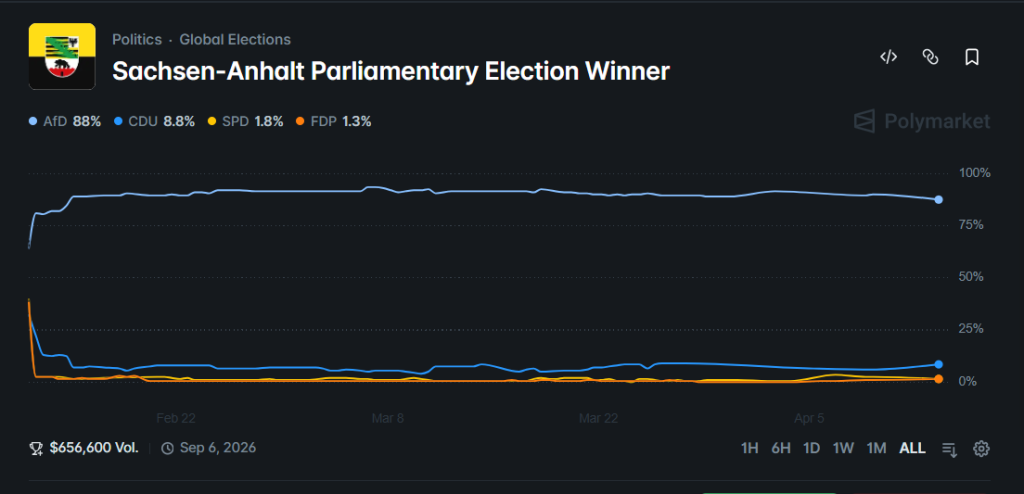
Even so, activity on prediction platforms has continued to rise. Markets linked to German elections have attracted notable interest, with Berlin-related outcomes among the most actively traded. In some cases, bets have gone beyond election results.
Supporters believe these markets can, at times, process information more effectively than traditional opinion polls, particularly when participants have financial stakes in the outcome. This argument gained traction during the 2024 elections, when some analysts viewed prediction markets as offering, in certain instances, more accurate signals than conventional surveys. Media organisations in the United States have since experimented with incorporating such data into their coverage.
Industry analysis suggests the growing interest in alternative wagering platforms, including established best online poker sites, reflects a broader shift toward more varied and dependable online betting options beyond traditional regulated offerings.
European nations in ‘grey zone’
However, regulators across Europe have taken a more cautious stance. In Germany, the absence of a clear legal category for prediction markets has left them in what some analysts describe as a “grey zone”, straddling the boundary between financial instruments and gambling products.
Authorities say the biggest issue is anonymity. Most of these platforms operate on crypto, making it difficult to know who is placing bets or whether groups are acting together. That creates a real risk of insider-style activity, where someone with early or privileged information could quietly profit before the wider public catches on.
There have already been moments that raised eyebrows. In a few cases, betting activity suddenly surged just before major geopolitical developments, including events involving Iran and Venezuela. It is not proof of wrongdoing, but it has been enough to make regulators uneasy about how these markets operate.
There is also concern about the wider impact. When platforms start assigning probabilities to political outcomes, those numbers can take on a life of their own, especially once they are picked up online. Big bets can shift the odds quickly, and that can create a sense that a particular result is “likely” or inevitable, even if that is not how the public actually feels.
Critics argue this risks distorting perception. People may begin following the market rather than forming independent views, particularly if momentum builds around one outcome. At the same time, there is a more fundamental worry. Once political events become something people can trade on, the focus can shift. Instead of debates around policy or governance, attention moves towards potential gains and losses.
For now, Germany is not changing its stance. Regulators continue to treat platforms like Polymarket as operating outside the law under existing rules. The difficulty, however, is enforcement. While payments can be restricted, the platforms themselves are still accessible, leaving authorities dealing with a system that is limited in theory but still very much within reach in practice.
All roads lead to the mother of all conferences in Rome from 02 to 05 November 2026. SiGMA World takes over Fiera Roma, bringing together 30,000 delegates, 1,000+ exhibitors, and 550+ expert speakers. This is where the right room can change your roadmap.


