


How Kenya’s past year trends have shaped the iGaming market

The iGaming market in Kenya has navigated a dynamic year with the influence of sports events and regulatory changes. The period between November and January was characterised by steady growth.
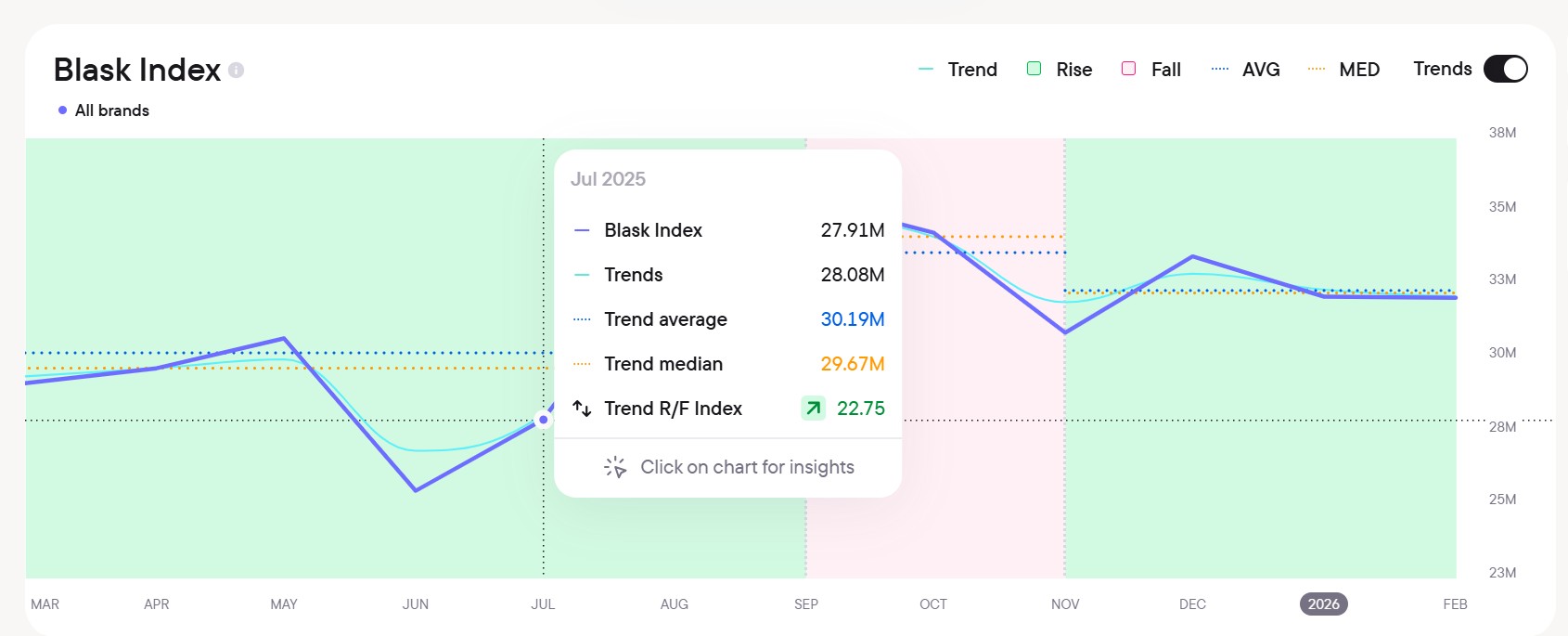
The data provided by Blask indicates stability in the growth pattern. The mean is 32.31M (shows the sum of all trend values divided by their count) with a median of 32.23M (middle of the trend data within the selected period). The data indicate a positive trend and growth pattern. The positive trend index of +0.83 suggests that the growth pattern is steady and has been fuelled by the influence of sports events.
Sports events drive the steady growth pattern
The performance of the iGaming market has been influenced by several events. The 2026 FIFA World Cup Qualifiers in November helped drive the market’s growth pattern. The events saw the Kenya national team win against Seychelles by 5-0 on 20 November. They provided a platform for people to engage in the betting market ahead of the festivities.
More sporting events like the Africa Cup of Nations took place between 21 December 2025 and 18 January 2026. They provided a steady growth pattern as the engagement continued for several weeks. The events culminated with Senegal winning the finals and the engagement continuing throughout the period.
Casino activity supported by jackpot buzz
Casino events also fuelled the steady growth pattern. The SportPesa Mega Jackpot win of KSh424.66m ($3.28m) in August influenced market trends. The win drove a positive growth pattern and reflected the influence of the regulatory environment.
During the AFCON period, operators likely cross-sold sports traffic into casino products. This overlap helped maintain overall platform engagement during peak betting weeks.
However, the exact contribution of casino activity remains uncertain due to overlapping timelines. The effect size is difficult to isolate from sports-driven growth.
Regulatory headwinds recalibrate marketing
Regulation played a defining role in shaping Kenya’s iGaming landscape over the past year. In April, authorities introduced a 30-day blanket suspension of all gambling advertisements.
This move significantly reduced brand visibility and slowed search momentum into September and October. Operators were forced to rethink acquisition strategies amid reduced marketing exposure.
There was a licensing moratorium in October, which restricted new licences and renewals, thus limiting marketing efforts. Overall, these factors created headwinds, especially during the second half of 2025. However, their impact was softened between November and January, especially due to high sports activity.
Payments and macro stability provide balance
Kenya’s macro environment remained stable during this period. Inflation levels remained flat at 4.5%, thus indicating minimal upward pressure on prices. These trends would have had minimal impact on discretionary spending, especially on entertainment activities such as gaming.
During this period, payments were not a concern, especially due to system reliability. There were no system outages, especially during this period. While there were system maintenance issues, these were limited to off-peak hours. There was a power outage in December, which did not impact activity, especially due to its quick resolution, which did not affect gaming activity. Overall, these factors ensured that external factors did not negatively impact market activity.
A market shaped by convergence and resilience
Kenya’s iGaming market demonstrated resilience despite regulatory and operational challenges. Sports events provided a strong backbone for user engagement and revenue stability.
At the same time, casino activity and jackpot narratives helped sustain broader interest. Even under tighter regulations, operators maintained engagement through strategic adjustments.
The interplay of sports, regulation, and consumer behaviour has defined the sector in the past year. The sector has thus recorded a strong foundation in terms of demand. The future of the sector is thus expected to be defined by the need to find a balance between regulation and innovation in the sector. The case of Kenya is a good one in the context of the overall African iGaming sector and the emerging convergence of the betting, entertainment, and digital sectors.
Brazil’s not waiting, and neither should you. BiS SiGMA South America, 06–09 April 2026, brings 18,500 delegates, 250+ sponsors to LatAm’s gaming capital. São Paulo’s bringing more sizzle than a beachside samba. Get in early or get left behind.


