


Meta boosts illegal gambling ads despite global warnings: Report


Meta, the parent company of social media giant Facebook, continues to promote online gambling advertisements on its platforms despite bans in multiple countries, according to a new investigation by Rest of World, a non-profit publication. The report raises concerns about the company’s enforcement of both local laws and its own advertising policies.
The analysis found that Meta hosted illegal gambling ads in at least 13 countries where such promotions are prohibited. These ads appeared across Asia and the Middle East, despite Meta officially classifying many of these regions as “unsupported markets” for gambling-related advertising.
Asia: The main pressure point
Between 2021 and 2024, online gambling activity surged in India, driven by falling mobile data costs and widespread smartphone adoption. In response to concerns over illegal operators and consumer harm, the Indian government banned all real-money online gambling and related advertising in August 2024. However, Rest of World identified at least 140 illegal gambling ads still running on Meta platforms in India as of December 2024. Furthermore, upon checking the Meta Ad Library, the number of active advertisements in January 2026 stands at 910.
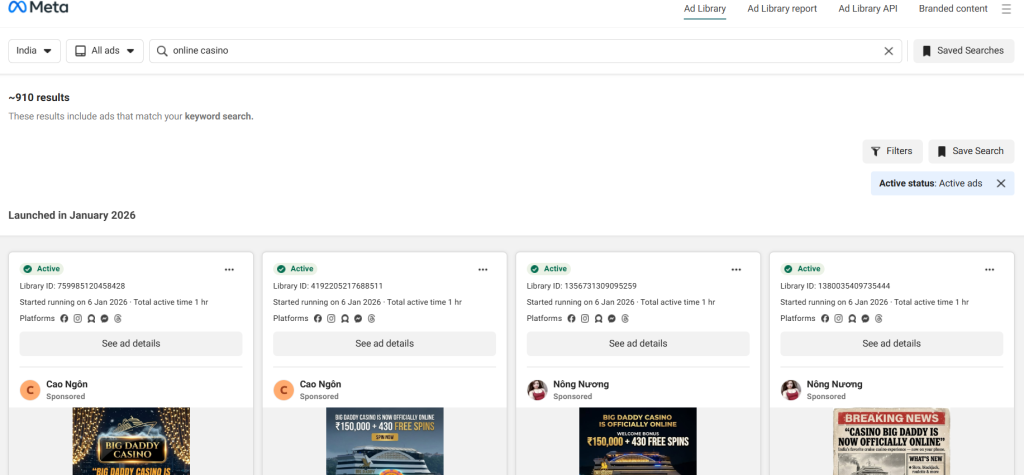
Data from Meta’s public ad library showed nearly 1,000 active gambling ads across countries, including Malaysia, Singapore, Pakistan, and Saudi Arabia. Another 2,400 ads were inactive, yet many pages promoting them remain live, suggesting enforcement is limited over the long term.
Malaysia has emerged as a particular flashpoint. Gambling advertising is illegal under Malaysian law, yet dozens of pages were found promoting online betting services on Facebook and Instagram. Analysts say this highlights a growing rift between regulators and Meta, with authorities struggling to keep pace with fast-moving and often anonymous ad networks.
In the Philippines, more than 170 gambling ads ran in November 2025 alone, many redirecting users to apps promising “millions” in withdrawals, referral bonuses, and so-called “loss rescue” schemes. Regulators estimate that more than 60 percent of the country’s online gambling operations are illegal.
Many of the advertisers use fake addresses and run ads for just a few hours before disappearing, making enforcement difficult. Thailand, where online gambling remains illegal despite recent moves to legalise physical casinos, was also highlighted. A network of Thai-language pages was found to have run more than 500 gambling ads in a single day, promoting live casino games and slot machines.
Europe, Brazil resist ad policy
The issue extends beyond Asia. In Europe, Meta also faces scrutiny over gambling ads. In Belgium, loot boxes in video games are legally classified as gambling, and investigations found that Meta-served ads promoting such features reached millions of users, including minors. Italy has fined Meta for hosting gambling ads despite a nationwide ban, while Romania’s regulator has demanded disclosures over ads linked to unlicenced operators. In response, Meta plans to introduce alternative advertising settings for European countries this year.
In the Americas, Brazil’s Attorney General issued a legal warning ordering Meta to remove illegal gambling ads within 48 hours. Separate Reuters investigations suggest Meta has generated billions of dollars in revenue from scam and illegal advertising globally.
Analysts say Meta appears to be prioritising revenue over compliance with national laws, but critics warn this advertising approach has allowed the widespread promotion of illegal gambling on its platforms.
Asia’s undisputed regional heavyweight lands in Manila, 01–03 June 2026. Backed by PAGCOR and powered by 16,000 delegates, SiGMA Asia delivers two levels of game-shaping influence. If you’re serious about the region, this is the room for you.


