


Mobile-first boom reshapes South Africa's billion-dollar industry


South Africa’s gambling landscape has tipped decisively toward the internet era. During the financial year ending March 2024, South Africans wagered R1.14 trillion ($63.9 billion), and gross gambling revenues reached R59.3 billion ($3.3 billion), according to the National Gambling Board (NGB). Betting now delivers 60.5% of all gambling income, eclipsing casinos, bingo halls, and limited-payout machines, and it is almost entirely an online business powered by smartphones.
Sportsbooks lead, casinos follow
Analysis published by MyBroadband shows just how sharp the pivot has been: betting turnover reached R761 billion ($42.6 billion), more than double the R297 billion ($16.6 billion) attributed to casinos. Digital sportsbook brands such as Hollywoodbets, Betway, SunBet, and World Sports Betting sit at the centre of that surge. Each offers sports odds alongside live-streamed table games that mimic traditional casinos, creating a seamless, hybrid experience that keeps punters logged in around the clock.
Two provinces, outsized returns
The geographical spread of the money is equally striking. Mpumalanga and the Western Cape—provinces with far smaller populations than Gauteng—recorded the highest gambling turnover, at R359.3 billion ($20.1 billion) and R353.2 billion ($19.7 billion), respectively. The reason is straightforward: many leading operators have secured their licences in these jurisdictions, giving provincial regulators a direct stake in the fastest-growing segment of the market.
National ban, provincial loophole
Yet the legal framework governing this boom remains frozen in time. Under national law, only sports and horse-race betting are permitted online. Casino staples such as slots, blackjack, and roulette remain illegal, a stance reinforced by the 2011 Piggs Peak ruling in the Supreme Court. Even so, online sportsbooks routinely offer these very games, exploiting gaps between national statutes and provincial licensing rules. The NGB has flagged the practice as “a critical compliance issue,” but legislative fixes—including the stalled National Gambling Amendment Act—have failed to advance in Parliament.
Influencers turn gambling into lifestyle content
Smartphones alone do not explain the sector’s magnetic pull; social media has made wagering an aspirational pastime. Influencers flash giant pay-outs and colourful bet slips, implying easy riches are just a tap away. The cashless convenience of mobile deposits and withdrawals lowers the barrier still further. Pandemic lockdowns sealed the deal, drawing first-time bettors online when entertainment options were scarce.
South Africa’s metrics climb steadily
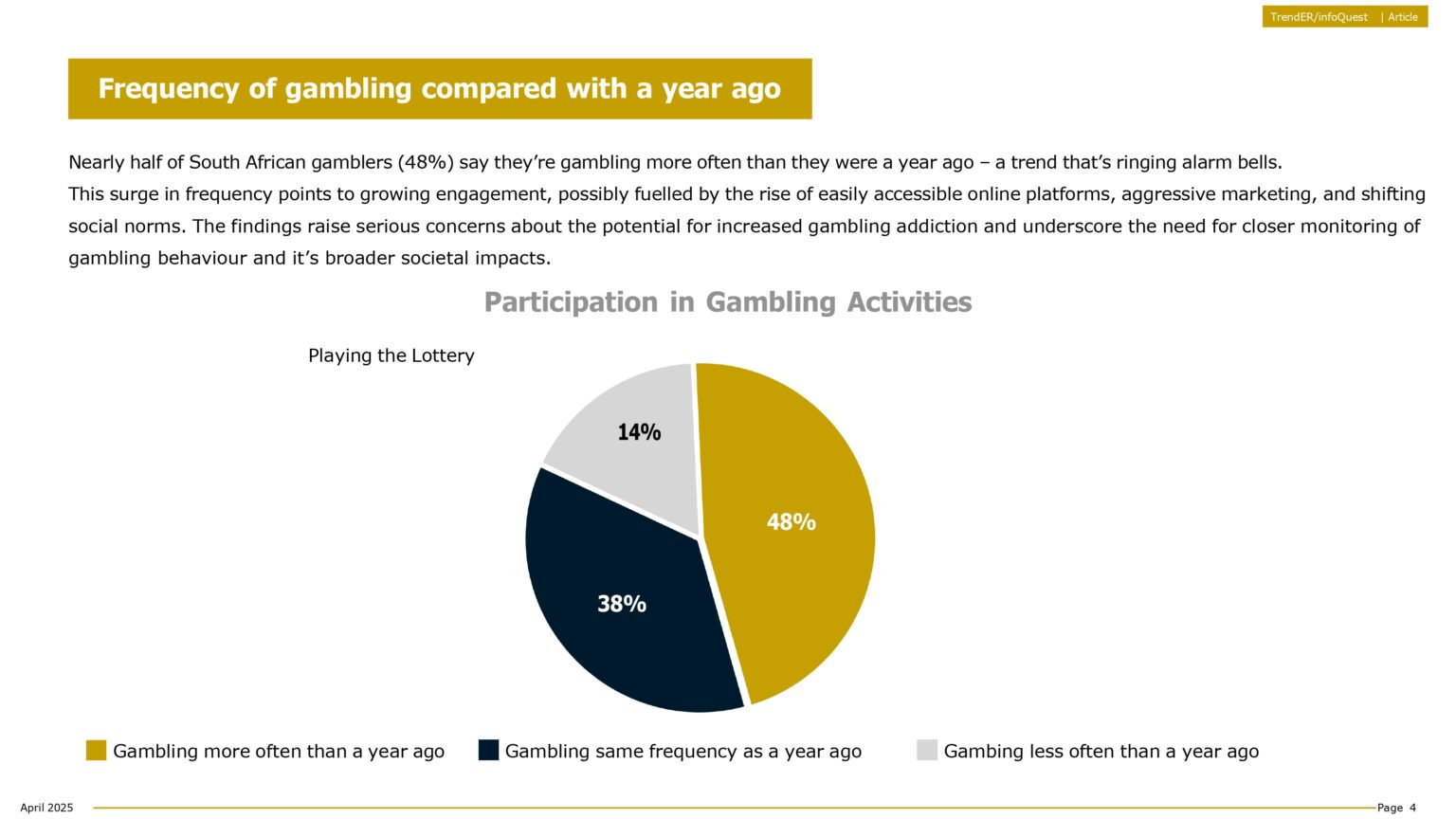
The human cost is starting to emerge in complex data. A 2025 InfoQuest survey found 48% of respondents are gambling more often than only a year earlier, while 63% admitted to staking money that is “not classified as surplus.” The proportion of problem gamblers has rocketed to 31%, up from 6% in 2017. Many of those at risk are unemployed or earn less than R15,000 ($838.7) per month, underscoring how financial pressure and easy mobile access feed a damaging cycle. Perpetua’s ESG report puts a fine point on the trend: 56% of gamblers cite financial need as a primary motivator.
Law enforcement statistics reveal how lightly the law is currently enforced. Police Minister Senzo Mchunu told Parliament that only 39 arrests were made for illegal gambling over the past five years, resulting in 22 convictions. The gap between mass participation and minimal enforcement is widening by the month.
A tax bonanza—but for whom?
Provincial coffers are reaping the windfall. The Western Cape collected R1.46 billion in gambling taxes, ahead of Gauteng’s R1.15 billion ($64.3 million) and Mpumalanga’s R890 million ($49.8 million). Operators also enjoy a lighter burden than their bricks-and-mortar counterparts: online betting firms typically pay about 7% of their gross gambling revenue in taxes, compared with the 10% levied on casinos. The imbalance places added strain on legacy giants such as Sun International and Tsogo Gaming, both of which are scrambling to shift customers online; SunBet alone saw its revenue quadruple to R733 million ($41 million) by 2023.
Growth versus governance in South Africa
The NGB projects betting revenues will grow 20% annually through 2027, even as casino income plateaus. That trajectory promises more jobs in tech and marketing but also threatens traditional casino employment, which still supports more than half the sector’s workforce.
Without modernised laws, transparent data reporting, and robust public health initiatives, the boom may deepen existing social fractures. South Africa’s online gambling surge is testing the limits of an outdated regulatory regime—and for now, the digital house keeps winning.


