


Thousands flee scam hubs in Cambodia, seek embassy aid


Thousands of workers were seen gathered outside their embassies like the Chinese Embassy in Phnom Penh in recent days, following reports that Chinese nationals escaped or were released from online scam compounds. Many are now seeking consular assistance to return home, according to Cambodian media and official Chinese statements.
Regional crackdown on fraud networks
China, Cambodia, Myanmar, and Thailand have stepped up cooperation to dismantle the multibillion-dollar cross-border telecom and online fraud industry.
On 7 January, authorities extradited founder of Cambodia-based Prince Group Chen Zhi from Phnom Penh to China. The move drew renewed attention to scam operations in the region. Considered to be the ringleader, Chen is a Chinese national who acquired Cambodian citizenship in 2014. He was later sanctioned by the U.K. and the U.S. in October 2025. The U.S. accused him of running transnational criminal networks through investment scams that siphoned billions from victims worldwide.
Embassy response and consular assistance
Chinese Foreign Ministry spokesperson Guo Jiakun announced on 19 January that China and Cambodia’s joint efforts against cyber fraud had achieved “notable results.” He added that the Chinese Embassy in Phnom Penh continues to coordinate closely with Cambodian authorities.
Local media reported that after several large-scale scam compounds were dismantled, thousands of individuals were allowed to leave freely. Many have since lined up outside their embassies, hoping to secure temporary travel documents or return certificates after losing their passports.
Camboja News noted that some Chinese nationals fled scam parks in hopes of returning home before the Lunar New Year. Embassy security staff said only a small number were directly linked to scam operations, while others were applying for standard travel visas.
Wider impact across Southeast Asia
The Cambodian government has pledged to intensify its crackdown on telecom fraud, aiming to improve the country’s global reputation. Chinese nationals are not the only victims. The Indonesian Embassy in Phnom Penh reported that 1,440 of its citizens were also released from scam centres.
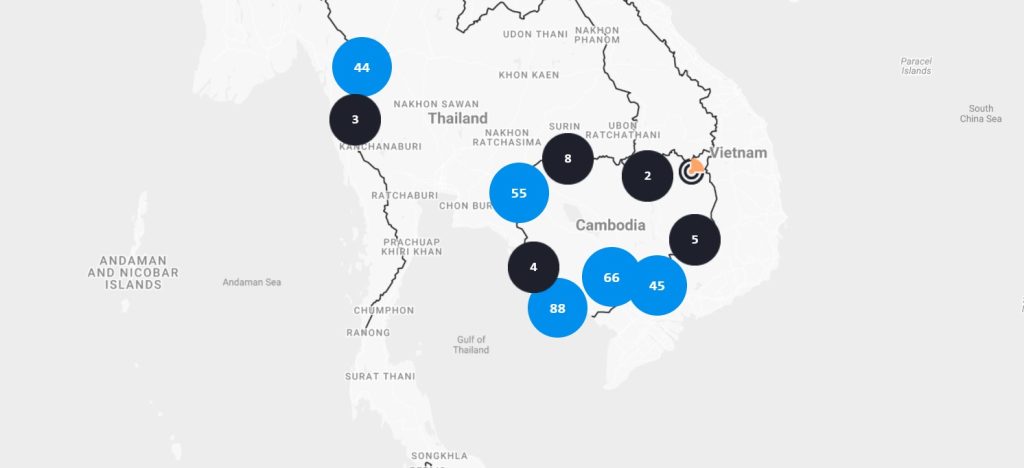
Amnesty International geolocated 15 videos and images showing individuals leaving compounds across Cambodia. Many were provided by the research group CyberScamMonitor. At least 10 scamming compounds across Cambodia released their workers. As reported by Amnesty International’s June 2025 report, these compounds were coined as BA01, KA02, SI03, SI08, SI15, SI37, and SI38.
While thousands may have been freed, Amnesty’s regional director Montse Ferrer said the role of police in the releases remains unclear. Some footage showed police presence, while others appear not to have any.
Ferrer fears about the lack of support for some released workers, noting that some were seen wandering in search of assistance, while others found refuge in safe houses. She also warned that without proper safeguards, victims risk being recruited again into new scam operations. In addition, some videos revealed people who appear to be getting beaten by security guards at the gates at one of the sites in Bavet (BA01).
Amnesty has already interviewed more than 100 victims of the scamming industry. They were recruited outside of Cambodia, where they were enslaved, forced to scam or to recruit others. Additionally, they were denied their liberty and tortured if they did not follow instructions.
Scale of the crisis
The United Nations estimates that 100,000 people are trapped in scam hubs across Cambodia. Similar operations continue to thrive in other parts of Southeast Asia, luring victims with false job offers before forcing them to conduct online scams such as romance-investment schemes and cryptocurrency fraud.
Step inside the world’s biggest iGaming community. Join HERE for weekly updates from the world’s iGaming authority and unlock subscriber-only offers.


