


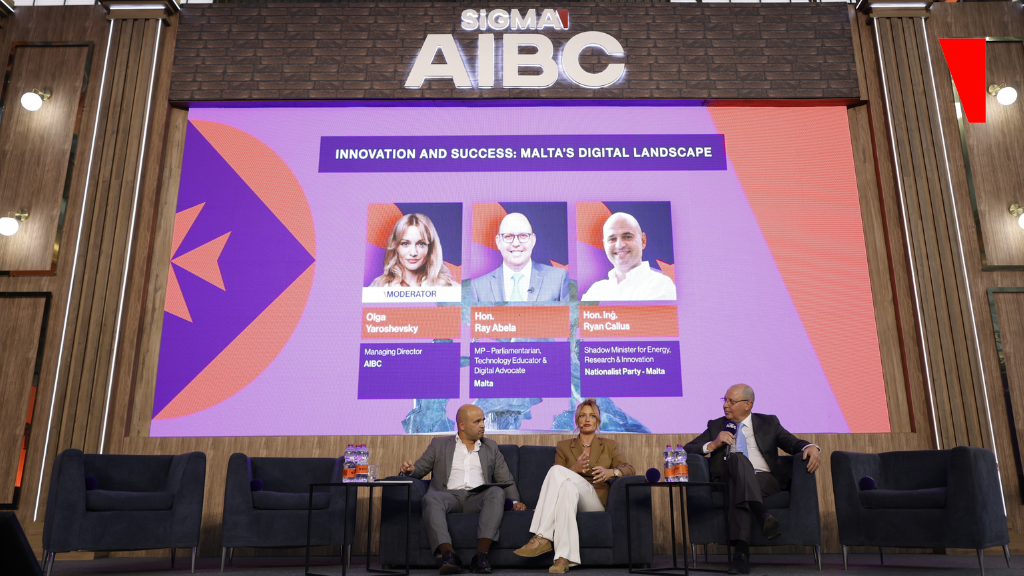
As Europe increasingly embraces digital transformation, Malta has positioned itself at the forefront of innovation, leveraging technology to drive economic growth and regional influence. At SiGMA Euro-Med 2025 on the AIBC stage 02 September, industry leaders and policymakers gathered to examine how emerging technologies are shaping Malta’s digital landscape and its future role in the broader European tech ecosystem. The panel titled Innovation and Success: Malta’s Digital Landscape featured insights from prominent members of Malta’s Parliament, including Hon. Ing. Ryan Callus, Shadow Minister for Energy, Research & Innovation and Hon. Ray Abela, MP, Technology Educator & Digital Advocate, alongside moderator Olga Yaroshevsky, Managing Director of SiGMA AIBC. Together, they explored how government initiatives, technological adoption and regional collaboration are driving Malta’s innovation agenda and digital success.
Embracing the evolution of technology
Hon. Ray Abela brought a personal perspective to Malta’s digital journey, reflecting on his decades-long involvement in ICT education. “This is a topic that I’ve been discussing myself for the past 40 years. I started my business at 17. I have seen a lot of technologies and courses and training for our citizens. It’s a way to empower our citizens in the use of digital technology,” he explained.
From the early days of programming lessons to the arrival of the internet in 1995, Abela has seen first-hand how each wave of technology reshaped Malta. Today, he sees artificial intelligence as the next defining milestone. “Nowadays we are talking a lot about AI. This is the evolution of today and tomorrow. In five years’ time, we will be speaking about AI the same way we used to talk about the internet.”
Abela also stressed the importance of public trust and responsible adoption. “As a parliamentarian I seek to embrace this technology… I use AI for research, it’s important to use it responsibly. When I speak in parliament I speak about the importance of using AI responsibly as a support.”
Driving sustainable digital infrastructure
For Ing. Ryan Callus, the conversation extended beyond digital opportunity to the environmental impact of emerging industries. Using gaming as a case study, he highlighted how data-heavy sectors demand high energy usage and cooling solutions.
“Gaming is a sector which requires a lot of energy, electrical energy. Power in turn results in heating and that requires a lot of cooling. We have to make gaming more environmentally efficient with more efficient data centres,” Callus noted.
AI, he argued, could be part of the solution. “If you have heat very high, with AI you can predict when that peak of heating occurs. You’ll be saving money and increasing profits.” He also floated the idea of introducing green game server trust marks to reward companies that adopt sustainable practices, helping Malta cement its reputation as an environmentally conscious tech hub.
The challenges ahead
Despite Malta’s progress, both speakers acknowledged the challenges ahead. For Abela, regulatory agility and human resources are critical. “We are a small nation and we strive for agility. If you’re in the front of making regulations, you have to move fast with fast-moving technology. Secondly, it is about human resources… as a government we need to invest heavily in evolving specialised training courses in these areas.”
Callus echoed this concern, highlighting the need for talent pipelines and foreign expertise. “It’s useless making legislation but then not being geared up educationally. We need foreign technical expertise. We need to look at special visas for very high-tech individuals that may not be available in Malta.” He added that capital and partnerships will be essential to fuel growth, “There is a big appetite in the market which we are not feeding, so we need to be more intelligent attracting foreign assistance to make research in Malta jump.”
Partnerships and citizen engagement
Both panellists also underscored the role of partnerships in sustaining digital momentum. Abela pointed to Malta’s strong ICT literacy among young people, 96% of those aged 16-24 have ICT skills, but urged broader inclusivity. “I’m happy when we are 100%. We need to start diversifying with education, not just ICT skills. Parents need to be given training about the social impact of AI and social media, and cyberbullying and cybercrime.”
He cited recent legislative progress, including laws against cyberstalking and bullying, and stressed the importance of involving citizens in digital governance. “We have been the first in EU countries in electronic governance, but what we’re doing to have the uptake of citizens in the use of these services?”
Stay tuned for more exclusive insights from SiGMA Euro-Med 2025 and follow us across our channels for real-time updates, interviews and in-depth industry analysis.


