Top Blockchains for Gambling dApps

Blockchain technology has moved far beyond buzzwords and speculation—especially in the online gambling space. Today’s gambling dApps are reshaping how players interact with casinos while accelerating blockchain and crypto casino trends focused on transparency, decentralization, and instant payouts. Instead of relying on opaque systems and third-party assurances, decentralized gambling platforms put transparency directly on-chain.
But here’s the catch: the blockchain a gambling dApp runs on defines its strengths and weaknesses. From transaction fees and confirmation times to security, decentralization, and scalability, each blockchain creates a different gambling experience.
In this guide, we take a deep dive into the top blockchains powering gambling dApps, why developers choose them, and what players should know before placing their bets.
- 01. Why Blockchains Matter in Gambling dApps
- 02. The Main Types of Blockchains Powering Gambling dApps
- 03. Ethereum: The Pioneer of Gambling dApps
- 04. Polygon: Ethereum’s Scalable Gambling Layer
- 05. BNB Chain: Speed and Simplicity for Casino Games
- 06. Solana: High-Speed Gambling at Scale
- 07. Avalanche: Custom Blockchains for Gambling Ecosystems
- 08. TRON: A Gambling Giant in Disguise
- 09. What Players Should Look for Beyond the Blockchain
- 10. The Future of Gambling dApps and Blockchains
- 11. Finding the Optimal Blockchain for dApp Gambling
Why Blockchains Matter in Gambling dApps
Traditional online casinos operate on closed systems. Players have to trust that the games are fair, payouts are legitimate, and funds are handled responsibly. Gambling dApps flip this model on its head.
Every wager, outcome, and payout can be verified on-chain. Game logic is controlled by code rather than humans, and funds are often held in decentralized smart contracts rather than centralized wallets. For players new to this ecosystem, it’s helpful to start by understanding blockchain gambling platforms and how decentralization fundamentally changes casino mechanics.
Another crucial element is automation. Using smart contracts, gambling dApps can:
- Lock in game rules permanently
- Execute payouts instantly without manual approval
- Eliminate the risk of operator interference
If you want to explore this further, this guide on smart contracts in crypto gambling explained breaks down how automated contracts power fairness and trust.
However, not all blockchains handle these processes equally well, which is why choosing the right network matters.
The Main Types of Blockchains Powering Gambling dApps
Not all gambling dApps are built with the same priorities in mind. Some blockchains focus on maximum security and decentralization, others emphasize speed and low fees, while a few are designed for customizable casino ecosystems. Understanding these differences helps explain why certain gambling platforms feel instant and frictionless, while others prioritize transparency and high-value betting.
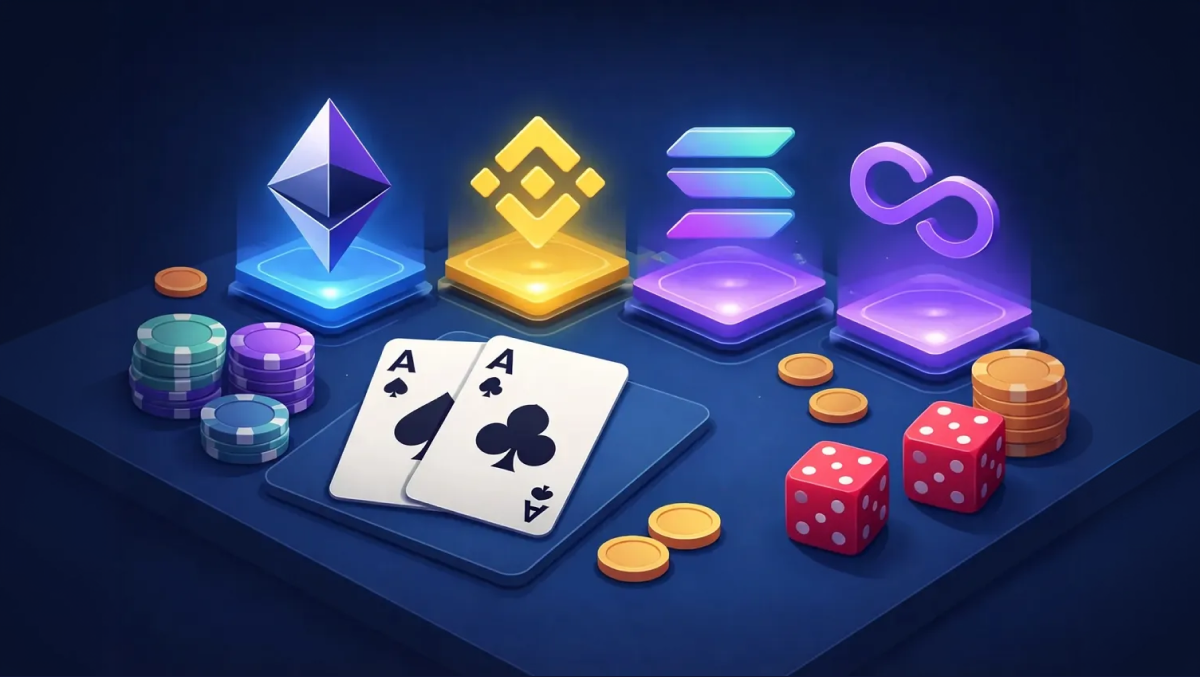
Broadly, today’s gambling dApps are powered by a mix of Layer-1 blockchains and scaling solutions, each catering to a specific use case. Networks like Ethereum lead with security and trust, Polygon improves scalability for frequent betting, BNB Chain balances speed with accessibility, Solana enables real-time gambling experiences, while Avalanche and TRON cater to high-volume or custom casino ecosystems.
Below, we break down the most influential blockchains for gambling dApps, explaining what each one does best and why developers and players gravitate toward them.
Ethereum: The Pioneer of Gambling dApps
Ethereum is where decentralized gambling truly began. As the first major smart-contract blockchain, Ethereum laid the foundation for provably fair games, decentralized casinos, and on-chain betting protocols.
Why Ethereum Works for Gambling
- Mature smart-contract ecosystem
- Unmatched decentralization and security
- Massive developer and tooling support
Ethereum’s biggest strength is trust. Its network is secured by thousands of validators, making it extremely resistant to tampering. For high-stakes gambling dApps, this level of security is invaluable.
Why Developers Choose Ethereum
Ethereum offers unparalleled security through decentralization. With thousands of validators and a battle-tested consensus mechanism, altering or manipulating smart contracts is practically impossible once deployed. For gambling platforms handling large wagers or high-value games, this security is non-negotiable.
Limitations for Gambling Use
The biggest downside is cost. Ethereum’s gas fees can fluctuate significantly during network congestion, making frequent betting expensive. This is why many Ethereum-based gambling dApps either:
- Target high-stakes players
- Use Layer-2 scaling solutions
- Offer Ethereum as one of multiple supported networks
Despite its challenges, Ethereum remains a cornerstone of decentralized gambling.
Polygon: Ethereum’s Scalable Gambling Layer
Polygon emerged as Ethereum’s answer to scalability issues and gambling dApps have embraced it wholeheartedly.
Built as a Layer-2 solution, Polygon offers the same Ethereum compatibility with a fraction of the cost and significantly faster transactions.
Why Polygon Is Ideal for Casino Games
Gambling involves frequent interactions: placing bets, spinning slots, claiming wins, and withdrawing funds. Polygon’s low fees make micro-bets viable, while fast confirmations keep gameplay smooth and uninterrupted.
For players, this means:
- Faster betting cycles
- Near-instant payouts
- Minimal transaction costs
Polygon is particularly popular for slot games, crash games, and casual betting platforms where speed and affordability matter more than raw decentralization.
BNB Chain: Speed and Simplicity for Casino Games
BNB Chain has emerged as one of the most widely used blockchains for crypto gambling, especially among newer platforms targeting mainstream users.
Its low fees and high throughput make it attractive for fast-paced gambling environments, while strong wallet support ensures easy onboarding.
Why Gambling dApps Thrive on BNB Chain
BNB Chain strikes a balance between performance and accessibility. Transactions are fast, costs are predictable, and the ecosystem already supports a wide range of DeFi and gambling applications.
This makes it particularly suitable for:
- Sports betting dApps
- Casino platforms with large user bases
- High-volume betting models
The trade-off is a more centralized validator structure compared to Ethereum, but for many gambling operators, performance outweighs this concern.
Solana: High-Speed Gambling at Scale
Solana is built for speed, and few blockchains can match its performance.
Capable of processing thousands of transactions per second, Solana enables gambling dApps to offer real-time, near-instant gameplay experiences that feel closer to traditional online casinos.
Where Solana Excels
Solana shines in:
- Live betting
- Multiplayer gambling games
- On-chain poker and roulette
With negligible fees and ultra-fast confirmations, players can place bets and receive outcomes almost instantly.
What to Consider
While Solana’s technology is impressive, developers must account for its historical network outages. Although reliability has improved, uptime remains a consideration for mission-critical gambling platforms.
Avalanche: Custom Blockchains for Gambling Ecosystems
Avalanche brings a unique value proposition to the table: customizable subnets.
Instead of deploying on a shared network, gambling platforms can launch their own dedicated blockchain while still benefiting from Avalanche’s security framework.
Why Avalanche Is Gaining Momentum
Avalanche is ideal for gambling ecosystems that go beyond a single casino. Operators can build:
- Dedicated casino networks
- Native gambling tokens
- Multi-game platforms with shared liquidity
This flexibility makes Avalanche especially attractive for enterprise-level gambling projects with long-term growth plans.
TRON: A Gambling Giant in Disguise
While often overlooked in Western crypto discussions, TRON is one of the most widely used blockchains for gambling dApps globally.
Its low fees, high throughput, and strong presence in Asian markets have made it a dominant force in decentralized betting.
Why TRON Works
TRON’s affordability allows players to place frequent bets without worrying about fees eating into winnings. This makes it ideal for:
- Dice games
- Slots
- Continuous betting formats
TRON-based casinos also see strong adoption in Asian markets, giving the network a global gambling footprint.
What Players Should Look for Beyond the Blockchain
While the blockchain is critical, it’s only one part of the puzzle. A gambling dApp built on a top-tier network can still be unsafe if the platform itself lacks transparency or safeguards.
Before committing funds, players should evaluate:
- Audited smart contracts
- Provably fair game mechanics
- Clear terms and conditions
Exploring top-rated cryptocurrency casinos is a good way to find platforms that combine strong blockchain infrastructure with player-focused design.
At the same time, understanding red flags is essential. Knowing the signs of a scam crypto casino can help players avoid poorly designed or malicious platforms, regardless of the blockchain they use.
The Future of Gambling dApps and Blockchains
The evolution of gambling dApps is not a passing trend; it is a structural shift in how online gambling platforms are designed, operated, and trusted. Early decentralized casinos focused heavily on proving that blockchain could work for gambling. The next phase is refinement: making these platforms faster, safer, more user-friendly, and capable of supporting large-scale adoption without sacrificing transparency.
As blockchain technology matures, gambling dApps are moving beyond single-network dependence and basic smart-contract logic. Developers are now experimenting with architectures that prioritize flexibility, interoperability, and long-term scalability, while regulators and players alike demand higher standards of accountability.
Several key developments are already shaping the next generation of decentralized gambling platforms:
- Cross-chain casinos support multiple networks
Rather than limiting players to a single blockchain, future gambling dApps are increasingly designed to operate across multiple networks. This allows users to choose their preferred blockchain—whether for lower fees, faster gameplay, or higher security—without switching platforms entirely. Cross-chain compatibility also improves liquidity and broadens a casino’s player base. - Layer-2 and rollup-based gambling platforms
To overcome congestion and high fees on major blockchains, more gambling dApps are adopting Layer-2 solutions and rollups. These technologies enable high-speed betting and micro-transactions while retaining the security guarantees of underlying Layer-1 networks like Ethereum. For players, this translates into smoother gameplay and quicker settlements. - More transparent, on-chain auditing standards
Transparency is becoming a competitive advantage. Advanced on-chain auditing tools allow players to verify not just individual game outcomes, but entire payout history, liquidity reserves, and contract behavior. This level of visibility raises the bar for trust and makes it harder for poorly designed or malicious platforms to operate unnoticed. - Improved UX bridging Web2 and Web3 gambling
One of the biggest hurdles to mass adoption has been complexity. Future gambling dApps are focusing heavily on user experience—simplifying wallets, reducing transaction friction, and offering interfaces that feel familiar to traditional online casino players while retaining the benefits of decentralization under the hood.
Ultimately, the most successful gambling dApps will not be defined by technology alone. They will be the platforms that strike the right balance between a well-chosen blockchain, robust and fair game design, and a genuine commitment to player trust. As decentralized gambling continues to evolve, these elements will separate experimental projects from platforms built to last.
Finding the Optimal Blockchain for dApp Gambling
Choosing the right blockchain for gambling dApps isn’t about chasing trends; it’s about matching technology to purpose. Each network plays a distinct role in the decentralized gambling ecosystem. Ethereum sets the benchmark for trust and security, making it ideal for high-value, provably fair platforms. Polygon builds on that foundation with faster speeds and lower costs, perfect for frequent, casual betting. Solana pushes the limits of real-time gameplay, while BNB Chain focuses on accessibility and mass adoption. Meanwhile, Avalanche enables tailored casino ecosystems, and TRON excels at high-volume, low-cost wagering. Together, these blockchains form the backbone of modern gambling dApps, giving players transparency and operators the flexibility to innovate with confidence.