


AGA: US gaming leaders confident about future of the industry


The American Gaming Association’s latest snapshot of the sector points to a turn for the better in the third quarter, with executives reporting stronger trading and a clearer runway for growth than they saw at the start of the year. In the AGA’s own words, the new Gaming Industry Outlook shows “sentiment improves amidst lingering economic uncertainty,” a cautiously optimistic framing that matches how many in the business say the past few months have felt.
“Executive sentiment across U.S. gaming industry strengthened in Q3 2025 as key performance indicators improved since the first quarter”, explained the AGA.
Momentum returns, but not without caveats
The AGA says the mood music among leaders and suppliers has brightened materially since winter. “Overall gaming executive sentiment rose to a net positive 7.1% in Q3 2025, the highest since Q3 2022, with outlooks improving across nearly all business indicators.” The short-term view has particularly improved. And on the longer horizon, “26% of respondents now expect stronger business conditions over the next 6–12 months – the most optimistic long-term view in three years.”
That renewed confidence rests on tangible improvements. The AGA notes leaders are seeing “rising revenues, stronger balance sheets, increasing consumer activity, and decreasing promotional spending,” all of which lift margins and reduce the need to buy share with costly offers. It helps that the sector enjoyed a robust summer season. As the association’s vice-president of research, David Forman, put it: “Following a strong summer that underscored the resilience of gaming consumers and the entertainment value of gaming products, the industry’s outlook is the most positive in years,” adding, “While executives are increasingly concerned about regulatory and tax challenges, they plan to continue reinvesting in capital spending to provide players with compelling gaming options and amenities.”
Solid demand and policy headwinds
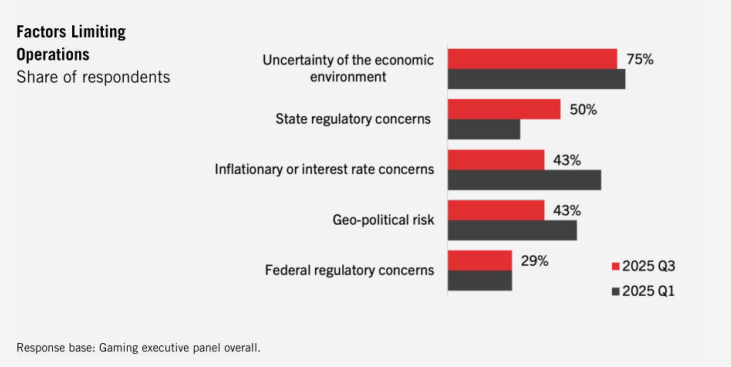
That duality, solid demand alongside policy headwinds, runs through the outlook. “While overall economic uncertainty continues to be the primary factor limiting industry operations, executives expressed increasing concerns about state-level regulatory and tax pressures.” The AGA’s survey spells it out: “Half of respondents (50%) now cite state regulatory concerns as a factor limiting operations, the highest level since the measure was first tracked in early 2023.” And the pressures are not abstract. “Specifically, 46% cited tax or regulatory policy changes as pressuring margins, up from 36% earlier this year.”
Even with those constraints, the group says investment plans remain intact. “As the industry navigates these challenges, executives remain confident in the long-term health of gaming in the U.S. and expect capital investment to remain steady over the coming 12 months.”
A growing audience
The industry’s improving tone lands against a complicated backdrop. Separate AGA research this autumn found that more Americans are engaging with casinos and legal wagering than ever before. According to that survey, 57 percent of US adults participated in some form of gambling in the past year, “the highest engagement levels ever recorded.” The AGA also reported that 90 percent say casino gambling is acceptable for themselves or others, and 62 percent find it personally acceptable. Visitation is rising too, with an estimated 134 million adults (53 percent of the population) visiting a casino over the past 12 months.
Yet public attitudes to the fastest-growing slice of the business, sports betting, are hardening. A major polling project published in October reported that 43 percent of American adults now view the legalisation of sports betting as bad for society, up from 34 percent in 2022, with 40 percent saying it is bad for sports. The number of people who actually placed a bet in the past year has only inched up, from 19 percent to 22 percent, but the visibility of betting, particularly online, has surged. That perception gap matters: it feeds the very “state-level regulatory and tax pressures” that executives say are beginning to bite.
The AGA’s framing of this quarter’s results, “sentiment improves amidst lingering economic uncertainty”, captures that tension. On one hand, casinos and their digital brands are welcoming record numbers of adults who view gaming as mainstream entertainment, and many consumers describe casino experiences as innovative and good value for money. On the other, policymakers are fielding louder concerns about addiction risks, aggressive advertising, and the integrity of sport, issues that can translate into new rules, higher fees and tax changes that executives warn are “pressuring margins.”
The fuse is lit. In Mexico City, 01–03 Sept 2026, North America meets Latin America. SiGMA North America welcomes 4,000 delegates for three days of deals, insight, and startup sparks. Serious insight. Real deals. Book your spot.


