


Canada’s iGaming market hits $9.5B amid offshore surge

Canada’s online gambling market reached an estimated valuation of $9.5 billion in 2025, positioning the country as the world’s third-largest iGaming market by Competitive Earning Baseline (CEB), according to the latest USA and Canada iGaming landscape 2025 report of Blask. Trailing only the United Kingdom and the United States, Canada has emerged as one of the fastest-growing jurisdictions in the global industry.
The report highlights that Canada recorded the highest year-on-year growth among the world’s top five markets, cementing its status as a key target for international operators and suppliers. With over 230 brands competing for market share, the landscape is increasingly saturated, yet still sharply divided between regulated provincial platforms and unlicensed offshore operators.
Offshore segment adds $1.6 billion in a single year
Based on the data, offshore operators are dominating Canada’s iGaming market. In 2025, offshore CEB grew by 40.2 percent, significantly outpacing the 23.1 percent growth recorded by licensed domestic brands.
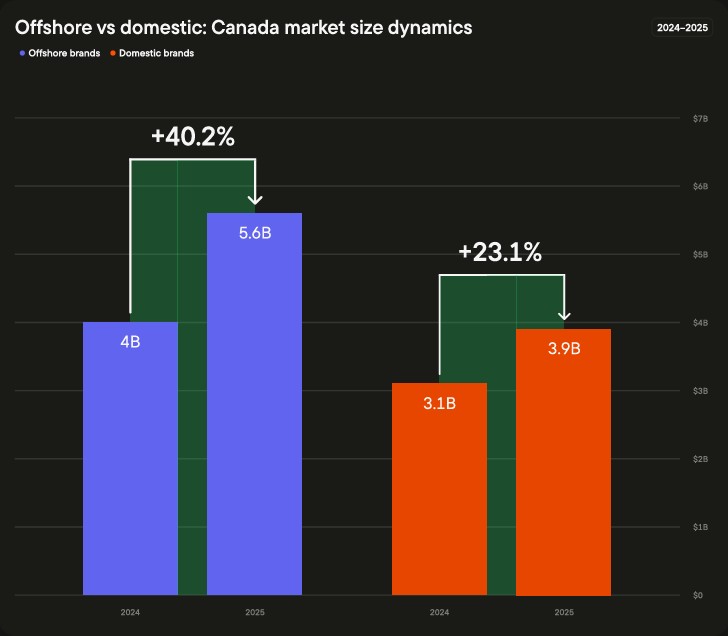
Rather than narrowing, the gap between offshore and regulated markets widened over the year. Offshore operators added approximately $1.6 billion in value, double the $800 million generated by domestic platforms. Currently, 63 percent of all brands serving Canadian players are unlicensed, with major offshore players such as Stake and Roobet continuing to outperform even the largest regulated operators.
Ontario model successfully captures domestic value
The report finds that Ontario, the most populous province in Canada, continues to stand out as the benchmark for effective regulation. Since launching its open, multi-operator market in April 2022, the report says the province has successfully channelled most of the player activity into licensed platforms.
A key factor behind this success was allowing former grey-market operators to obtain licences, enabling a seamless transition for existing users with minimal disruption. As a result, the report finds that Ontario has reduced offshore activity to just 15 percent, achieving an 85 percent channelisation rate.
Monopoly provinces struggle to retain players
In contrast, the report finds that provinces operating under monopoly models continue to lose ground to offshore competition. On average, these regions capture only around 24 percent of total market activity domestically, with the remaining 76 percent flowing to unlicensed platforms.
Saskatchewan shows the highest level of offshore leakage at 93 percent, followed by Alberta and Manitoba at 88 percent. Despite offering regulated options, the report says these provinces struggle to compete with the broader product range and user experience provided by international operators.
Alberta emerges as the next regulatory frontier
Alberta is widely viewed as the next major opportunity for regulatory reform, the report says. In May 2025, the province passed Bill 48, paving the way for an Ontario-style open market.
Currently operating under a monopoly system that captures just 12 percent of market activity, Alberta’s shift is expected to significantly strengthen the domestic segment. However, industry experts caution that results will take time, noting that meaningful channelisation gains are typically measured over years rather than months.
Québec faces pressure to liberalise iGaming market
Meanwhile, pressure is mounting in Québec as the Québec Online Gaming Coalition (QOGC) calls on the provincial government to open its iGaming market to private operators, challenging the long-standing monopoly of Loto-Québec.
While the state operator reported around $1.1 billion in revenue between April and September 2025, critics argue growth remains skewed toward land-based gaming, with online expansion lagging. The coalition estimates Québec is losing roughly $220 million annually in tax revenue due to the lack of a competitive regulatory framework, as more than 2,000 unregulated sites continue to serve local players.
Public sentiment appears aligned with reform, with two-thirds of Quebecers supporting a regulated open market and 73 percent already using private platforms.
Online casino dominates player demand
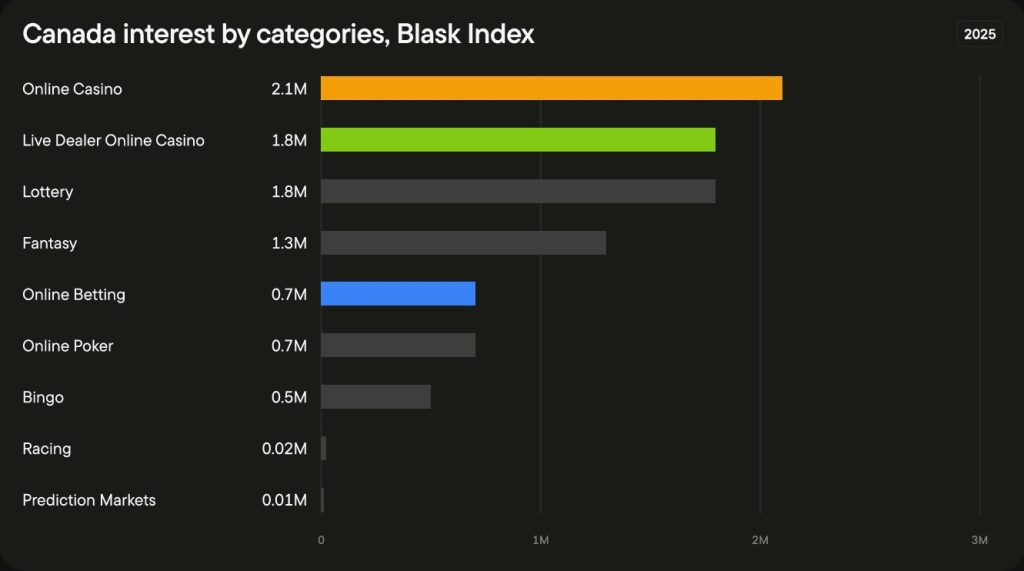
The Blask report also finds that Canadian player preferences remain heavily skewed toward online casino products, followed by live dealer, lottery, and fantasy offerings. Within the casino segment, slots and Plinko drive the highest engagement, while blackjack leads the live dealer category.
In sports betting, hockey retains its position as the country’s top sport. However, the NFL continues to gain ground, reflecting the league’s growing cultural influence in Canada.
Emerging brands are also capitalising on these trends. Casino-focused operator Betty, for example, recorded the fastest year-on-year CEB growth among Canada’s top 10 operators.
Don’t just read the news — stay ahead of it. Subscribe HERE to SiGMA’s Top 10 News countdown for stories shaping iGaming’s future, weekly insights from the world’s biggest iGaming community, and exclusive subscriber-only offers.


