



Online gambling deposits in Indonesia have risen sharply following the Muslim holiday of Eid al-Fitr for a second consecutive year, according to officials, even as authorities continue a sweeping crackdown on illegal betting platforms.
The warning comes from the country’s financial intelligence unit, the Financial Transaction Reports and Analysis Centre (PPATK), which monitors banking activity for signs of illicit transactions. The agency works with major banks to flag and freeze accounts linked to online gambling. Although the numbers broke last year’s record, it was not disclosed.
Officials said activity picked up both during and immediately after the Eid period, when spending typically rises across the country. Eid this year was observed between 19 and 20 March.
The agency is yet to release full figures for 2026, but PPATK confirmed that transaction volumes in late March are already higher than those seen in January and February. A similar pattern was recorded last year.
$300M transacted in March 2025
Data from 2025 illustrates the trend. Deposits on illegal gambling platforms stood at around IDR 2.96 trillion (about $175 million) in January, rising marginally to IDR 3.05 trillion ($180 million) in February. Activity dipped in March, before surging by 96 percent in April to IDR 5.08 trillion ($300 million), shortly after Eid.
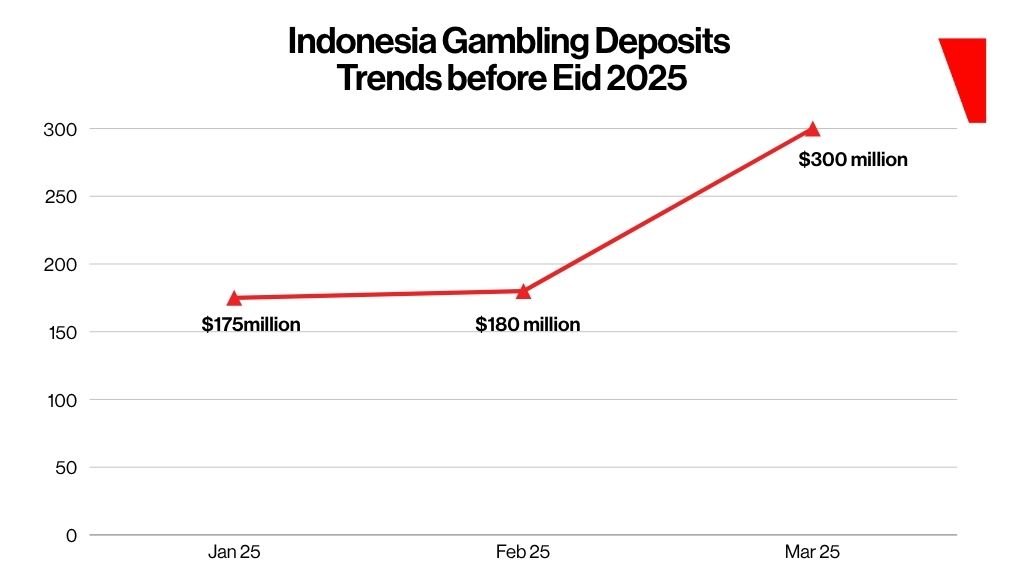
PPATK chief Ivan Yustiavandana said the spike is not unusual. “The sharpest increase typically occurs after Eid, when money circulation rises nationwide,” he said. Experts point to a combination of higher disposable income and more free time during the holiday period as key drivers behind the surge.
The increase comes despite an ongoing government effort to stamp out online gambling, which remains illegal in all forms across Indonesia. Authorities have, in recent years, blocked thousands of gambling websites and mobile applications, in addition to targeting payment channels used by operators.
Just a week ago, Jakarta police confirmed that 132 online casino sites were dismantled during the operation, which was conducted by the Cybercrime Directorate of the Indonesian National Police. This unit, known as Dittipidsiber, specialises in investigating digital crimes such as cyber fraud and online gambling fraud.
Law enforcement agencies have also pursued financial networks linked to the sector. Earlier this month, prosecutors in West Jakarta transferred around $31.3 million in seized funds to the state after dismantling an online casino operation and a related money-laundering scheme.
Yet demand appears strong. Industry observers say operators continue to adapt, frequently shifting domains and using alternative payment routes to bypass restrictions, making enforcement a constant challenge.
Impact of social media?
The social impact is becoming increasingly visible. Medical professionals warn that addiction linked to online gambling is placing pressure on public health services. Psychiatric units in several major cities report rising admissions tied to gambling-related issues, with some facilities operating close to capacity.
Doctors have also linked the trend to a broader rise in social harm, including financial distress, crime and family breakdowns. Courts in parts of the country have reported an increase in divorce cases where gambling addiction is cited as a contributing factor.
For regulators, the post-Eid surge highlights a persistent gap between enforcement and behaviour. Despite tighter controls, access to online gambling continues — and during peak periods, appears to grow even faster.
Manila’s calling and it’s not whispering. From 01 to 03 June 2026, SiGMA Asia returns to the undisputed regional heavyweight. With 16,000 delegates, 3,040 operators, and 250+ speakers under one roof, this isn’t just an expo. It’s ignition!


