


ENADA workshop 2025: Italian public gaming sector calls for clarity, innovation and a new pact with the State

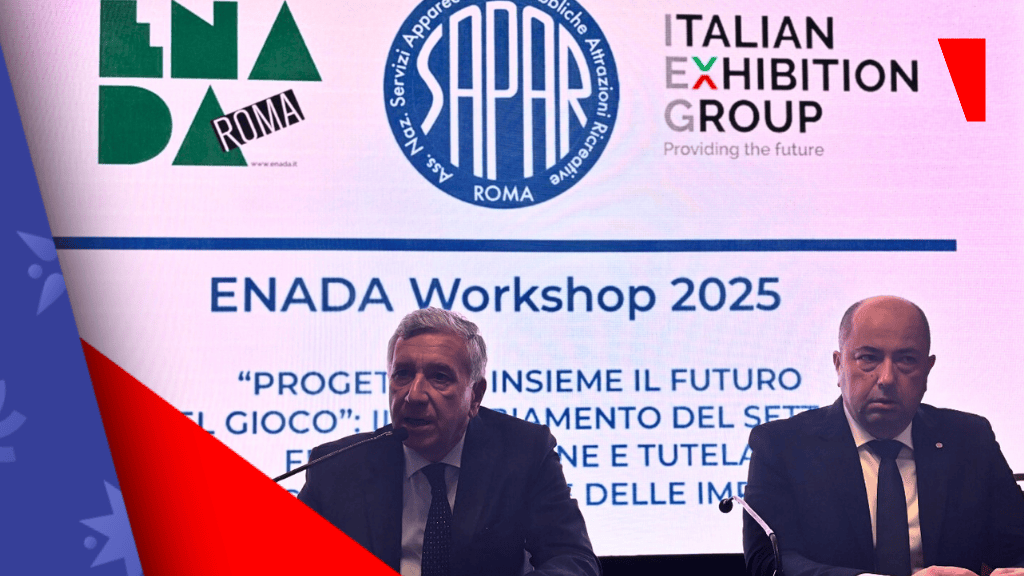
The fourth edition of the ENADA Workshop 2025 offered a clear snapshot of the moment the Italian public gaming sector is experiencing. On stage, operators, associations and industry representatives addressed the issue of regulatory reform without filters – a topic that shapes the expectations and tensions of a supply chain seeking recognition, space and, above all, rules capable of looking to the future.
Opening the proceedings was Sergio D’Angelo, president of Associazione nazionale dei Gestori e Costruttori degli apparecchi del gioco di Stato (Sapar), who immediately identified the “red line” shared across the sector: a reform that fails to recognise the role of operators, he said, would amount to “rewriting a business model that would ultimately exclude us.” After twenty-five years of investment, training, responsibility and sacrifice, such an outcome is deemed unacceptable.
Operators as industrial and social anchors: “we are rooted in the territory, not marginal”
Sapar president Sergio D’Angelo defended the industrial identity of operating companies, noting that these are Italian businesses deeply rooted in their local communities – a far cry from multinational models driven solely by financial logic. For this reason, he called firmly for an “inclusive and modern” reform, one capable of integrating innovation and aligning with European standards without erasing those who, over the years, have built a widespread network of venues and territorial oversight.
At the heart of his address was a denunciation of the marginalisation the sector has suffered over the past decade, particularly in favour of vertical operators who act simultaneously as concession-holders and service providers. “Some believe we have become marginal. We know that is not the case,” D’Angelo remarked, highlighting the importance of the pure amusement segment – often overlooked in the public debate yet essential for maintaining daily contact with communities and local areas.
Bars, small venues and the risk of illegal gambling
One of the clearest points concerned bars and small retailers, the beating heart of Italy’s physical public gaming network. Believing that removing machines will reduce gambling, D’Angelo argued, is a dangerous illusion: demand does not disappear – it simply shifts towards illegal channels. This is confirmed by Moige data showing how easily minors can access unauthorised content.
Sapar’s proposal is explicit: full legal recognition of the operator’s role and access to concession-holders’ shares, enabling them to become an integral part of the industrial model. Such a step, D’Angelo argued, would finally create a “genuine balance” within the supply chain. He also reminded the state that, over the past twenty years, operating companies have contributed almost €100 billion to public revenues.
Eurispes: “without a strong legal offer, the underground market grows”
A macroeconomic perspective was offered by Angelo Caliendo of Eurispes, who highlighted that the sector generates over €157 billion a year, confirming its status as one of the most significant components of the Italian economy. Yet public opinion continues to blur the line between legal and illegal gambling – a misunderstanding that harms the entire system.
Caliendo reiterated a simple yet often overlooked point: reducing the legal offer does not reduce demand – it merely drives it towards unregulated environments. To overcome this fragmented scenario, a uniform regulatory framework is essential, replacing distancing rules and regional regulations born out of “emotional reactions” and lacking any real effectiveness.
Moige: “Responsibility is the key word”
Antonio Affinita of the Movimento Italiano Genitori (Moige) presented alarming data on how easily minors can access prohibited games. “When a minor gambles, it becomes instantly illegal,” he stated bluntly. While acknowledging the efforts of law enforcement and the ADM, Affinita urged operators to act as the first line of responsibility, noting that it is impossible to “place a police officer in front of every slot machine.”
Acadi: “Online is not the enemy”
Geronimo Cardia of the Association of Public Gaming Concessionaires (Acadi) delivered a direct and assertive speech, criticising the recurring tendency in public debate to identify a new “enemy” of legal gambling every few years. Today, it is online gaming; yesterday, it was slot machines. This approach, he argued, is “extremely damaging”, as it prevents the sector from being understood and regulated in its full complexity.
He was equally unequivocal on distancing rules: “They protect no one. It is a concept that should be eradicated.” Cardia pointed to the real frontiers of player protection: recognition technologies, alert systems, safer products and fair tools for players.
EGP: “The goal must be 100% legal gambling”
Emmanuele Cangianelli, president of the Association of Public Gaming Operators (EGP), reiterated the need to channel all player demand towards the regulated offer. Closing or restricting part of the machine supply, such as AWP devices, does not eliminate demand – it simply redirects it elsewhere. A normalisation of the offer, by contrast, would enable more stable and secure investment planning.
STS: “Time bands and distancing rules do not work”
For Emilio Zamparelli of the Sindacato Totoricevitori Sportivi (STS), the real problem today is no longer the street-level “toto nero” of the past, but the explosion of illegal online gambling. .com platforms, he noted, “reach everywhere.” This underpins his open criticism of regional authorities and compromise-based policies built around ineffective tools. According to Zamparelli, the reform must restore dignity to retailers who represent the state on the ground.
Novomatic: “Innovation and responsibility are the key to a sustainable system”
Mara Di Lecce of Novomatic refocused the discussion on the sustainability–innovation balance. Responsible gaming, she stressed, is not a slogan but a structural commitment that requires safer machines and clear identification of legal products.
Global Starnet: “Rules are not born well”
According to Stefano Sestili of Global Starnet, the industry and the ADM speak the same technical language, while political decision-making often produces rules that resemble marketing more than regulation. Hasty or ill-informed decisions, he argued, create inefficiencies and risks.
CNI: “Debating the operator’s role is still paradoxical”
Vito Palo, president of the Confederazione Noleggiatori Italiani (CNI), retraced the evolution of AWP machines since 2004, recalling how operators helped to clean up a market once dominated by unauthorised devices. For this reason, he finds it absurd that their role is still being questioned. He also stressed the need for less intrusive machines with higher and fairer payouts for players.
U.T.I.S.: “Illegality seeps into regulatory gaps”
Stefano Sbordoni, general secretary of U.T.I.S. (Unione Totoricevitori Italiani Sportivi), pointed to poorly drafted or poorly enforced regulations. It is within these gaps, he noted, that illegality thrives. The legislator, he argued, must listen to those who work within the sector.
AGSI: “Politicians decide without understanding”
Pasquale Chiacchio of the Associazione Gestori Scommesse Italia (AGSI) criticised the lack of technical expertise among those who draft regulations. Delays, inconsistencies and a lack of consultation, he argued, create unmanageable situations. It is not legal gambling that generates vulnerability: “Eighty per cent of it comes from the illegal market.”
SGI: “The State must protect its own image”
Gennaro Parlati of SGI (Sistema Gioco Italia) overturned the prevailing narrative around the sector’s reputation: “We operate on behalf of the state. It is the state that must protect its own image.” Before attempting to harmonise regulations, he added, the structural mistakes must first be corrected.
Regione Lazio: “More resources for municipalities and a central role in the reform”
Councillor Massimiliano Maselli highlighted the investments made by the Lazio Region to combat problem gambling: over €1.4 million for proximity services and support initiatives. With a share of gaming tax revenues, municipalities could gain additional resources for social services, public safety and prevention efforts. According to Maselli, regions must play a central role in the national reform, not merely a consultative one.
The new Sapar AWP: technology, security and a fairer payout
Bringing the proceedings to a close was the presentation of Sapar’s prototype for a new AWP, introduced by vice-president Francesco Gatti. The model is conceived as a transitional solution, set to come into operation in 2026 while awaiting the new VPR machines scheduled for release between 2027 and 2028.
The prototype introduces a minimum payout of 70% and a maximum win of €200 – parameters designed not to make gameplay more aggressive, but to restore competitiveness and fairness in line with European standards, where player return rates are already significantly higher.
The machine abandons continuous coin payouts in favour of a digital “bank” system that accumulates credits and allows players to cash out in a single action, reducing mechanical wear and offering a smoother user experience, similar to video lottery terminals. Dynamic messaging accompanies the player with moderation warnings and helpline references, anticipating the requirements of future VPR models.
On the security front, an encrypted ADM QR code allows authorities to carry out rapid checks without physically opening the machine – a safeguard against tampering and cloning.
According to Gatti, the new model provides an immediate response to the migration of players towards online gaming – often via unauthorised platforms – and represents a way to regain competitiveness while protecting state revenues.
Towards a new balance between innovation, protection and legality
The ENADA Workshop 2025 clearly revealed a sector that recognises the need for change, yet is determined not to be excluded from the reform process. The industry is calling for clear rules, safer technologies, a stronger role for the state and, above all, recognition of the work carried out across the territory.
A sector that, through responsibility, innovation and player protection, aims to remain a bulwark against illegality and a cornerstone of the Italian economy.
This article was first published in Italian on 1 December 2025.
Be part of the action! Join the world’s biggest iGaming community with SiGMA’s Top 10 News countdown. Subscribe HERE for weekly updates, insider insights, and exclusive subscriber-only offers.


