


Minnesota’s sports betting push faces familiar roadblocks


Minnesota legislators are once again facing resistance as they attempt to legalise sports betting in the current legislative session. The measure’s future remains uncertain due to ongoing political divides and stakeholder disagreements.
The proposed bill, Senate File 4139, would establish a regulated framework for sports gambling, including mobile betting and partnerships with tribal operators. It aims to bring oversight to an activity that legislators already said thrives underground.
Supporters call for regulation
Co-author Senator Nick Frentz showed optimism that regulation could ease concerns about illegal betting. He said that when a bill is passed, it will result in buy-in from all different corners, as quoted on media outlet KTTC, stressing collaboration over confrontation.
Critics raise concerns
Opponents remain wary. Senator John Marty argues the legislation fails to adequately address problem gambling and addiction, pointing to evidence from other states where legalisation coincided with rising gambling activity. He has also called for stricter safeguards to prevent operators from targeting minors and accountability measures for companies that encourage individuals struggling with gambling addiction.
A history of stalled efforts
In the past, sports betting bills emerged in 2022, 2023, 2024, and now again in 2026. But the state has repeatedly tried and failed to legalise it. Each effort has stalled due to conflicts among legislators, tribal operators, and advocacy groups.
While bipartisan support exists, entrenched opposition has blocked progress at critical stages. For one, disagreements over how to allocate tax revenue: whether it should be allowed towards education, infrastructure, or addiction treatment, resulting in further complicated negotiations.
A portion of projected revenue would fund problem gambling programmes, including treatment services, public awareness campaigns, and self-exclusion systems. Additionally, tribal operators play a central role in revenue-sharing, potentially supporting community programmes, infrastructure, and local development. Yet debates over exclusivity have slowed momentum.
Regional and national context
Minnesota remains one of the few Midwestern states without legalised sports betting, even as neighbours like Iowa and South Dakota have moved forward with it.
Sports betting has been made legal in 40 states, including Washington, D.C., with 32 states offering online and mobile options. States like New York and New Jersey already generate billions annually, with New York directing much of its revenue into education. Mobile platforms, in particular, have accelerated adoption and consumer demand.
Revenue projections
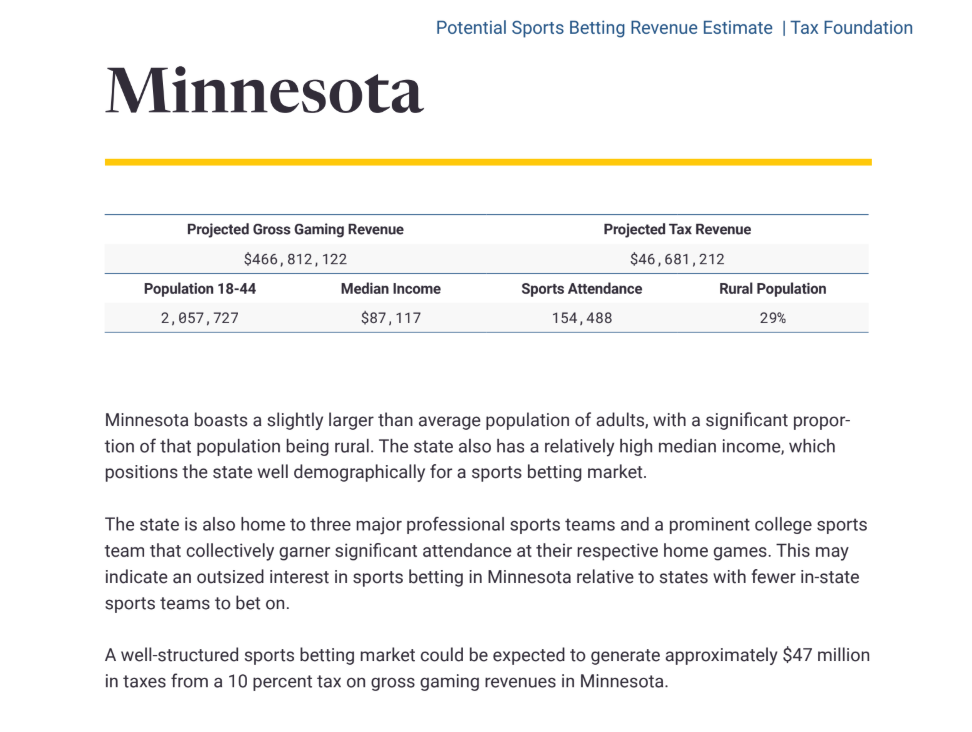
Legalised sports betting in Minnesota could generate an estimated $466 million in Gross Gaming Revenue (GGR) annually, yielding about $47 million in taxes at a 10 percent rate. Allowing mobile platforms alongside tribal partnerships is expected to boost participation and revenue, according to the Tax Foundation.
Other examples include states like Iowa and Michigan that have illustrated strong returns from legalisation, underscoring Minnesota’s potential if it joins the national trend.
Moreover, legalising sports betting in Minnesota could create hundreds of new jobs across technology, compliance, hospitality, and tribal enterprises—mirroring growth seen in states like Iowa and Michigan. In addition, these roles would range from sportsbook operators and data analysts to marketing, customer service, and addiction prevention specialists, as noted by job search platform Indeed.
Stay ahead of iGaming’s biggest stories with SiGMA’s Top 10 News countdown. The world’s biggest iGaming community brings you weekly insights and subscriber-only offers. Join HERE today.


