


Inside the numbers: how illegal online gambling dominates the US


The U.S. online gambling market has expanded from being quite niche to becoming a major industry, with revenues reaching over $71.92 billion in 2024. This growth is thanks to more states choosing to legalise online betting and players feeling more at ease gambling on their phones and computers.
But, the growth isn’t straightforward. Each state has its own specific rules, creating a patchwork of laws that companies need to navigate carefully. Experts at Grand View Research anticipate the market to expand from $12.68 billion (€11.66 billion) in 2024 to $22.19 billion (€20.42 billion) by 2030, at a compound annual growth rate (CAGR) of 9.8 percent. Mordor Intelligence is even more optimistic, predicting it will more than double from $5.97 billion (€5.49 billion) in 2025 to $12.81 billion (€11.78 billion) in 2030, growing at 16.5 percent a year.
Illegal operators taking majority of revenue
Most betting now happens on mobile devices and new features like live dealer games are catching on quickly. Younger, tech-savvy players are looking for fast, easy access and exciting new experiences. As more states relax their rules, the U.S. online gambling scene is not just growing but also transforming how people enjoy the game.
However, research from the market intelligence firm Yield Sec found that in 2024, unlicensed offshore gambling platforms accounted for a staggering 74 percent of the United States’ total online gross gambling revenue (GGR), which stood at $90.1 billion (€82.9 billion). That means nearly three-quarters of all online gambling dollars are flowing through illegal channels. Legal platforms accounted for the remaining 26 percent, or approximately $23 billion (€21.2 billion).
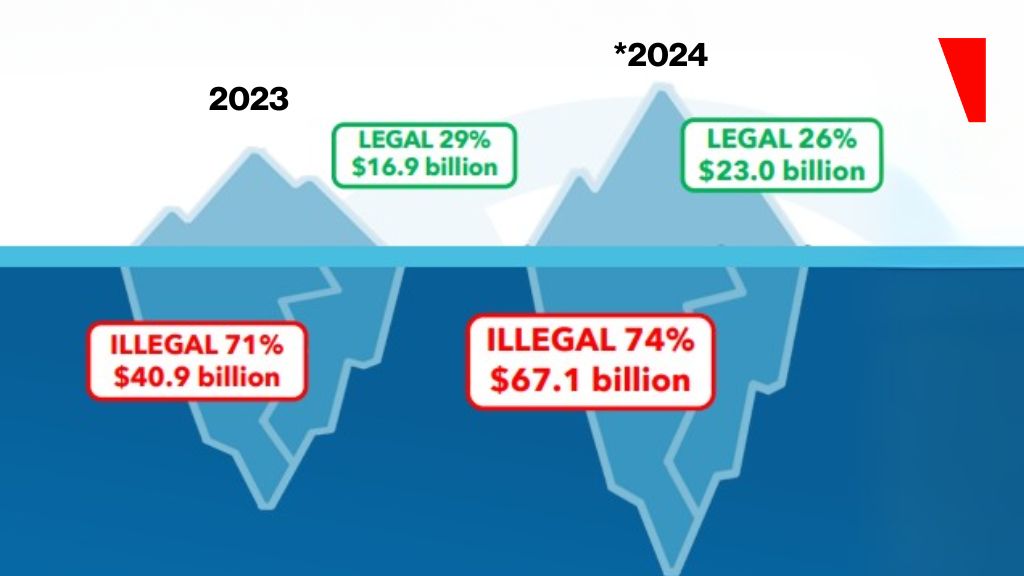
The legal sector experienced a 26 percent increase in revenue compared to the previous year, while illegal operators expanded even more rapidly with a 64 percent growth. Speaking exclusively with SiGMA News, Ismail Vali, CEO of Yield Sec, explained that illegal platforms evade the strict regulations and taxes imposed on legal operators.
“If you operate without a licence in a territory, you’re not just breaking rules—you’re stealing from that market.”
~ Ismail Vali, CEO, Yield Sec
The scale of the illegal sector is immense. The report lists 917 illegal platforms, compared to just 95 licensed ones. Supporting them are 668 affiliates promoting offshore operations, which is six times the number backing legal sites. This vast network gives illegal operators far greater visibility.
And visibility matters. In 2024, legal platforms captured only 12 percent of audience exposure, while offshore operators aggressively used major sports events and media channels to boost their presence. Legal operators also face growing competition from sweepstakes casinos, which operate in a regulatory grey zone in some states. Some states, like Montana and Connecticut, have banned them outright, and New York has taken legal action against such unregulated operations.
Examining states individually, the market varies significantly. In states like Pennsylvania, New Jersey, and Michigan—where sports betting and online casinos are fully legal—regulated platforms account for roughly 57 to 58 percent of gross gaming revenue. But in states such as California, Texas, and Ohio, where online gambling laws are limited or absent, illegal operators dominate. Ohio, for example, sees 85 percent of its online gambling revenue coming from illegal sources, totalling $5.26 billion (€4.82 billion).

Ohio is particularly striking. It recorded the highest per capita GGR for online casinos at $316 (€289) and also led in illegal sports betting losses at $130 (€119) per person. One year after legalising sports betting, Ohioans reportedly lost 1.33 percent of their average income to gambling—more than twice the national average.
Interestingly, the report highlights that legalising gambling tends to increase total losses without cutting into illegal activity. States without legal online gambling have a GGR per capita of 0.31 percent of income, which rises to 0.77 percent in states with legal sports betting, and jumps to 1.12 percent in those allowing both sports betting and online casinos. That’s a 261 percent increase in losses per capita.
The overall picture is clear: the total U.S. online gambling marketplace in 2024 is huge, at $90.1 billion (€82.9 billion), but $67.1 billion (€61.7 billion) of that comes from illegal operators. Honestly, the numbers are pretty worrying. But how does the data stand out, and how can one conclude that the US market is in such torment? Vali discussed with SiGMA News how the study was conducted, the exclusion of sweepstakes in the study, and his thoughts about the Big Beautiful Bill signed by U.S. President Donald Trump.
SiGMA World: We would like to understand the model and insights from the research. How confident are you in the numbers? Could you please provide a brief explanation of the figures?
Ismail Vali, CEO, Yield Sec: Our monitoring is basically a technical platform. We adapted a military platform originally used for counterinsurgency and anti-terrorism, and repurposed it for gaming in 2020. It gets updated every day. We’re looking at monitoring every country in the world, every legal marketplace. For example, in the U.S., we examine state-based markets — New Jersey is regulated, while California is unregulated — and we find both legal and illegal websites using an apples-to-apples methodology.
We track eight ecosystem essentials where 99.7 percent of the audience spends their time online — watch engines, streaming, social, websites, apps, peer communications, affiliates, and ads. Our method uses anonymous audience surveillance, supply chain signals intelligence, video and image recognition, plus third-party data from Google, Facebook, affiliates, and search engines to understand where the audience moves and where bets are placed.
We’ve been tested publicly for three years, including during the Super Bowl and March Madness, and we have been right on both legal and illegal revenue predictions. The legal revenue is verifiable because regulators publish marketplace accounts, and our methodology is consistent for comparing legal and illegal markets. We’re very confident in these numbers.
SiGMA World: Are sweepstakes included in this U.S. data report? If not, why?
Vali: No, they’re not. In the U.S. data report we published, products covered include sports betting, casino (including poker), and crypto. However, sweepstakes, daily fantasy sports, social betting, prize draws, and lotteries are not covered.
The reason is that sweepstakes have a complex and varied legal status across states — in some states, sweepstakes are legal, in others illegal, and many are currently under legal challenge. For example, New Jersey is reconsidering whether to ban sweepstakes this year. Because of this noise and inconsistency, we left sweepstakes out of this report. That said, we do monitor sweepstakes if clients specifically request it, as our platform covers it.
SiGMA World: If you can comment on the Big Beautiful Bill signed by U.S. President Donald Trump, limiting gamblers’ loss deductions, could it push more Americans toward illegal gambling?
Vali: The bill changed the tax code so that American gamblers can now only deduct 90 percent of their gambling losses instead of 100 percent. For example, a professional gambler in a legal state like New Jersey who lost $1,000 (€920) and made $100 (€92) profit could previously deduct the full $1,000 (€920), but now only $900 (€828).
This creates a hole in the system for legal gamblers who use online services — they’re essentially losing money on tax relief. This could push them to gamble illegally because illegal sites won’t withhold that 10 percent. So legal gamblers might migrate to illegal operators to avoid losing that tax benefit.
This is a big problem because America already has a significant illegal gambling market, which is growing. In 2023, illegal gambling profits were $57.8 billion (€53.2 billion); in 2024, that’s grown to $90.1 billion (€82.9 billion). Most of this growth comes from crypto products and prediction markets. So yes, the bill risks pushing more consumers into this illegal market, which is already far larger than the legal one, especially since only 95 legal licensed brands operate compared to 917 illegal ones.
Illegal gambling in the U.S. is not just rising—it’s surging, and recent legislation risks putting it on a fast track to explode even further. If the authorities don’t tighten their grip and urgently rethink their laws, billions of dollars will continue to slip through legal loopholes, fueling the underground market. This isn’t just a financial hit; it’s a warning sign that without swift, decisive action, the entire regulated gambling industry could be on the losing side.


