


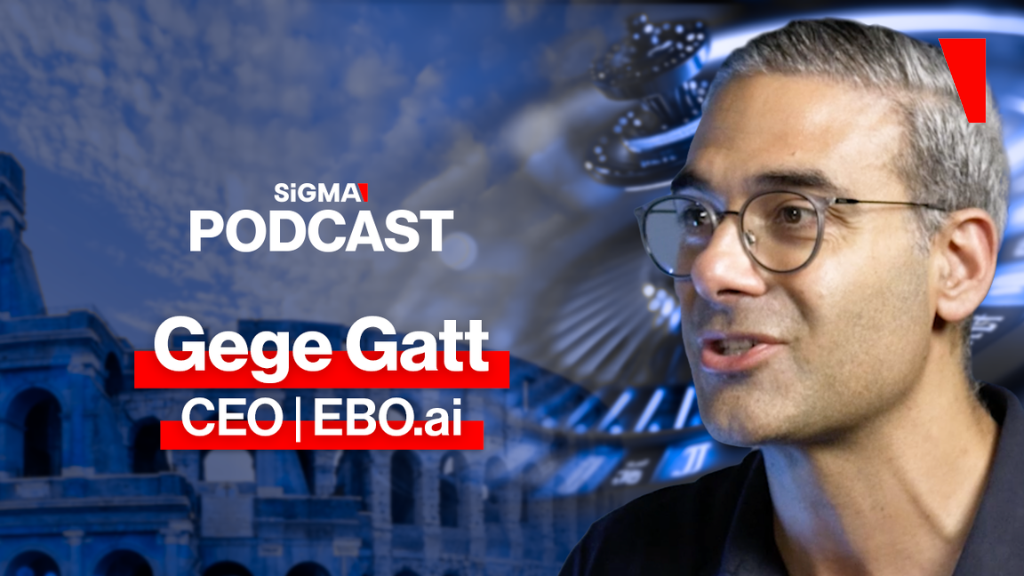
In this episode of SiGMA Podcast, spotlighting Italy’s rapidly evolving gaming landscape, Trevor Degiorgio, Regulatory and Compliance Specialist, sat down with Gege Gatt, CEO of EBO.ai, to unpack how artificial intelligence is reshaping responsible gaming.
Rather than viewing AI as a futuristic add-on, the discussion framed it as a practical, already-deployed tool that is fundamentally changing how operators identify risk, protect players and meet regulatory expectations.
A new RG lens
At the heart of the conversation was a shift away from traditional, rule-based responsible gaming systems toward behaviour-driven intelligence. As Gatt explained, “Artificial intelligence is great at detecting patterns… it can find the proverbial needle in a haystack.”
Crucially, AI is no longer limited to analysing raw transactional data. Instead, it examines the behaviours that lead to those transactions. Sudden increases in bet size, changes in frequency, unusual deposit patterns or persistent late-night play can all serve as early indicators of potential harm. “Erratic behaviour is the most common precursor of risky behaviour,” Gatt noted, adding that AI excels at identifying “the seed which could possibly grow into a risky plant.”
Unlike legacy systems that rely on fixed thresholds, the classic “if this, then that” logic, AI establishes a personal baseline for each player. “Every person has a different way of interacting with a game,” Gatt said. Once that baseline is understood, deviations become visible in real time, allowing operators to intervene during a session rather than after harm has already occurred.
Culture, geography and personalisation
A key challenge in RG has always been context. Behaviour that looks risky in one jurisdiction may be culturally normal in another. Degiorgio raised the example of Spain, where late-night gambling reflects local routines rather than problematic play.
According to Gatt, AI is uniquely suited to handle this complexity. “Artificial intelligence can combine multiple data sources… culture, ethical frameworks, behaviours,” he explained. By fusing transactional data, behavioural signals, third-party inputs such as KYC and jurisdictional insights, AI creates a richer, more accurate understanding of player risk. This leads to risk scoring as a living metric that evolves alongside the player. “Imagine an integer from 0 to 100, which changes over time,” Gatt said. As emotional or behavioural circumstances shift, so too does the risk score, enabling operators to prioritise interventions where they are genuinely needed.
Responsible gaming as a competitive advantage
One of the strongest themes to emerge was the idea that effective RG is not at odds with commercial success. “Sometimes you hear an argument which places RG and regulatory compliance as in opposition to profit. It’s not true,” Gatt said. Instead, he argued that companies embedding AI-driven care into their operations gain a competitive edge through trust, dignity and superior player experience. “Player experience and player care… will make companies which really cherish these values the ones which are most pro-customer,” he added.
AI also opens the door to more proactive interventions. Studies cited during the podcast show that machine learning models can predict self-reported problem gambling using behavioural signals alone, such as scrolling speed, pauses, or time spent on specific pages, long before financial harm becomes visible.
AI as infrastructure
Gatt was clear that the industry mindset must evolve. AI should not be treated as a bolt-on feature but more as “core infrastructure.” From monitoring and risk scoring to intervention workflows and customer service automation, AI needs to sit at the centre of operations.
He highlighted four major breakthroughs accelerating this shift including increased computational power enabling real-time monitoring, unsupervised learning capable of spotting entirely new anomalies, advances in natural language processing and generative AI, which allows for highly personalised RG messaging. “Imagine a cooling-off message… bespoke to you. That is effectiveness,” Gatt said.
Human judgment and ethics
Despite AI’s capabilities, the podcast ended with a clear warning against over-reliance. “AI should always be an augmentation mechanism and not a replacement mechanism,” Gatt stressed. “Think of AI as a radar, not a pilot.”
Human oversight, transparency and ethical design remain essential, particularly when dealing with vulnerable players whose behaviour may be influenced by life events AI cannot fully understand. As Gatt concluded, efficiency must never come at the expense of empathy, making responsible gaming more human.
For more thought-provoking discussions on AI, gaming and regulatory trends, check out the rest of our SiGMA Podcast episodes to stay updated, informed and ahead of the trends shaping the future of the iGaming landscape.


