


When I gamble, I don't exist: Women's gambling harm is still misunderstood

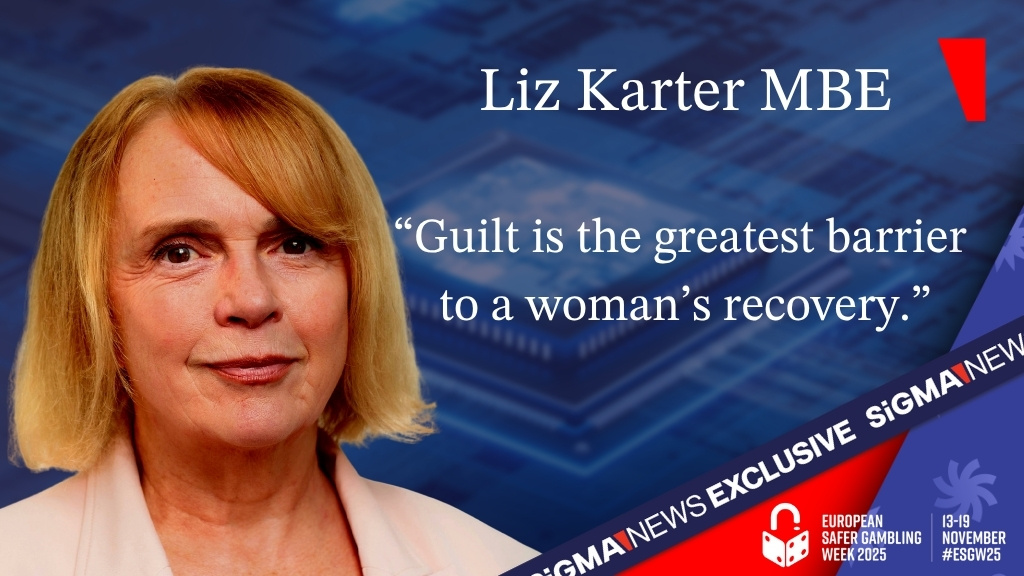
“When I’m gambling, it’s like I don’t exist.” The sentence lands quietly, not as a confession but as a fact. It is a line that Liz Karter MBE has heard many times across 25 years of clinical work with women experiencing gambling harm. For her, it remains the most accurate description of how addiction removes presence long before it removes money.
Women have historically appeared less visible in treatment and public conversation, not because the harm is smaller, but because women’s gambling harm is more hidden and more stigmatised. Often, because women use gambling as a coping strategy, they are afraid to let it go. Until recent years, Liz saw women who were told by male gamblers that women did not have “real” gambling problems. Male and female gambling patterns present so differently, so this dismissive message prevented women from seeking treatment.
That invisibility has shaped how gambling harm is understood, measured, reported, and treated. While progress has been made, a deeper understanding of the female experience still sits beneath the surface of the wider industry narrative. Liz argues that until women can speak without fear of moral judgment or misunderstanding, policy and practice will continue to miss vital warning signs.
What women show us about how harm works
Liz’s work reveals a pattern that has been hiding in plain sight. Many women do not gamble for the sake of noise, thrill, or competition. They gamble for quiet. They gamble for breathing space. The aim is not a rush but a pause; not to win more, but to feel less. This is where we see why women’s gambling harm is still misunderstood. The motivation is often emotional escape rather than excitement or risk-taking.
While men may be drawn towards speed, rivalry, and adrenaline, a large number of women describe gambling as a soft cocoon that gives them temporary distance from exhaustion, fear, or grief.
One line Liz hears often in therapy captures the feeling completely: “When I gamble, I stop existing for a while.”
Understanding that difference matters. It does not place one form of harm above another. It recognises that the reasons a person turns to gambling must inform how help is offered and how harm is prevented. If the driver is “feeling” overwhelmed rather than “the desire to feel” excited, the solution cannot be built solely on logic. In Liz’s clinic, many female clients describe gambling less as entertainment and more as an emotional anaesthetic.
Slots, bingo rooms, and automated repeat-play mechanics offer immersion, rhythm, and silence. The product becomes a holding space rather than a leisure activity. Liz notes that this emotional form of gambling is not exclusive to women.
“I work with young men these days who are seeking that similar experience, as life for young people becomes increasingly hard and worrying.”
From there, shame and guilt build a second trap. When women eventually speak about their situation, they often apologise before they explain. The fear is rarely about money alone. It is about falling short of roles they were expected to uphold: mother, partner, organiser, employee, and emotional anchor. Harm becomes layered. The gambling itself, and the belief that the consequences of her gambling problem make her a “bad woman.” That internal story can wound more deeply than the financial loss.
For that reason, therapy is not just about stopping play. It is often about helping women learn how to treat themselves with kindness and respect. Learning how to rest. How to say no to others’ demands. How to embrace her imperfections and still be worthy of love and care. Liz describes it as guiding someone back to the part of themselves that was buried beneath duty.
Her view is simple, but powerful:
“Women are not gambling because they do not care. Many are gambling because they have cared too much, for too long, without anywhere to put the weight of the burden.”
Liz frames this through one of her most resonant clinical observations: “It is caring so much that she has put everyone above herself, and burnt out from overwhelming responsibilities, which has driven her to escape into gambling.”
Why women’s gambling harm is still misunderstood
For years, the frameworks used to identify, measure, and respond to gambling harm were built around male-pattern behaviours: financial escalation, visible risk-taking, overt chasing, and a sharp rise in spend. These indicators still matter, but they are not universal. In Liz’s words, women’s gambling harm is still misunderstood, not because it is new, but because it has never been examined on its own terms.
Women may eke out funds across long sessions rather than spending aggressively. They may gamble late at night at home with children asleep, in the office, or on the train home, rather than in betting shops or social spaces. Equal to the financial risk is the time wasted. Most are articulate, functioning, and well-presented. They can mask distress, explain behaviour, and pass risk checks that rely heavily on financial red flags.
This is not a criticism of clinicians, operators, or regulators. It reflects how most behavioural-health models emerge: shaped by the majority profile of people who enter treatment first. For gambling, that was historically men. But when the blueprint is built on one demographic, every other group is assessed through a distorted lens.
Progress has been made. Women-only treatment spaces, lived-experience networks, and trauma-informed practice are developing. But the system is still catching up to the truth Liz has observed for decades: if the signs we search for don’t match the ways women feel, we stop seeing the people who need help most.
When the words meant to help become the words that wound
If both the cause and consequence of gambling addiction are emotional and mental distress, then language is not decoration — it is intervention. Liz has seen firsthand how commonly used industry terms can unintentionally deepen shame and guilt instead of offering support, and how women’s gambling harm is still misunderstood at the level of tone, not just policy.
Phrases like “responsible gambling” land very differently when heard by someone who already feels they have failed every role they value. The implied opposite, irresponsible, becomes another reminder of perceived inadequacy as a mother, partner, colleague, or carer.
“Affordability checks” trigger a similar response; not because women oppose protection, but because the phrase signals exposure, judgment, and the threat of being “found out”.
For many women, gambling is not thrill-seeking. It is anaesthesia. A way to disappear, to quiet the noise, to feel nothing rather than everything. Telling someone to be “responsible” in that state is like handing a compass to someone who is already underwater.
Liz argues that language must validate the emotional landscape, not simply reference money or risk. Words that acknowledge stress, mental health, and lived experience create safety rather than defensiveness. When a woman hears, “You deserve support and space to talk about what led you here”, she is more likely to step forward than shut down.
When we change the language, we do not dilute responsibility. We open the door to it.
What the industry still misses, and why subtle harm goes unseen
Much of the industry’s safeguarding still revolves around financial markers and visible risk. Yet, Liz stresses that women’s gambling harm often progresses quietly, without the dramatic spikes many systems are tuned to detect.
Where men may chase wins, place bets aggressively, or move between products, many women stretch small amounts over long sessions, seeking emotional numbness rather than financial thrill. In that state, the time spent becomes a truer indicator of harm than the money lost. Liz says that a number of these women are highly sensitive introverts and do not easily speak out.
Liz shared an example that highlights this blind spot. A client with severe emotional distress convinced a customer operative that she was fine because she still had a large balance in her bank account. That money came from a divorce settlement while she was in deep grief. She was articulate, professional, and able to mask her pain in that single conversation. Two days later, the entire balance had gone.
A different approach might have slowed the damage. Not a checklist, not suspicion, but curiosity, questions about life changes, emotional state, or sudden shifts in behaviour. In other words, not “Can you afford it?” but “How are you holding up?”
That difference is not sentimental. It is clinical. And meaningful. And it can change trajectory, not just reporting numbers.
Why self-compassion matters, and how empathy changes the course of recovery
If there is one constant across Liz Karter’s twenty-five years of therapy, it is this:
Guilt is the greatest barrier to a woman’s recovery.
When gambling stops, the noise falls away. What floods in after the initial relief is the backlog of everything she feels she failed to do — for her children, her partner, her home, her job, herself. Liz calls it the “over-compensation stage”: women pour every remaining ounce of energy into giving back what they believe they took. It is unsustainable and eventually breaks them. Exhaustion becomes resentment, resentment becomes shame, and shame becomes a straight line back to relapse.
The pattern is predictable yet deeply human: She gambled to escape overwhelming responsibility. She stops gambling and feels responsible for everything. And crushes herself under the weight of trying to make amends.
For Liz, the turning point is always the same. Self-compassion is not a soft concept. It is a clinical intervention. She asks women to mentally rewind to the moment before their gambling escalated, to the earlier version of themselves who was burnt out, frightened, overstretched, or emotionally drowning. When they look at her with kindness rather than judgment, something shifts within her. The guilt loosens. The cycle breaks. Recovery becomes possible.
This is also where industry language matters. If operators mirror shame-based framing — “responsible gambling,” “affordability,” “control” — they reinforce the very mindset that prolongs harm. When language instead acknowledges emotional load, life context, and human vulnerability, women become far more likely to step forward early.
Empathy does not lower standards. It is not condoning gambling behaviour. It is understanding what has driven it for that customer.
It raises them.
Because it creates the conditions under which people can actually change.
A challenge for European Safer Gambling Week
For this year’s safer gambling campaign cycle, Liz offers a challenge that is simple yet radical: tell more women’s stories. Tell them fully.
Not only the financial collapse.
Not only the shock headlines.
Not only the final crisis point.
She argues that true prevention and early intervention are only possible when the route in is illuminated as clearly as the route out. When women hear others speak honestly about burnout, loneliness, caregiving pressure, hidden depression, identity collapse, or unresolved trauma, long before the bank account is empty, they recognise themselves sooner. This is where the wider recognition of women’s gambling harm must begin: not at the point of crisis, but at the quiet build-up no one sees.
It could be the difference between asking for help at month two instead of year five. Stories are not just awareness tools. They are mirrors, maps, warnings, and invitations. If the gambling sector wants to reach women before harm escalates, then messaging must develop from “Look what happened to me” to “Here’s how I got there, and why it could happen to others.”
That narrative shift would not only help women feel understood. It could also help family members, employers, educators, and operators spot risk earlier, before crisis point. Recent treatment networks have noted that women often present later, after prolonged escalation, and are less likely to disclose harm until crisis point, reinforcing the urgency of gender-specific pathways.
A future built on empathy, not assumption
Women’s gambling harm has always existed, but only recently has it started to speak in its own voice. The lesson from Liz’s work is not simply that women experience addiction differently, but that their pathways into harm and their routes out require understanding on their terms, not industry assumptions.
If safer gambling is to be more than compliance language, it must recognise nuance: harm is not always loud, visible, or financial. For many women, it is silent, emotional, and masked by responsibility. Better early questions, a more considerate tone, and greater cultural awareness could encourage people to come forward long before a crisis.
Progress has been made, but the next step is not louder warnings.
It is earlier listening.
European Safer Gambling Week offers a yearly spotlight. The work of Liz Carter MBE reminds us that empathy, careful practice, and gender-aware support cannot switch off once the spotlight fades. The real task is to ensure that women arrive in treatment as part of the story, not as visitors to it.
The future of safer gambling will not be measured only by tools or rules, but by whether people feel understood before harm escalates.
This is the third in a series of SiGMA News exclusive articles for European Safer Gambling Week. Previously, Craig Cornforth from EPIC Global Solutions discussed lived experience as operational intelligence, explaining how prevention begins long before harm becomes visible, while Grainne Hurst from the Betting and Gaming Council opened the series with a clear look at consumer protection, early intervention, and the reality behind public narratives on gambling harm.
Be part of the conversation shaping safer play. Subscribe HERE to SiGMA’s Top 10 News countdown for stories shaping iGaming’s future, exclusive interviews, and industry insights delivered straight to your inbox. Don’t just read the news, stay ahead of it.


