


On 13 March, Denmark’s state-owned operator Danske Spil published its 2025 annual report and announced a record net profit of DKK 2.008 billion (€269 million).
Against the backdrop of steady growth in Denmark’s gambling market, the figure is not surprising. Danes continue to show a strong preference for lotteries, and state operators continue to be the main beneficiaries of a regulated market. The report, however, points to a more complex industry picture than the top line suggests.
Key findings from the annual report
The report published on Danske Spil’s website confirms that 2025 was a record year for net profit. At the same time, gross gaming revenue (BSI) declined, contributions to public-benefit purposes also declined, and the profit increase is explained not only by demand but also by the cost structure.
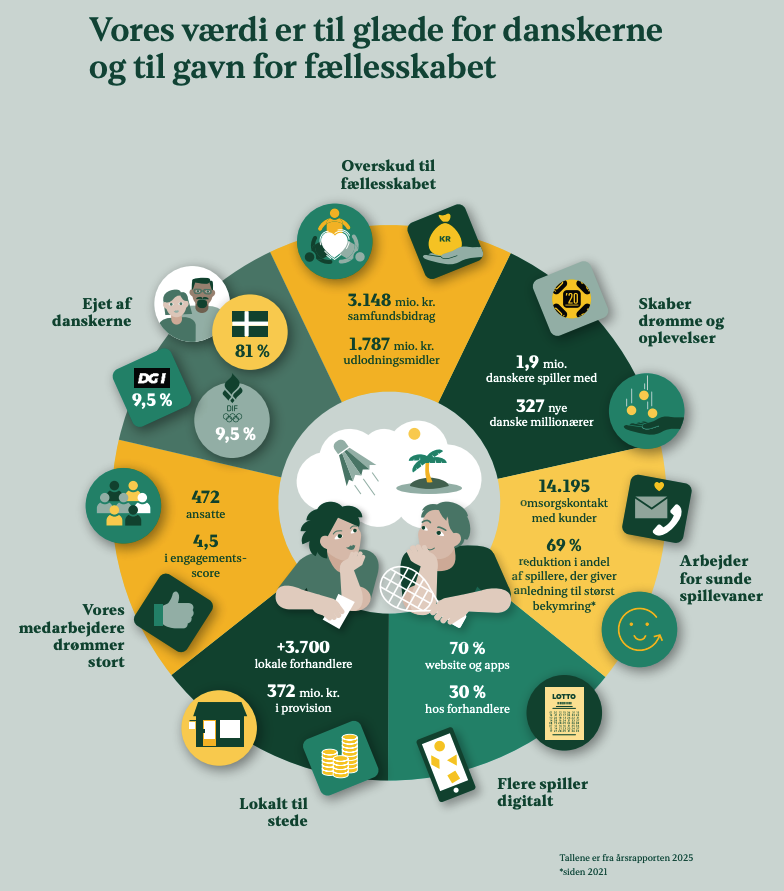
Group BSI totalled DKK 5.158 billion (€690.3 million) versus DKK 5.256 billion a year earlier. Danske Spil’s total contribution to society — taxes, licence fees, and funds for public-benefit purposes — amounted to DKK 3.148 billion (€421.3 million) in 2025. Of this sum, DKK 1.787 billion (€239.1 million) went into udlodningsmidler, Denmark’s mechanism for distributing funds to sport, culture and social projects. The figure was slightly lower than in 2024, when it stood at DKK 1.820 billion (€243.6 million).
The report also explains where the record profit came from. EBITDA — earnings before interest, taxes, depreciation and amortisation — fell from DKK 2.817 billion (€377 million) to DKK 2.773 billion (€371.1 million), indicating a slightly weaker operating result. At the same time, EBIT — operating profit after depreciation and amortisation — increased to DKK 2.583 billion (€345.7 million) from DKK 2.480 billion (€331.9 million), while net profit rose to DKK 2.008 billion (€268.7 million) from DKK 1.948 billion (€260.7 million). The company explicitly attributes the final result to lower depreciation and write-down costs, alongside a moderate reduction in certain expenses.

Lotteries remained the main pillar
Lotteries remained the operator’s main pillar. Danske Lotteri Spil delivered revenue of DKK 3.011 billion (€402.9 million) and net profit of DKK 1.701 billion (€227.6 million). Once again, lotteries generated the bulk of group profit. Danske Spil links this dynamic to the pan-European Eurojackpot lottery. In 2025, there were only four draws with the maximum jackpot, compared with 13 such draws a year earlier. Large prize pools typically drive the strongest uplift in player interest and ticket sales.
Other products helped offset the impact. Quick instant lotteries performed better, seasonal sales increased, and new digital formats — Klub Lotto and an updated subscription product — added additional momentum. This combination helped stabilise the segment despite a calmer year for Eurojackpot.
The licensed commercial segment showed a contrasting performance. Danske Licens Spil (sports betting, online casino, poker) closed the year with revenue of DKK 1.584 billion (€212.0 million) and net profit of DKK 171 million (€22.9 million), with both metrics declining year-on-year. The report says sports betting came under pressure, while online casino grew and set a new BSI record, but that was not enough to offset weakness in betting.
Why responsible gambling is a strategic priority
A dedicated section of the report focuses on responsible gambling. Danske Spil says the share of players considered high-risk has fallen by 69% since 2021. For the 18–24 age group, strict deposit limits apply, and where risky behaviour indicators appear, restrictions are tightened automatically. Average monthly spend among under-25s on betting and online casinos has fallen below DKK 130 (€17.4).
This aligns with Denmark’s political direction. In early March, the government introduced Bill L 127, under which gambling advertising could be banned during sports broadcasts and near schools. Danske Spil directly links its strategy to a political agreement reached in autumn 2025: the standards for responsible gambling are rising, and the market is moving towards tighter oversight of advertising and exposure of younger audiences.
What it means for the market
The key takeaway is that Danske Spil delivered record profit at a time when the market is becoming more complex. Lotteries remain the primary income source, betting is losing stability, online casino is strengthening, and the regulatory agenda is increasingly shaping advertising rules and youth-related safeguards. For 2026, the company forecasts BSI in the range of DKK 5.2–5.3 billion (€695.9–709.3 million) and net profit of DKK 1.95–2.05 billion (€261.0–274.3 million) — indicating expectations of stability rather than further growth.
This article was first published in Russian on 16 March 2026.
Subscribe HERE to SiGMA’s Top 10 News countdown and SiGMA’s weekly newsletter. Stay up to date with all the latest iGaming News from the world’s iGaming authority, and benefit from subscriber-only offers.

