


Expert: Financial crime risks grow with gaming expansion

The gaming and gambling industry is facing rising financial crime rates and requires stronger collaboration across stakeholders, according to Alexander Ngo, Director at LexisNexis Risk Solutions. Speaking at the AML session “High Stakes, Hidden Risks: Financial Crime Trends in Gaming and Gambling” at G2E Asia @ the Philippines, Ngo shared insights on emerging threats and anti-money laundering (AML) challenges in Southeast Asia and beyond.
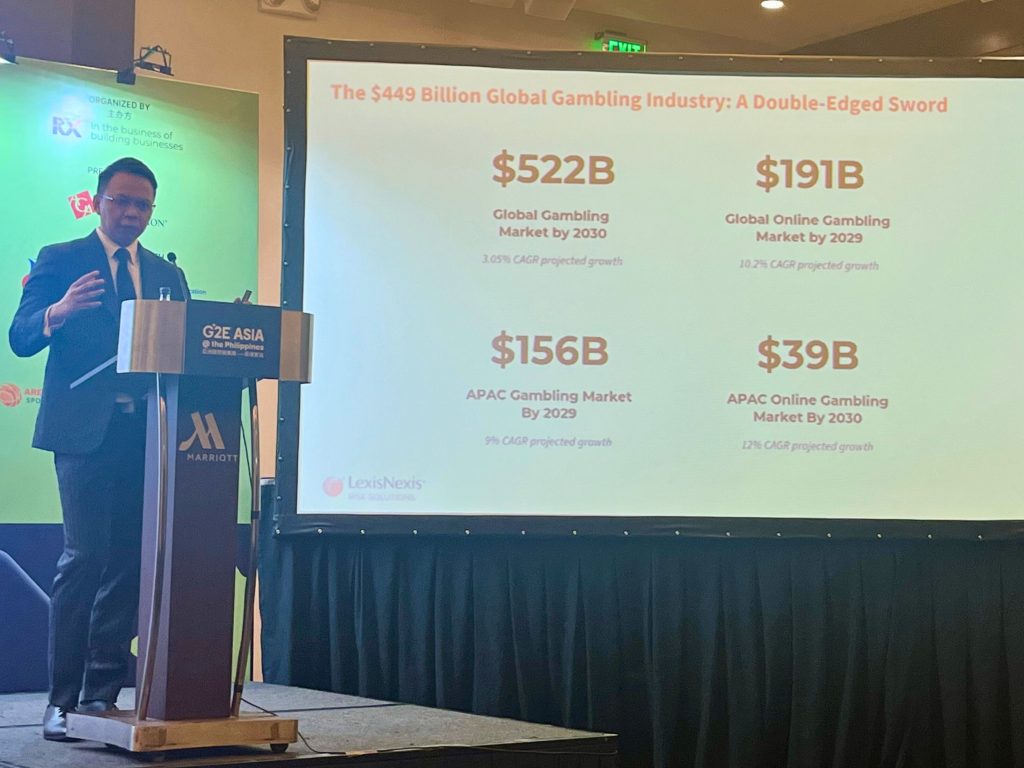
“By 2030, the total gaming and gambling industry is projected to reach $520 billion, which is growing at a compound annual rate of over 3 per cent. Online gaming of that as a subset is expected to grow even faster at 10.2 percent CR projected growth,” Ngo said. “Now, coming more specifically to APAC, the entire market is forecasted to reach $156 billion by 2029. And the online segment alone is expected to grow to $39 billion by 2030.”
While the expansion creates opportunity, Ngo stressed that it also increases vulnerability. “The digitisation of gambling and the rise of mobile platforms have made the industry more vulnerable to sophisticated financial crimes. This includes laundering, various financing and complex fraud schemes as well. Balancing this growth with robust risk management will be critical for operators and regulators for life.”
AML threats and regulatory response
Ngo detailed ongoing AML risks in digital platforms. “When we move digital, where the industry is growing online, platforms complicate the identity verification and customer due diligence process.”
He highlighted how criminals exploit weaknesses in online gambling. “Criminals exploit controls through chip purchases, minimal play, and rapid cash outs to layer illicit funds. With online, the industry, but most sectors are always playing catch-up to the fraudsters.”
Regulators are intensifying enforcement globally. “Regulators worldwide are strengthening oversight and gaming operations with increased enforcement actions and enhanced reporting requirements,” he said. “In the Philippines, this is a focal point for AML compliance in the region, with the AMLC increasing audits and enforcement actions. We’re seeing this across different markets as well.”
Technology-driven fraud trends
Ngo cited global examples of rising fraud.“In Europe, identity theft is rising exponentially. We saw 7,700 gambling-related impersonation complaints. In Latin America, sportsbook fraud incidents rose by 30 percent year on year. AI-driven fraud has increased by 78 percent based on falsified ID documents in Brazil. Deep fake identity fraud has jumped 822% in 2024. Traditional eKYC is no longer sufficient.”
In the APAC region, he observed similar trends. “Projects grew 16.4 percent year on year. AI-driven attacks are up 180 percent globally,” he shared. “APAC is leading the adoption of deepfakes and synthetic identities. Online gambling scams are up to 76 percent in Q2 2025.”
Collaboration and networked fraud
“Historically, we would see fraudsters operating in isolation. Now fraudsters are operating as a highly organised enterprise working across regions, across markets with very targeted attacks on different sectors,” Ngo stressed.
“Fraudsters are no longer working in isolation. They’re working as a network. We, as an industry, need to work as a network and collaborate,” he emphasised.
Ngo also described the cross-sector nature of attacks. “Fraudsters are attacking different sectors at the same time. They may go on e-commerce platforms, try to use bots to guess and formulate passwords. Once able to do that, they can try to take over accounts in gaming and gambling portals. They do that equally in FinTech because that’s when they’re trying to withdraw the funds. Ultimately, that will flow over to the banking sector as well.”
Mitigation strategies and technology
Addressing the solutions, Ngo outlined multiple layers of protection. “The best approach to identifying risk is to have multiple layers of authentication and verification, as well as targeted rules and policies based on the specific use case and specific touch points in those digital journeys. In account opening, this is where we’re trying to verify the user identity.”
Be part of the action! Join the world’s biggest iGaming community with SiGMA’s Top 10 News countdown. Subscribe HERE for weekly updates, insider insights, and exclusive subscriber-only offers.


