


From launch to lawsuits: Kalshi’s tumultuous timeline

Kalshi was founded in 2018 and has quickly become a flashpoint in the debate over prediction markets. Legal challenges, high-profile backers and billion-dollar valuations have marked its rise, making it a case study in how far a start-up can push into contested territory.
Early foundations and official approval
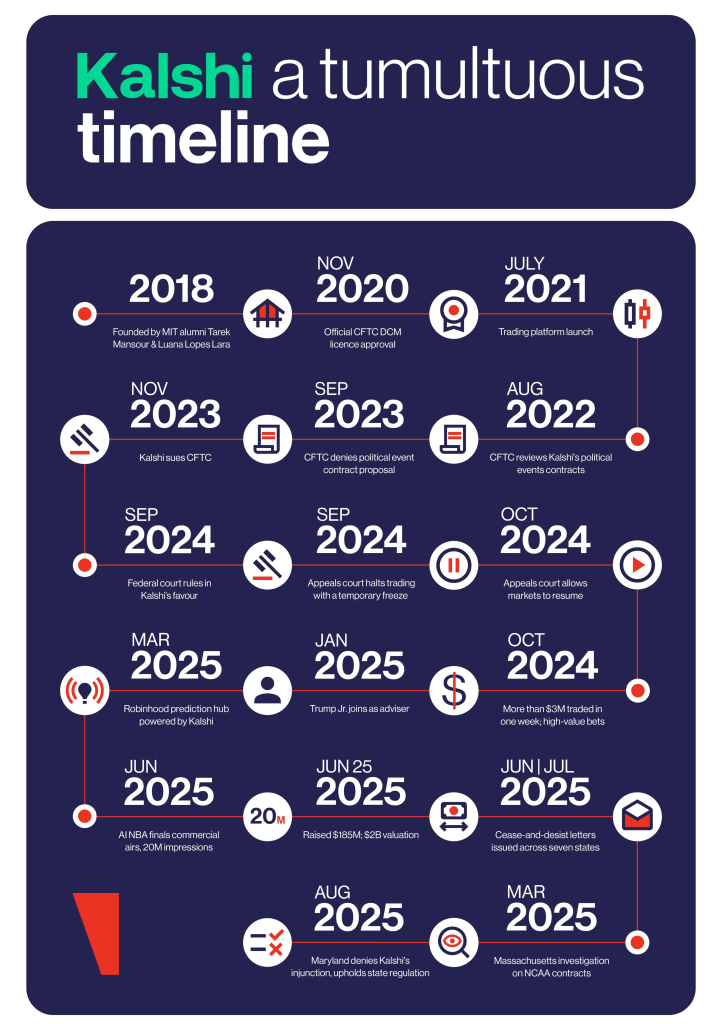
The idea for Kalshi took shape in 2018, when MIT classmates Tarek Mansour and Luana Lopes Lara decided that financial markets needed a new tool. Traders could hedge currencies and commodities, but not the outcome of an election or a major policy decision. Brexit had just shown how disruptive such shocks could be, and the two saw an opening for an exchange built around event contracts.
The breakthrough came in November 2020. That month, the Commodity Futures Trading Commission gave Kalshi the green light to operate as a designated contract market, making it the first exchange built for event contracts to receive such recognition.
The company officially launched its trading platform in July 2021, opening access to investors who wanted to trade outcomes in a way that looked familiar to derivatives markets but focused on real-world events.
Regulatory challenges and court victories
In August 2022, the CFTC started to examine Kalshi’s bid to introduce political event contracts, including trades on which party would control Congress. A year later, in September 2023, the agency rejected the plan, saying such markets could be considered gambling and were not in the public interest.
Kalshi did not accept the decision quietly. In November 2023 the firm filed suit, accusing the regulator of overreaching. Nearly a year later, in September 2024, a federal court backed Kalshi’s position. An appeals court briefly froze activity, but trading was allowed to resume soon afterwards.
By October 2024, political contracts were live again and the platform recorded more than 3 million dollars traded in a single week, reflecting strong demand for event-based speculation. Kalshi’s CEO Tarek Mansour described the decision as “a new era for financial markets,” according to Reuters.
Funding, expansion and state-level friction
The start of 2025 brought a string of headline-making moves for Kalshi. In January, Donald Trump Jr. signed on as an adviser, putting the company in the spotlight for its political connections.
Two months later, Robinhood introduced a new prediction hub built on Kalshi’s infrastructure, giving retail investors easy access to its contracts. Around the same time, Massachusetts regulators announced they were looking into whether Kalshi’s NCAA-related markets complied with state law.
The summer brought even greater headlines. In June 2025, Kalshi raised 185 million dollars in a Series C funding round, giving it a valuation of 2 billion dollars. The round included investment from Sequoia, Paradigm and Citadel CEO Peng Zhao. Speaking to Reuters, Mansour said the funds would help the company “scale our technology team and strengthen integrations with broker partners.”
Kalshi also ran an artificial intelligence-driven commercial during the NBA Finals that summer, generating an estimated 20 million impressions.
In mid-2025, Kalshi ran into trouble with state regulators. Authorities in at least seven jurisdictions, among them Nevada and New Jersey, sent cease-and-desist letters that argued the company’s sports contracts were effectively gambling products. Kalshi pushed back, saying that as a federally regulated exchange it was not subject to state gaming rules.
According to ESPN, if courts were to support that position it could “open the door for widespread use of sports-based event contracts outside of traditional sportsbook regulation.”
The legal setbacks mounted in August, when a Maryland court refused to grant Kalshi an injunction and confirmed the state’s regulatory authority.
Predicting the prediction market
Kalshi’s growth has been rapid, but rarely straightforward. What began as a small start-up has become a licensed exchange valued in the billions, and the journey has been shaped as much by legal fights as by new products.
As Investopedia has noted, prediction markets “sit at the intersection of finance, gambling and information.” The way Kalshi’s legal battles play out will not only decide its own future but may also shape whether event-based trading gains wider acceptance in the United States.


