


Polymarket expands fees across markets, tightens compliance

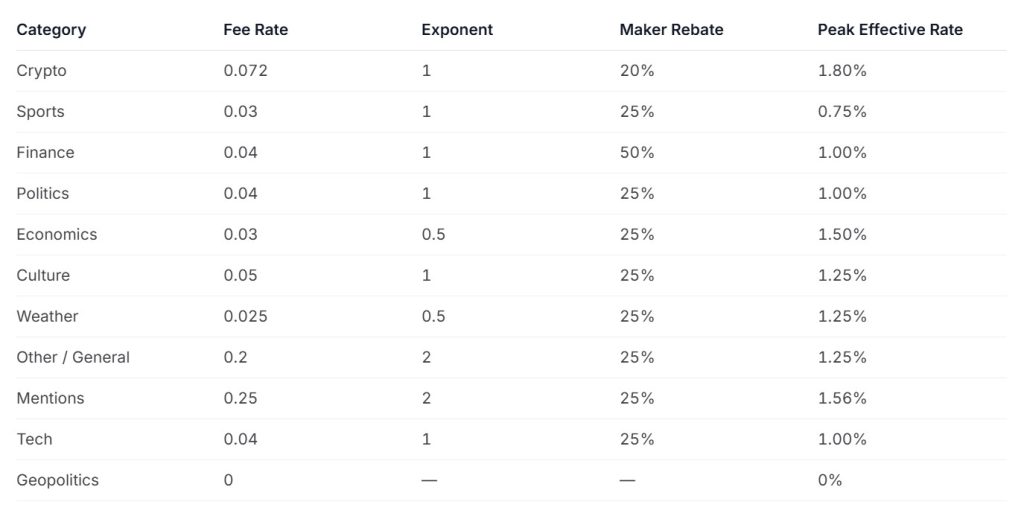
Polymarket has announced that it is expanding fees across a wider range of market categories starting 30 March and updated compliance rules amid insider trading concerns. Under the updated framework, trading fees will apply to additional categories, including politics, finance, economics, culture, weather, technology, and general markets. Currently, the trading fees is only applied to crypto and sports event contracts.
Different fees for segments
Polymarket will continue to operate a probability-based pricing model rather than a fixed commission. Moreover, different segments of the market will feature diverse fee structures.
Crypto markets will see the highest effective rates, peaking at 1.8 percent at mid-probability. Meanwhile, sports markets will remain the lowest, reaching 0.75 percent at the same level.
Liquidity incentives maintained
Even with the increase in fees, Polymarket has assured that its maker-taker model will still be maintained. Participants who supply liquidity by placing maker orders will keep benefiting from rebates funded by taker fees.
The company is also expanding its rebate programme, with rewards distributed daily in USDC based on the volume of liquidity provided and executed. This approach is designed to sustain order book depth and improve trading efficiency as fees increase.
Alongside the fee changes, Polymarket is rolling out a referral programme that allows active users to earn a share of trading revenue generated by new participants. The programme is open to users with a minimum trading volume of $10,000. Eligible participants can generate referral links and earn 30 percent of fees from direct referrals and 10 percent from second-level referrals.
New rules target insider trading
The update also features improved compliance protocols designed to bolster market integrity. Polymarket has introduced revised rules across both its international cryptocurrency platform and its regulated US exchange. The platform has outlined three key forms of prohibited activity, which are: trading on stolen or confidential information, trading based on illegal tips, and trading by individuals able to influence event outcomes.
This comes after a wave of concerns of insider betting following spiked activity on Polymarket as traders speculated on escalating US-Venezuela tensions. A user accurately predicted the timing of the attack and generated profits exceeding $436,000.
Most recently, over $500 million was staked on contracts tied to the timing of US attacks on Iran and even on the removal of the country’s supreme leader, Ayatollah Ali Khamenei, including bets that correctly predicted on 28 February (Saturday) as the date of the first strikes.
Regulatory action on Polymarket
Apart from this, many countries have imposed regulatory action against the platform and banned its operations. The platform faces regulatory actions from countries including Hungary, Portugal, Ukraine, and the Netherlands.
In February, the Dutch gambling regulator ordered Polymarket to stop offering bets in the Netherlands, threatening weekly penalties of €420,000. Hungary and Portugal temporarily blocked access to Polymarket for users in January, citing alleged breaches of national gambling laws and the provision of unlicensed betting services. Ukraine’s gambling and lottery regulator blocked Polymarket and classified the platform’s activities as bookmaking.
Subscribe HERE to SiGMA’s Top 10 News countdown and SiGMA’s weekly newsletter to stay up to date with all the latest iGaming News from the biggest iGaming community in the world and benefit from subscriber-only offers.


