


Prediction market platforms that allowed traders to wager on the timing of military strikes on Iran and even on the removal of the country’s supreme leader, Ayatollah Ali Khamenei, are facing renewed scrutiny in the United States after a surge of controversial payouts.
More than $500 million was staked on contracts tied to the timing of attacks, including bets that correctly predicted Saturday as the date of the first strikes. Separate markets on whether Ayatollah Ali Khamenei would be removed from power drew a further $150 million in wagers.
Khamenei was killed in Israeli strikes over the weekend, sending betting markets into sharp motion as rumours spread online before confirmation. As reports solidified, contracts tied to his removal surged, with payouts quickly becoming the focus of dispute.
Prediction markets allow users to buy and sell “yes” or “no” contracts linked to real-world events. Prices move as traders react to new information, effectively signalling how likely an outcome is seen to be.
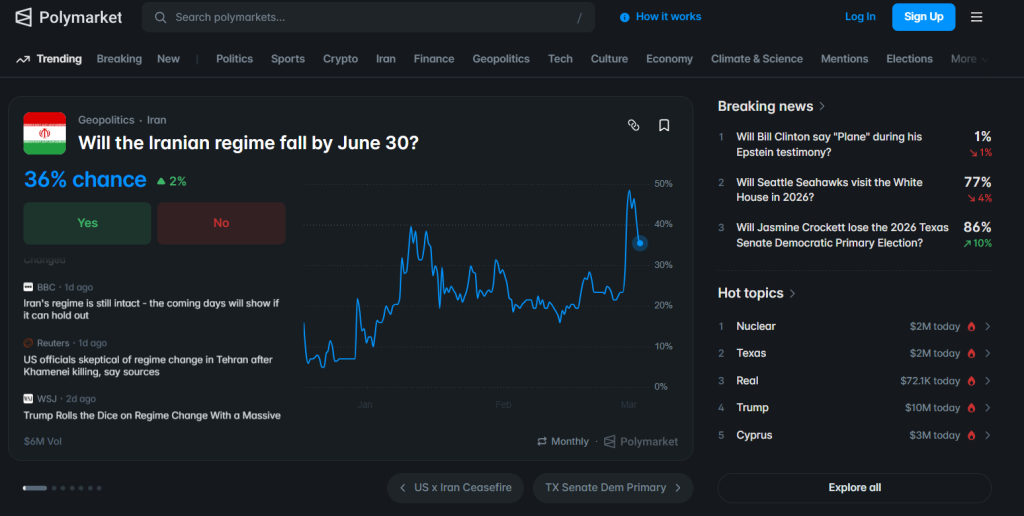
Once the result is confirmed, winning contracts settle at $1. Supporters say this structure can reflect crowd sentiment in real time. Yet critics say some subjects — particularly those involving war, assassination or regime change — raise serious ethical and legal concerns.
Crypto-based platform Polymarket hosted several of the Iran-related contracts now under debate. Analytics firm Bubblemaps said six accounts generated profits of about $1.2 million from bets funded shortly before the strikes. Separately, other firms also noted a wave of buying in mid-January from newly created digital wallets with little or no prior trading history, concentrated in wagers on “Khamenei out” by the end of March.
Polymarket, Kalshi under the radar
Polymarket has not publicly responded to the latest allegations. Contracts tied to Khamenei’s removal have entered a “debate period” after token holders disputed how the outcome should be resolved.
A rival exchange, Kalshi, also ran a market on Khamenei’s potential ouster. Its chief executive, Tarek Mansour, said the company had reimbursed certain fees and adjusted payouts in line with its rules. Writing on social media, he said markets involving possible deaths are structured to prevent participants from profiting directly from fatal outcomes.
The payouts and accusations of insider trading have intensified political concern. Under US law, derivatives contracts deemed contrary to the public interest — including those linked to war or assassination — may be prohibited.
Last month, six Democratic senators wrote to the Commodity Futures Trading Commission (CFTC) expressing concern that prediction markets were breaching regulatory boundaries. Senator Chris Murphy described the Iran-related wagers as “insane” and said he intended to introduce legislation to ban such markets.
Insider trading yet again?
Similar controversies have surfaced before. In January, a mystery trader made a roughly $410,000 profit after betting on the ouster of Venezuelan president Nicolas Maduro. Even during the recent events, several accounts suspiciously made millions in just a day.
Major financial institutions have also taken notice. Intercontinental Exchange, parent company of the New York Stock Exchange, recently acquired a $2 billion stake in Polymarket, while retail trading platforms have begun offering similar products in partnership with regulated exchanges.
For now, prediction markets continue to operate in what some legal experts describe as a regulatory grey area — growing in scale, drawing Wall Street interest, and attracting mounting political attention as they push into increasingly sensitive territory.
The fuse is lit in Mexico City. SiGMA North America hits Mexico City, 01–03 Sept 2026. 4,000 delegates. Three days of deals, insight, and startup sparks. The most serious stage of the Spanish-speaking sector. Lead from the front and book your spot.


