



NEXT.io’s latest report traces the evolution of prediction markets: its origins, when gambling first had its breakthrough moment, and how today’s competitive landscape is being amended. From dominant incumbents driving early liquidity to a new wave of builders fuelling innovation, the report highlights the forces shaping the next phase of this market.
Additionally, it examines the regulatory and investment dynamics that will determine what comes next. According to experts that NEXT.io consulted, prediction markets could evolve into a high-engagement product category that sits alongside, and potentially competes with, traditional sportsbooks.
“Prediction markets are no longer a curiosity, but no one quite agrees on what they really are. It’s chaotic, it’s confusing, and, for many, it’s irresistible,” the report notes.
Explosive growth
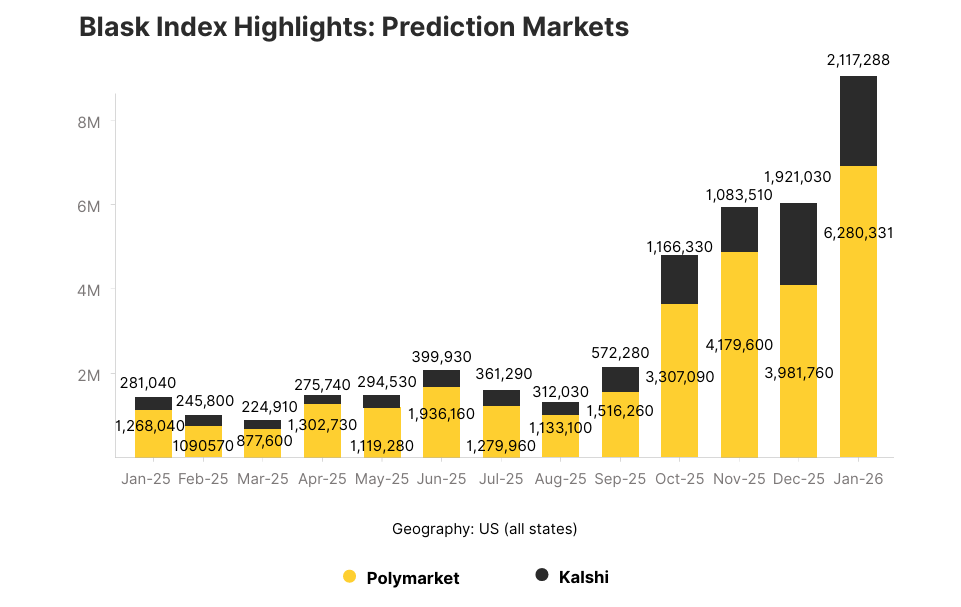
The numbers can no longer be denied. Trading volumes on prediction platforms have surged from under $100 million per month in early 2024 to more than $13 billion by December 2025. In the first month of this year alone, monthly volume doubled again to $26 billion. By February, single-day records exceeded $1 billion during the Super Bowl.
This meteoric rise also sheds light on a central question, though: Is it gambling or trading? CEOs in this space prefer the language of “predicting” or “trading,” distancing themselves from the legally loaded term “betting.”
Regulatory crossroads
Prediction markets are not a U.S. invention, but their rapid adoption in the United States has triggered legal battles. Advocates argue that they are financial instruments regulated federally by the Commodity Futures Trading Commission (CFTC). Critics, however, counter that sports-related contracts should be treated as gambling under state law.
While the CFTC defends its jurisdiction, the Securities and Exchange Commission (SEC) has warned that some contracts may fall under its oversight. Still, analysts note that a Supreme Court ruling may ultimately be required to settle the matter.
Industry shifts
The report also reveals that by late 2025, Kalshi and Polymarket emerged as industry benchmarks. Additionally, major players like DraftKings and FanDuel have embraced prediction markets compared to a year ago, even leaving the American Gaming Association over regulatory disagreements. Venture capital firms now describe the sector as being at an “inflection point.”
However, opponents warn of consumer protection risks: marketing gambling as investing, enabling manipulable markets, and partnering with questionable influencers. Tribal operators are the most opposed. They see prediction markets as a direct competitive threat to decades of established gaming infrastructure.
Innovation and niche growth
With innovation further accelerating, these platforms are experimenting with combo bets, trend-driven contracts tied to social sentiment, and chat-based integrations that allow trading directly through apps like Telegram. On the B2B side, shared infrastructure is emerging to provide compliance, liquidity, and trading mechanics.
But liquidity remains critical. The report pointed out that without balanced buyers and sellers, contracts risk mirroring casino-style offerings too closely, thus inviting regulatory scrutiny in the long run.
Market outlook
NEXT.io also points to the immense global transaction volume that grew from $15.8 billion in 2024 to $63.5 billion in 2025—a 400 percent increase. According to NEXT.io’s analysts, they forecast U.S. sports betting migration of 5–10 percent, representing a $2–5 billion revenue pool. In addition, long-term projections suggest that the industry could generate over $10 billion annually by 2030.
At the moment, prediction markets stand at a crossroads: poised to transform sports betting or collapse under regulatory pressure. Their appeal lies in binary simplicity, intuitive probability framing, and social-driven engagement.
Still, challenges continue with regulatory uncertainty remaining large. For one, experts warn that the current “Wild West” era is just temporary and will not last. Whether prediction markets are ultimately defined as federally regulated derivatives or state-controlled gambling products will shape their trajectory.
Additionally, fragmented liquidity, transparency gaps, and unresolved legal battles continue. NEXT’s report frames the debate with one central question: Are prediction markets the future of online sports betting—or a bubble waiting to burst?
Be part of the action! Join the world’s biggest iGaming community with SiGMA’s Top 10 News countdown. Subscribe HERE for weekly updates, insider insights, and exclusive subscriber-only offers.


