


Nevada judge blocks Kalshi with temporary restraining order


A northern Nevada judge issued a temporary restraining order (TRO) on Friday, one day after the Ninth Circuit Court of Appeals rejected Kalshi’s bid to halt state efforts to ban the prediction market operator.
The order bars Kalshi from offering wagers on sports, politics, and entertainment in Nevada until April 3, when Judge Jason Woodbury will hold a preliminary injunction hearing in Carson City. In his ruling, Woodbury said the Nevada Gaming Control Board “has a reasonable likelihood of success on the merits” and warned of “irreparable and non-compensable” harm if unlicenced prediction markets continue to operate.
Regulator’s concerns
The Board argued that Kalshi’s platform undermines its ability to protect minors and safeguard the integrity of competition overseen by licenced sportsbooks.
This TRO is the latest step in a year-long legal battle between Nevada regulators, Kalshi, and other prediction market operators. The Board filed suit last month, insisting such platforms must be licensed and regulated by the state. Kalshi counters that its authority derives from the Commodity Futures Trading Commission (CFTC), which permits nationwide operation.
Board chair’s statement
Board chair Mike Dreitzer said the ruling reinforces Nevada’s stance in a statement:
“Kalshi has repeatedly stated that its operations are legal in 50 states, which is clearly not true. Prediction markets, to the extent they facilitate unlicenced gambling, are illegal in Nevada. We have a statutory duty to protect the public and ensure wagers are placed safely at licenced books.”
Federal vs. state jurisdiction
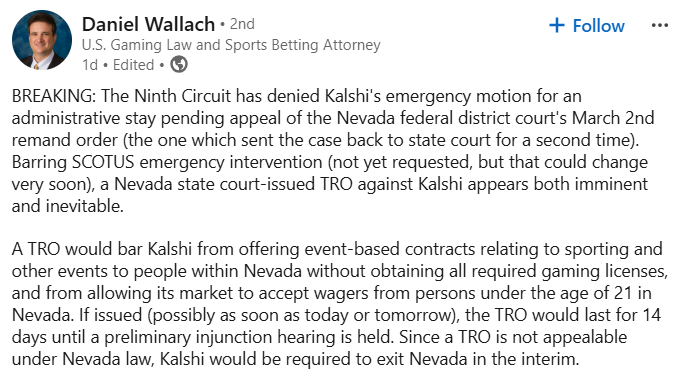
Opponents argue Congress never intended for the CFTC to authorise sports wagering, leaving regulation to the states. Legal experts note Kalshi may appeal to the U.S. Supreme Court for an administrative order allowing operations in Nevada.
Florida-based gaming attorney Daniel Wallach emphasised that the ruling highlights states’ need to pursue action in state courts rather than federal venues.
Broader legal context
This is the third TRO Nevada regulators have secured against prediction market platforms, following cases involving Polymarket and Coinbase. Nevada’s move mirrors that of Massachusetts, which recently obtained a preliminary injunction against Kalshi. Wallach said states are “learning from Massachusetts” and increasingly opting to sue first.
Courts have consistently rejected arguments that federal CFTC oversight preempts state gambling laws, strengthening regulators’ position. Other states, including Arizona and Tennessee, have taken similar steps, creating a patchwork regulatory environment that complicates claims of nationwide legality.
Prediction markets face inconsistent treatment across states, which is legal in some, banned in others, creating uncertainty for operators and investors.
Impact on innovation
Prediction markets like Kalshi provide insights into public sentiment and future events. But state bans risk-stifling innovation, discouraging new entrants, and limiting fintech startups exploring prediction-based trading models that could otherwise provide valuable forecasting data.
In other countries like the UK, prediction markets face stricter regulation. The UK treats them as gambling products requiring licences, while many EU countries ban them outright.
Kalshi spokeswoman Elisabeth Diana has defended the company, arguing that prediction markets operate within the regulatory framework established by the CFTC.
Stay in the loop and join the biggest iGaming Community in the world with SiGMA’s Top 10 news countdown. Subscribe HERE for weekly updates from the world’s iGaming authority and exclusive subscriber-only offers.


