


Arsen Tadevosyan on expanding gaming studios into Tier 1 markets

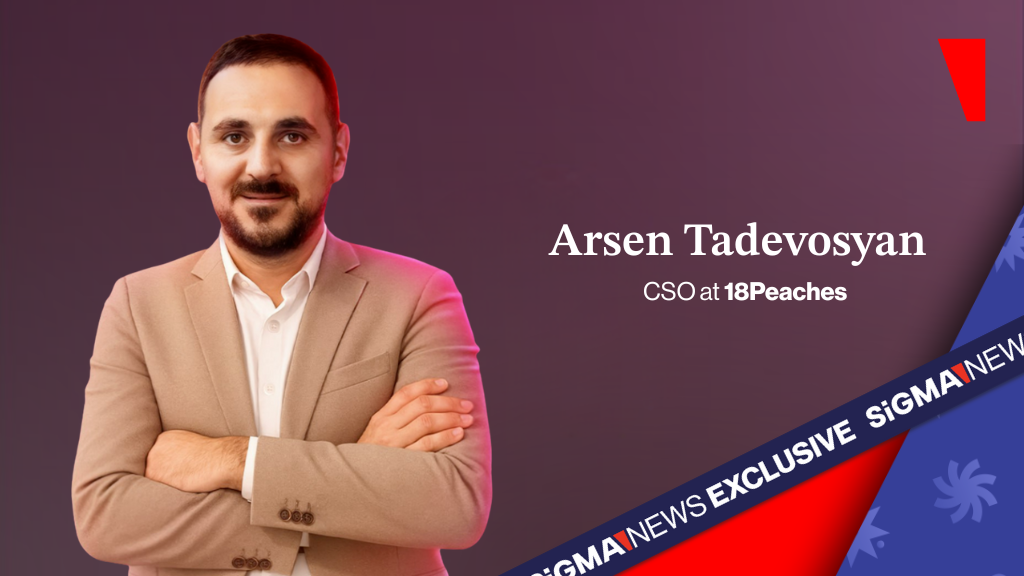
As strategy director at the gaming provider 18Peaches, Arsen Tadevosyan is familiar with the demands of online casino operators in the most lucrative markets. In an exclusive interview with SiGMA News, he revealed the key demands of gaming studio clients for 2025. He also noted an important shift in operator focus to consider when creating a strategy for the new year.
What operators want
What key requirements of Tier 1 operators have become decisive for the development of 18Peaches in 2025? How much has the focus of operators changed over the year?
In 2025, three things have become decisive for Tier 1 operators: stability, a measurable contribution to retention and clear, fast integration.
Operators are no longer interested in ‘just another studio with 30 slots’. They want a supplier that can address specific tasks such as player return, session depth, the quality of promotional tools and providing predictable support. That’s why we’ve increased our focus on game design with a specific strategy. Combined with a particular narrative, interesting mechanics, and mathematics, this approach to design makes players want to return to the game.
We also pay close attention to player psychology. That includes studying areas of focus at specific moments in the game; transparent product analytics; promotional tools (free spins, jackpots, sweepstakes) through a single unified API.
In addition, we are noticing less and less talk among operators about pure volume and more about how a particular game retains traffic, how remarketing is monetised, and how flexible and accessible the provider’s team is in their daily work.
How has the approach to partnerships with operators changed? Have there been more requests for exclusives, white labels, or joint development? What technological solutions do you consider to be drivers of growth?
There has been a noticeable increase in requests for exclusives and co-branded releases. Operators want to have at least a few of their own flagship products that cannot be found among their competitors. We respond to this request with customised versions of games and market-limited exclusives.
Joint development is also gaining momentum, but it makes sense when the operator has a clear understanding of its audience and access to data. Then we can jointly assemble a game for a specific funnel, rather than creating an abstract product.
Technologically, I see the following drivers of growth:
- Accessible tools for customising game functionality through a unified API;
- A deep system of jackpots, game stages, and bonus components;
- Comprehensive analytics that are readable for partners.
The easier it is to integrate and launch campaigns, the higher the value for the operator.
How providers are changing
How do you assess the role of AI in creating game mechanics and personalising content?
AI has already become a working tool at 18Peaches. However, it cannot be called a ‘magic button’ because it does not replace the team.
In game design, AI helps to quickly run through variations of themes, visual settings, and narratives, as well as to check the common sense of specific mechanics at an early stage. But the final decisions on mathematics, balance, and UX are the responsibility of the team’s specialists.
In personalisation, AI is most useful in recommendation systems and segmentation: which games to show to which player, which promotion will work best for a particular cluster. Here, providers and operators are still feeling their way towards the optimal depth of personalisation so as not to kill the sense of randomness and excitement.
Against the backdrop of the industry’s transition from mass production of games to niche solutions, what position does 18Peaches occupy? What competencies are becoming key for a modern studio?
We no longer believe in the ‘2-4 games per month at any cost’ model. Our focus is on a compact but straightforward portfolio, where each game has its own distinct role: flagship, retention tool, niche product for a specific region or segment.
18Peaches positions itself as a new generation studio for a new generation of players: more narrative, a little more self-irony, working with pop culture and cultural codes where appropriate. At the same time, the maths and reliability are always at a high level expected in the Tier 1 market.
The key competencies of a modern game development studio include:
- Product discipline, or a clear understanding of why each game is being made;
- Analytics and data management in collaboration with operators;
- Technological maturity – the availability of APIs, promotional tools, and stability;
- The ability to speak to the market in human language, not just through release notes.
Promising regions
Which regions do you consider most promising for growth in 2026? Which markets are overvalued or, conversely, undervalued?
In 2026, we see potential primarily in the multi-billion dollar Asian market, which is open to iGaming; the Middle Eastern market, which continues to gain momentum; regulated Latin America; select African markets where mobile internet is rapidly spreading; and local European jurisdictions that are only now moving towards stricter regulation.
Some of the high-profile markets are overvalued because the entry ticket there is growing faster than the real margin. These are mainly cases with high licensing, marketing, and compliance costs, while competition is already extremely fierce.
Undervalued regions are characterised by a stable, solvent audience and a growing infrastructure of payments and local partners. You can’t expect rapid growth there, but you can build a healthy, sustainable business.
How do you adapt your product strategy to different markets, taking into account regulation, player preferences, and the level of mobile technology penetration?
We look at the market through three layers: regulation, player behaviour through cultural factors, and device/channel.
First, we look at what can be done in general: restrictions on bets, bonuses, jackpots, and responsible gaming features. That determines the framework of the product line for a specific jurisdiction.
Next, we look at player tastes and habits: themes, volatility levels, what percentage of the audience plays on mobile devices, and how people perceive promotions. In some countries, story-driven games with vivid narratives are more popular, while in others, the most straightforward mechanics and pragmatic interfaces are preferred. Players in each market have their own set of habits.
Markets where player habits are still forming are of particular interest to us. We look at preferences related to game themes, interactivity, and specific sets of mechanics. For Tier 1, providers take these habits into account when developing visuals and mechanics. For a particular location, we can implement and test new technologies and themes.
The third layer is mobility and hardware: package size, download speed, and optimisation for low-end devices. For a number of markets, we deliberately make lighter but highly readable interfaces so as not to lose players at the first download stage.
How do you assess the impact of new regulatory initiatives in the EU and the US on the business model of providers? How vital are RTP transparency, certification, and compliance with responsible gaming standards to you?
While strict regulation raises the entry threshold in the short term, it ultimately makes the market healthier. For providers, this means higher costs for legal expertise, certification and technical support to meet various requirements. However, it also filters out casual players and provides operators with reliable partners.
Transparency of RTP, proper certification and compliance with responsible gaming standards are now mandatory. We consider these to be fundamental requirements: without them, it is not possible to cooperate with large, stable operators.
From the point of view of a provider’s business model, this forces them to think less short-term: projects with quick and dubious schemes simply will not survive the next round of regulatory changes. Those who invest in transparency and compliance ultimately win through market trust.
Forecast for 2026 for the B2B segment
Your forecast for 2026: what will demand grow for, and what will it fall for? What metrics do you consider most indicative for assessing the success of a new game in the new year?
Demand will grow for:
- Products with clear, readable value for the player: understandable mechanics, a straightforward and exciting narrative, tangible progression;
- Flexible promotional tools around games: missions, cumulative mechanics, jackpots, tournaments, personalised campaigns;
- Honest, transparent, and understandable UX without hidden traps. Players can sense insincerity, so it is essential to have a direct, open position on this issue.
Interest will decline in clones, games without a narrative, and games that do not help operators solve retention and monetisation problems, but take up space in the lobby.
To evaluate the success of a game in 2026, it is worth analysing the following metrics: repeat sessions, session depth, contribution to NGR and the game’s share of the operator’s category turnover, and conversion in promotional activities. If a game gives operators predictable, repeatable results on these metrics, then it is a successful product, not just another release on the list, concludes Arsen Tadevosyan.
This article was first published in Russian on 23 December 2025.
Stay in the loop and join the biggest iGaming Community in the world with SiGMA’s Top 10 news countdown. Subscribe HERE for weekly updates from the world’s iGaming authority and exclusive subscriber-only offers.


