


E-sabong persists in Philippines despite ban: Study


Online cockfighting, or locally known as e-sabong, in the Philippines continues to thrive on unregulated gambling platforms despite a nationwide ban, according to a new study by sociocultural research firm The Fourth Wall.
“Our latest report demonstrates how prohibited games like e-sabong remain easily accessible on unregulated platforms even to high-profile figures, underscoring persistent enforcement challenges,” John Brylle Bae, Research Director at The Fourth Wall, said.
The study noted that unregulated sites operate outside the consumer protections and strict protocols mandated by the Philippine Amusement and Gaming Corporation (PAGCOR), thereby exposing players to risks.
President Ferdinand Marcos Jr. ordered a halt to e-sabong through Executive Order No. 9 in December 2022. The order suspended all operations of online cockfighting and banned online, remote, or off-cockpit betting on matches, as well as live-streaming events outside official venues.
Proliferation in social media
Despite the ban, researchers found that unregulated platforms continue to host e-sabong and promote it openly on social media. Facebook groups and private messages are used to invite players to join. Some platforms require account registration, but the games remain widely marketed, showing both ongoing demand and the persistence of operators.
The visibility of e-sabong resurfaced in public debate after President Marcos’ State of the Nation Address (SONA) in July, when a congressman was caught on camera viewing a cockfighting livestream during the session.
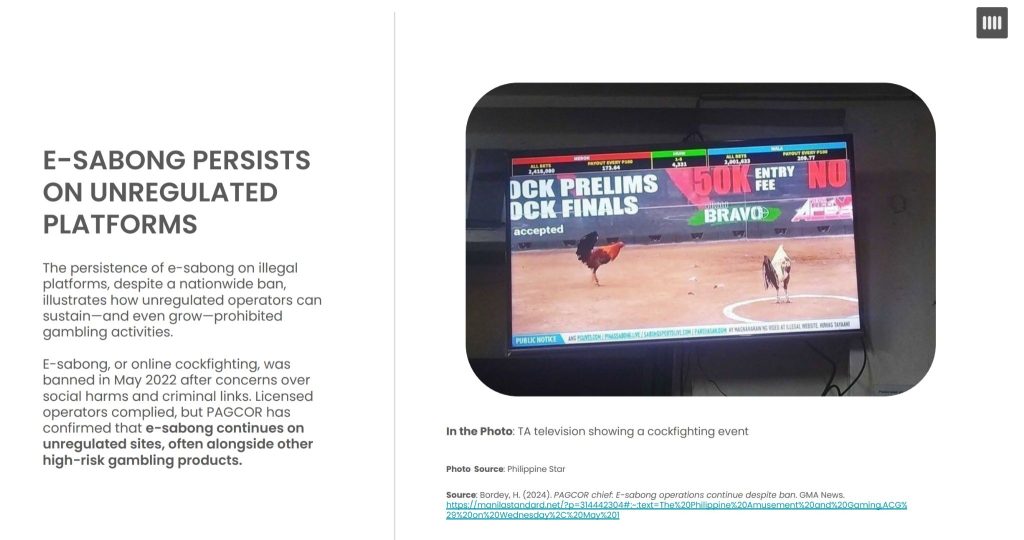
Gambling Platforms in the Philippines/The Fourth Wall)
Unregulated operators host 5,000 games
The report analysed regulated and unregulated online gambling platforms across various areas, including game offerings, promotions, affiliate structures, payment systems, Know Your Customer (KYC) procedures, trust and safety measures, and customer service.
According to the findings, unregulated platforms offer a broader range of games. On average, unregulated operators host approximately 5,000 games, compared with 2,900 games on regulated sites. The Fourth Wall study said that while regulated platforms must obtain PAGCOR approval and submit games for third-party audits, unregulated sites release games without checks, leaving players vulnerable to fake or manipulated content.
Verification and player risks
Regulated platforms require stringent verification procedures. Players must pass eligibility checks through a PAGCOR-branded pop-up at sign-up, which requires valid government IDs, age verification, and sometimes cross-checks with e-wallet registrations.
Unregulated platforms, by contrast, impose minimal requirements. Some only require an email address or phone number to register. The report even documented instances of minors gaining access to unregulated sites.
“The absence of safeguards in unregulated platforms highlights the need for targeted enforcement and public awareness,” Bae stated.
Payment systems and spending limits
The study noted further differences in payment structures. Regulated sites accept widely used payment systems, including GCash, Maya, QRPH, and bank transfers, but enforce transaction caps to comply with anti-money laundering rules. However, this will change as fresh regulatory pressure from the Bangko Sentral ng Pilipinas (BSP) has directed e-wallet providers to remove all icons and links to online gambling sites. BSP Deputy Governor Mamerto Tangonan told the Senate Committee on Games and Amusement that the Monetary Board approved the order to cut connections between payment platforms and gambling sites.
Unregulated operators, however, do not impose transaction limits, allowing players to spend freely.
Trust, safety, and dispute resolution
The study also found that trust and safety protocols diverge sharply between regulated and unregulated operators. Regulated platforms verify their games and provide formal complaint channels, with disputes eligible for escalation through PAGCOR, according to the study.
Unregulated platforms often lack consistent systems for resolving issues. These platforms have been linked to scams, phishing risks, and fake game listings, compounding the risks for participants.
Marketing and promotions
Promotional tactics differ. The study found that regulated operators offer sign-up bonuses and rebates, with promotions typically falling within the 10-40 percent range. Unregulated platforms provide more aggressive offers, sometimes reaching as high as 108 percent, accompanied by frequent promotions and cashback schemes.
Such marketing creates strong incentives for players to join unregulated sites, despite the lack of protections.
Affiliate programmes
Affiliate strategies also reveal disparities. The study showed that many unregulated platforms recruit agents with attractive revenue-sharing agreements, sometimes offering between 45 percent and 65 percent of Gross Gaming Revenue (GGR). This is in contrast with the regulated platforms, which typically provide commissions of around 30 to 40 percent, with clear structures for qualifications and payments.
The report concluded that operational differences between regulated and unregulated platforms extend beyond their functions to influence the risks faced by players.
“Our report shows that the operational differences between regulated and unregulated platforms do not just define how platforms function, but also shape the risks and potential harms players face, especially in unregulated spaces,” Bae said.


