


European Safer Gambling Week 2025: first benchmark for online gambling harm unveiled


The third day of European Safer Gambling Week 2025, organised by the European Gaming Betting Association (EGBA), emphasised the vital role of the nine markers of harm in promoting responsible gambling. Dr Maris Catania, an expert in gambling-related behaviour, delivered an educational presentation highlighting these nine markers as foundational European standards, described during the seminar as the “Holy Bible” of harm markers.
Introduction to the nine behavioural markers
These nine indicators provide a consistent vocabulary and framework for identifying behavioural changes suggestive of gambling-related risk, according to Dr Maris Catania, project leader for the European standard. The standard is based on substantial scientific study and was created over several months of cooperation between operators, regulators, academics, and health groups. The markers provide for flexibility while promoting uniformity across markets by offering recommendations without imposing precise intervention levels.
Marker 1: Volume of stakes
This marker measures how much a player wagers and the changes in their wagering over time. A sudden increase in the amount staked relative to an individual’s usual baseline is an important risk signal. For instance, a player significantly increases their bets in a short amount of time. If so, this might be a sign of increasing gambling damage or a loss of control. This identifier is essential for monitoring potentially troublesome financial conduct that could otherwise go unreported.
Marker 2: Speed of play
Speed of play assesses how quickly bets are placed. Particularly in continuous play forms or specific game types, faster betting may be a sign of diminished self-control. Due to impulsivity or a lack of time to think things through, players who put wagers quickly may be more vulnerable to injury. By identifying patterns of hazardous involvement, speed of play is a useful behavioural indicator that enhances the financial indicators.
Marker 3: Deposit frequency and timing
This marker examines both how often players deposit money and the timing of these deposits. Rapid, repeated deposits within short time frames usually signal financial management difficulties. Players who swiftly make several deposits, for example, can be chasing losses or feeling compelled to keep playing in spite of unfavourable results. Early detection of these patterns enables intervention before damage worsens. Recognising these patterns early helps to intervene before harm escalates.
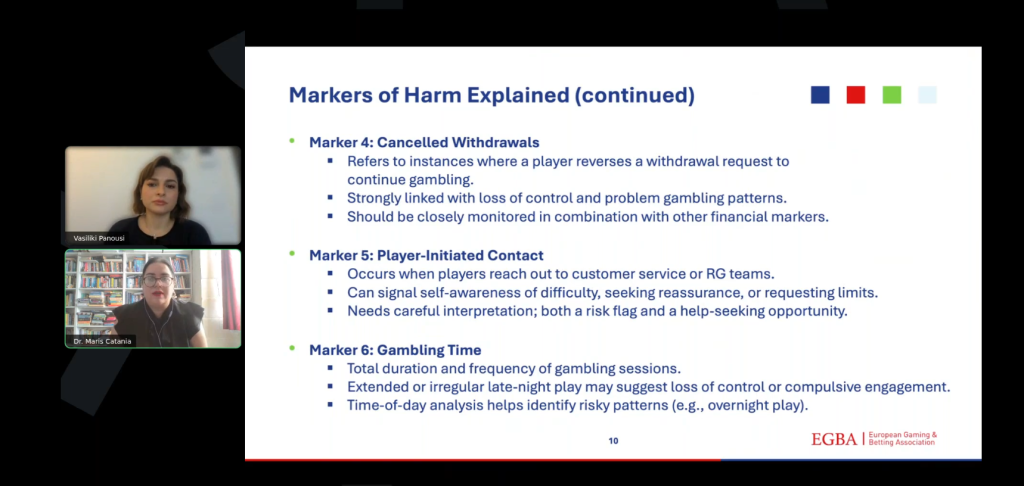
Marker 4: player-initiated contact
One of the positive behavioural markers, this reflects players who reach out to operators proactively, either for help or to apply responsible gambling measures like self-exclusion. A certain level of control and knowledge of one’s gambling behaviours is demonstrated by such contact. Player-initiated contact is both a warning flag and a chance for involvement that can reduce harm, according to early studies.
Marker 5: gambling time
This marker tracks the duration and frequency of gambling sessions, including patterns such as late-night play. Problematic gambling habits may be indicated by long sessions or frequent gaming during odd hours. Monitoring gaming time enables a more comprehensive picture of players’ behaviours beyond the financial aspect, indicating when gambling may be interfering with day-to-day activities.
Marker 6: time differences
Recognising that no single model fits all, this marker focuses on individual behavioural changes in timing, such as when players alter their usual gambling hours or frequency. It considers deviations from a player’s normal behaviour rather than applying a one-size-fits-all threshold. This personalised approach increases the sensitivity and relevance of harm detection.
Marker 7: product mix
The product mix marker observes if there is a shift from gambling on lower-risk products to higher-risk ones. A sudden move to riskier games can be an early indicator of emerging gambling harm. For example, switching from lottery tickets to fast-paced slot machines may increase vulnerability. This marker helps operators identify when players may be escalating their gambling behaviours.
Marker 8: use of responsible gambling tools
The frequent swings in time limits or deposit restrictions may be a sign of financial troubles and a lack of control, but the simple use of such instruments is not a sign of harm. This dynamic activity indicates that players find it difficult to uphold limits, which is a useful indicator for operators who want to engage and support at-risk persons successfully.
Marker 9: financial losses
This marker evaluates the amount and speed of money lost over time. When paired with other behavioural markers, rapid or large financial losses might be unmistakable symptoms of damage. Taking into account the real negative impacts of gambling behaviour, monitoring this indicator helps build a more comprehensive risk profile.
Collaboration and standardisation: a unified European approach
The introduction of this standard represents a notable achievement in collaboration. Bringing together academia, industry, regulators, and health sectors was a major task but essential to creating a unified framework. Dr Catania highlights that collaboration is key to moving Europe away from fragmented national models towards evidence-based prevention strategies.
Operators must ensure accuracy, protect player privacy, and incorporate these markers into the current data systems. Stakeholders must continue to communicate and work together to address these operational and technological challenges. As Dr Catania notes, adoption should be seen as a guideline rather than an immediate mandate, supported by continuous collaboration between regulators and operators to overcome obstacles smoothly.
Respecting local regulations while advancing Europe-wide standards
The standard does not take the place of national regulatory systems. Instead, its purpose is to support and reinforce those existing frameworks, using Europe’s shared approach as a foundation. Operators have the option to use the European baseline, but they are able to adapt it according to their own local circumstances. The standard does not take the place of national regulatory systems. Instead, its purpose is to support and reinforce those existing frameworks, using Europe’s shared approach as a foundation.
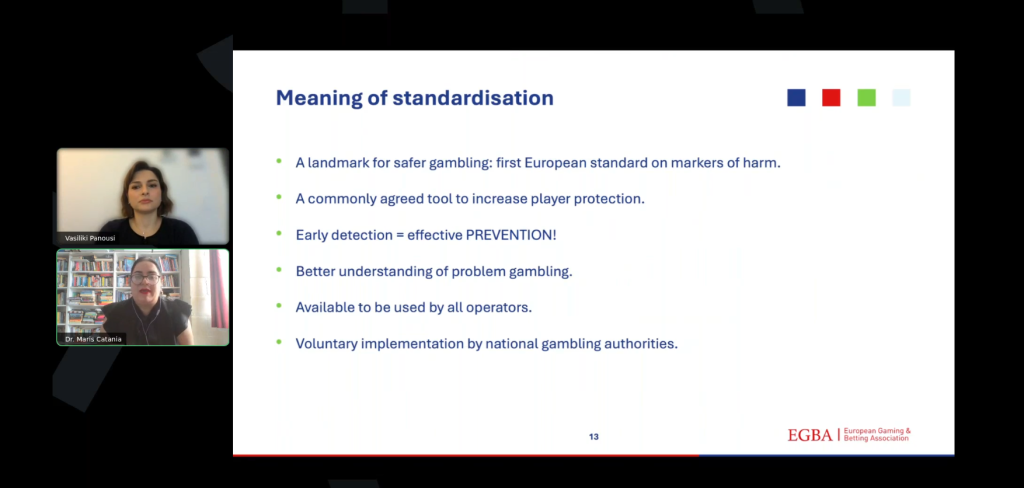
Operators have the option to use the European baseline, but they are able to adapt it according to their own local circumstances. In this way, cooperation and national independence go hand in hand, giving each jurisdiction the room to protect players effectively while remaining true to its own context. Dr Catania stressed the essential role of collaboration and continuous dialogue involving experts, regulators, and policymakers to identify common gaps and improve public policies around gambling regulation.
Europe’s first standard on gambling harm markers stands as a landmark in player protection
The differences in market maturity between Europe and other jurisdictions, such as Latin America, remain striking. In the Colombian case, for example, online gambling operates under a state monopoly. It is limited to a small number of licensed operators. In contrast, traditional land-based gambling continues to represent the majority of the industry, accounting for some seventy to eighty per cent of overall activity. In light of this, it is obvious that direct transfer of European internet market models is unlikely to be successful in areas where land-based activities are more common.
This framework’s common language, which enables risks to be identified earlier, facilitates data comparison across jurisdictions, and grounds decisions in trustworthy evidence, is one of its main advantages. Stakeholders can drastically change gaming environments throughout Europe and make them much safer for everyone by continuing to work together.
Be part of the conversation shaping safer play. Subscribe HERE to SiGMA’s Top 10 News countdown for stories shaping iGaming’s future, exclusive interviews, and industry insights delivered straight to your inbox. Don’t just read the news, stay ahead of it.


