


Malta’s gaming industry is contracting in headline licence numbers, but growing in a more subtle way. Behind the steady contribution to the economy and the falling licence count, the balance of activity under the Malta Gaming Authority (MGA) is shifting decisively towards business-to-business suppliers, reshaping what the island’s gaming hub looks like in practice.
According to the MGA’s interim report for the first half of 2025, B2B operators now account for 55.5% of the total licence base. Between January and June 2025, 64.3% of new licence applications and 87.5% of licences actually issued were B2B.
Talking to SiGMA News, the MGA has been careful not to frame the B2B rise as an explicit policy target. “The composition of the licence base reflects market behaviour,” a spokesperson said, noting that operator restructuring and international regulatory changes have influenced where companies choose to license different parts of their business.
From consumer brands to infrastructure
Still, the regulator does not hide the role of its own reforms in making Malta attractive to suppliers. “The 2018 overhaul of the Gaming Act and the introduction of a clearer, more streamlined authorisation framework laid the structural foundations for Malta to become a natural hub for high-value B2B suppliers,” the spokesperson explained.
The aim, the MGA says, was proportionality. “The reforms created the clarity and proportionality that B2B operators needed to scale sustainably.”
Six years on, the authority argues that the framework is “paying dividends”. Malta already hosts most of the world’s major online gambling brands, creating what the MGA calls “an immediate, integrated market” for suppliers offering platforms, games, technical services or payments infrastructure. Demand for “technical and platform-related services continues to increase”, reinforcing the B2B tilt.
The interim report frames the shift in risk terms. It describes the licence base as “progressively evolving towards activities with a lower risk profile”, language that the spokesperson said relates to the nature of B2B operations, “which do not involve direct interaction with players.”
But the authority is keen to stress that lower risk does not mean lighter supervision. “Regulatory expectations remain unchanged,” the spokesperson added. Oversight continues to focus on governance, AML and CFT obligations, outsourcing and dependency risks, and operational resilience.
Fewer licences, steady economic weight
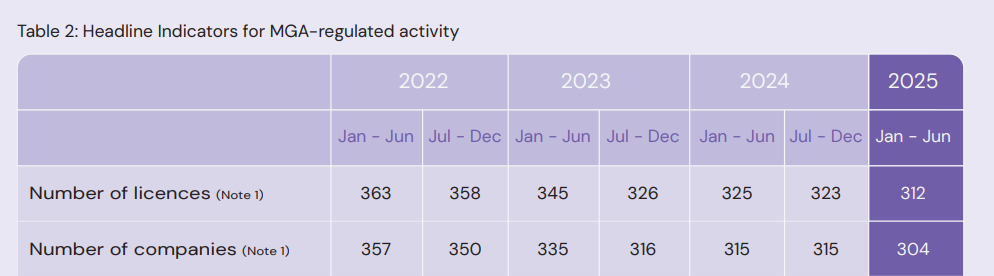
As of the end of June, 304 companies held 312 gaming licences, down on earlier years. Yet the sector’s economic footprint has barely moved. The MGA estimates that gaming generated €714.4m in gross value added in the first half of 2025, representing 6.5% of Malta’s total GVA, broadly unchanged since 2022.
Employment has also held up. The authority estimates that around 14,797 people work in Malta with MGA-licensed operators, a 3.1% increase on the end of 2024 and about 5% of the national workforce. The picture, again, is of fewer corporate entities employing more specialised staff.
In its interim report, the regulator describes this as a maturing market. “The decline in the total number of companies and licences reflects the continued consolidation of a maturing and evolving industry,” it said, adding that firms are “increasingly prioritising long-term sustainability and quality, within a more complex international regulatory environment”.
That language echoes the MGA’s broader pitch that Malta is moving “beyond a solely licensing-focused hub into a centre of innovation, regulatory quality, and high-value services”.
What makes a ‘ready’ B2B application
The concentration of B2B applications has sharpened the MGA’s expectations at the authorisation stage. Asked what distinguishes an application that moves quickly through the system, the spokesperson pointed to the basics.
“Applications that progress efficiently are those that demonstrate a clear operational model, defined governance arrangements, and risk management frameworks aligned with the proposed activity,” they said. The most common avoidable problems remain “incomplete or inconsistent documentation, unclear business plans or governance structures that do not match the complexity of the proposed activity”.
The figures suggest that scrutiny is biting. Of 28 new gaming licence applications received in the first half of the year, only eight licences were issued, with others rejected, withdrawn or still in process. Several applications were escalated to the Fit and Proper Committee or the Supervisory Council after concerns about misleading or incomplete information.
Enforcement and the invisible supply chain
While B2B firms are often less visible to players, the interim report underlines that enforcement remains a central part of the MGA’s work. Between January and June, the authority issued 23 cease and desist letters, 15 warnings, 23 administrative penalties amounting to €139,360, and cancelled one licence.
The report also highlights a parallel battle against misuse of the MGA brand. Of 75 URLs reviewed for unregulated activity, 34 were found to contain “fraudulent references to the Authority or its licensees”. Most cases involved sites falsely claiming to hold an MGA licence. The authority responds by issuing cease and desist letters, coordinating with other regulators and publishing a list of unauthorised URLs to warn consumers.
For B2B suppliers, whose clients rely on regulatory credibility, the policing of the licence’s reputation is part of Malta’s value proposition. As the MGA puts it, the jurisdiction rests on “regulatory credibility, a mature ecosystem, a supportive political and institutional environment, and clear, risk-based oversight”.
Looking ahead, the authority says it wants that proposition to evolve through “greater regulatory agility”, staying responsive to industry change without diluting standards. If the first half of 2025 is any guide, that balance is increasingly being tested not only on gaming and betting websites, but deep in the infrastructure that powers them.
Stay in the loop and join the biggest iGaming Community in the world with SiGMA’s Top 10 news countdown. Subscribe HERE for weekly updates from the world’s iGaming authority and exclusive subscriber-only offers.


