


Study: Filipino players drawn to unregulated gambling despite risks


A recent study by sociocultural research firm The Fourth Wall has revealed that many Filipinos who gamble online remain unaware of the risks tied to unregulated platforms. Out of 400 respondents surveyed in Mega Manila, Metro Cebu, and Metro Davao, 55 percent admitted they were unaware of the legal implications of betting on unregulated sites. In contrast, 33 percent said they knew “a little.” Only 12 percent found the rules clear.
Speaking exclusively with SiGMA News, John Brylle Bae, research director at The Fourth Wall, said that the knowledge gap suggests that regulatory measures alone may not be enough. “Community organisations, schools, and families can play a role in making the risks more understandable in everyday contexts, translating abstract ideas like ‘lack of legal recourse’ into relatable consequences such as financial vulnerability, scams, or unresolved complaints,” he said.
Bae added that schools could integrate modules on financial literacy and digital safety to address underage participation and scams, while families could take preventive measures at home. “Families can play a preventive role by monitoring e-wallet usage, particularly since our research shows that some minors were able to gamble through their parents’ accounts. Community organisations, meanwhile, can amplify responsible play campaigns and create peer-based support systems that make these risks more visible and relatable.”
Behaviour driven by trust and personal experience
The study found that legality often comes second to trust and perceived profitability when Filipino players decide whether to stay or leave a platform.
“Trust, not legality, drives player behaviour,” Bae said. “Confidence, fairness, and perceived profitability matter more than platform features. This explains why players, despite uncertainty and uneasiness, continue to engage with unregulated platforms as long as they perceive a chance to win.”
On whether cultural or psychological factors played a role, Bae explained that the data suggest that perceptions of profitability and fairness are more influential than rules in shaping behaviour. “Filipino players tend to stay if they feel they are ‘winning’ or at least managing losses, and leave if they encounter unresolved problems. This reflects a psychological tendency to value immediate financial outcomes and personal experience over formal assurances like certifications, which 65 percent do not recall seeing.”
“Culturally, this links to a broader reliance on social proof and lived experience rather than institutional signals—players trust what they feel and see directly, rather than abstract compliance marks. In our previous study on e-wallets’ impact on online gambling behaviour, we found that Filipino players often equate the continued availability of familiar payment tools—especially e-wallets—with legitimacy, reflecting a cultural tendency to trust the tool itself rather than the regulatory framework behind it,” he added.
High-frequency play and steep losses
Unregulated platforms in the Philippines not only attract more frequent play but also larger wagers. Forty-one percent of players reported gambling two to three times weekly, while nearly a third said they played four or more times a week. Bets typically ranged from PHP100 to PHP499 ($1.72 to $8.58), though higher stakes of PHP1,000 ($17.19) and above were mainly placed on unregulated platforms.
Losses were concentrated on these same platforms. Mid- to high-value losses of PHP100 to PHP999 ($1.72 to $17.17) were most common, but major losses of PHP5,000 ($85.94) or more occurred almost exclusively in unregulated environments. About 41 percent of players said they eventually quit because of financial setbacks.
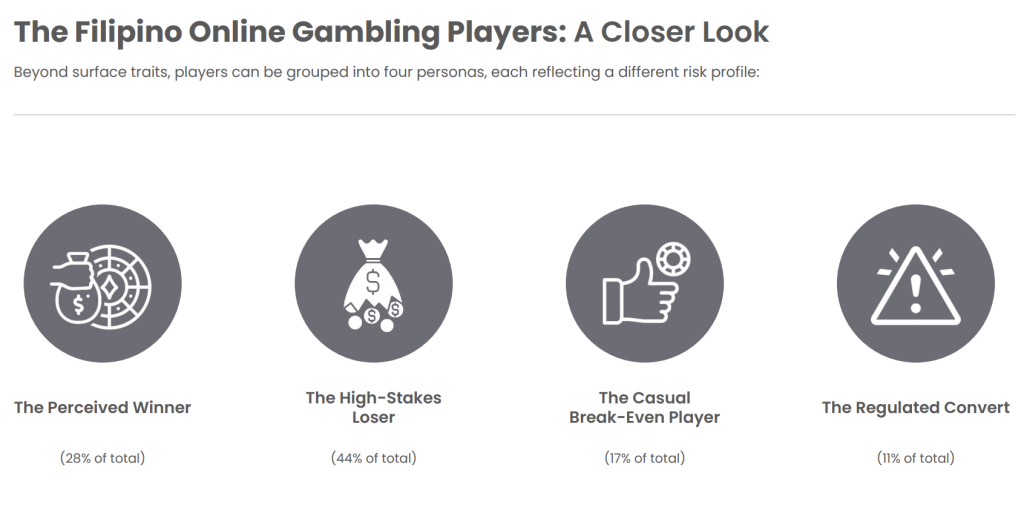
The study categorised players into four personas: “high-stakes losers” (44 percent), “perceived winners” (28 percent), “casual break-even players” (17 percent), and “regulated converts” (11 percent).
Easy access and weak safeguards
The study also revealed that accessibility of unregulated sites was another factor that encouraged participation. More than 90 percent of respondents said they signed up with little to no verification, often only requiring a phone number or email. Eighty percent reported that betting limits were absent, heightening risks for underage and vulnerable users.
Most players had not encountered fairness certifications, with 65 percent saying they had never seen one. Complaints were also often unresolved. Among those who experienced problems, 37 percent said their concerns were acknowledged but never fixed, while 16 percent received no response at all.
Promotions drive engagement
Nearly all respondents recalled exposure to promotions, with 52 percent reporting three or more in a month. These were primarily onboarding incentives such as free credits or welcome bonuses. Long-term incentives like cashback or rebates were less common.
Affiliate programmes were less influential, with only 15 percent of respondents saying they participated.
Campaign strategies for awareness
According to Bae, the way forward lies in reframing how risks are communicated. “Campaigns would be more effective if they focus less on abstract warnings and more on tangible risks and lived consequences. Our data shows that players respond strongly to experiences of loss (41% of former players left due to financial losses) and to the absence of trust signals like complaint resolution.”
“Awareness messages that highlight ‘what happens if things go wrong’ may resonate more than technical explanations of regulation. Moreover, since many players remain neutral or undecided, campaigns could target this group by emphasising the protections and recourse available in regulated platforms, presented in clear, everyday language. Storytelling grounded in familiar scenarios (e.g., scams, blocked withdrawals, or underage access) may also make the risks more relatable,” he concluded.
Step inside the world’s biggest iGaming community. Join HERE for weekly updates from the world’s iGaming authority and unlock subscriber-only offers.


