


Kalshi steps up Democratic outreach ahead of US midterms

Kalshi, a federally regulated prediction market operator, has opened a new office in Washington, D.C. and appointed Democratic strategist John Bivona as its first head of federal government relations. The move points to a deliberate push to engage lawmakers as the US heads towards its midterm elections.
The expansion marks a step-up in Kalshi’s engagement with Democratic lawmakers, who are widely expected to gain ground in Congress if current political trends hold. With control of the House once again in play, lawmakers are likely to revisit how political prediction markets should be regulated.
That places Kalshi in the unusual position of lobbying a party that has appeared to be among the sector’s most vocal critics, but may soon hold greater influence over its future. Kalshi’s own markets currently suggest that Republicans face up to a 77 percent chance of losing their House majority. If the forecast comes true, Kalshi may face fresh challenges in securing political support.
Narrow regulatory window
For the last few years, prediction markets have operated outside the US financial regulations. Platforms offering contracts on political outcomes have repeatedly faced legal challenges over whether they should be treated as financial derivatives or as gambling products governed by state law.
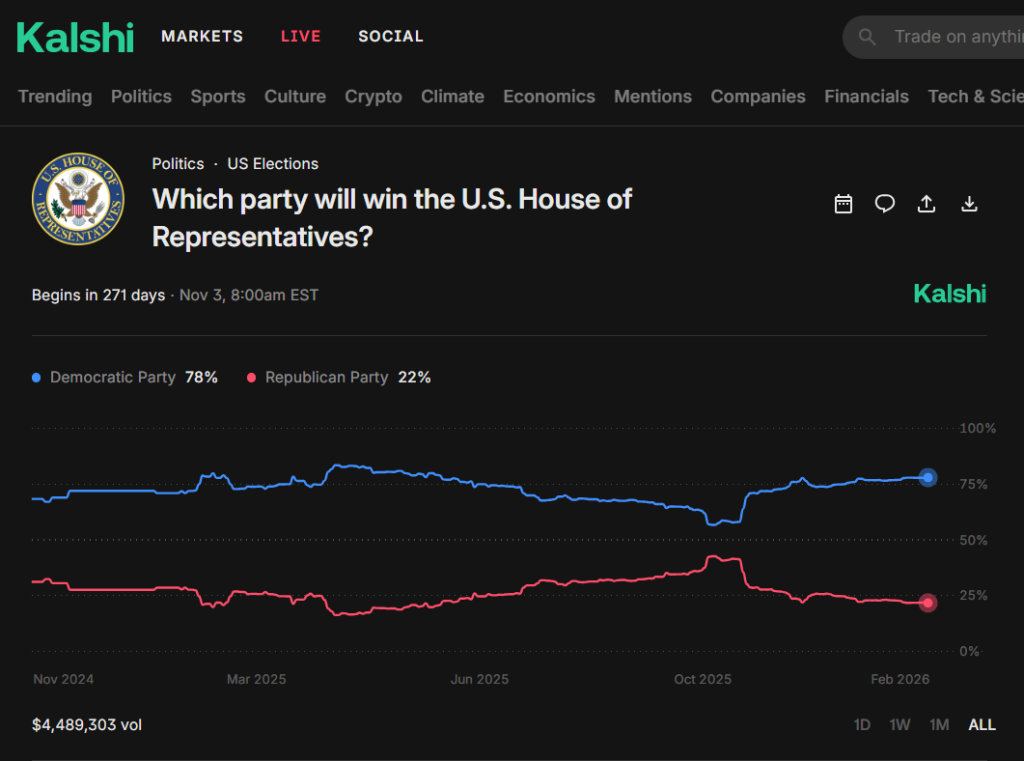
(Source: Kalshi.com)
However, the balance began to shift in 2025, when the Commodity Futures Trading Commission (CFTC) withdrew a proposal that would have banned political and sports-related prediction markets outright. Instead, the regulator signalled plans for a fresh rule-making process aimed at defining how such markets should operate.
For companies like Kalshi, the pivot away from prohibition opened a narrow but critical window to influence how future rules are written, particularly if control of Congress changes hands after the midterms.
Why Democrats matter
Bivona’s appointment reflects that calculation. He brings nearly two decades of experience across Democratic campaigns and the federal government, including a stint in the Biden administration as White House Liaison at the Department of Homeland Security.
He also played a senior role during the 2018 midterm elections as Deputy National Political Director at the Democratic Congressional Campaign Committee, the cycle that saw Democrats regain control of the House.
Kalshi says Bivona was drawn to the firm by its regulatory-first approach, noting that the company spent four years securing CFTC approval before launching. Still, the decision to hire a strategist so closely tied to Democratic politics has drawn attention in Washington, given the party’s scepticism towards election-related betting.
Forecasting power and scrutiny
In recent years, prediction markets have been increasingly framed as tools for real-time political forecasting rather than a form of gambling. That argument picked up momentum during the 2024 presidential race, when Kalshi’s contracts repeatedly pointed to Donald Trump as the likely winner, often putting him ahead of traditional opinion polls.
By October 2024, the platform was pricing Trump’s chances at roughly 55 percent, above those of former Vice President Kamala Harris. Trump later went on to win the election. Supporters say the episode showed how prediction markets can reflect political momentum more quickly than surveys, helping to push Kalshi into wider political debate. Critics, however, argue that it also intensified ethical and democratic concerns around betting on elections.
Democratic resistance remains
Despite Kalshi’s growing profile, opposition from Democratic lawmakers remains strong. In a letter to the CFTC, senators including Jeff Merkley, Sheldon Whitehouse and Elizabeth Warren warned that election-related contracts risk sabotaging democratic integrity.
“There is no doubt that the mass commodification of our democratic process would raise widespread concerns about the integrity of our electoral process,” they wrote, adding that betting on election outcomes is unlawful in many states and decidedly contrary to the public interest.
In the House, resistance has focused more on ethics than outright bans. Representative Ritchie Torres (D-NY) recently introduced the Public Integrity in Financial Prediction Markets Act of 2026, which would prohibit elected officials and senior government staff from trading on political prediction markets.
“Prediction market profiteering by government insiders must be prohibited — period,” Torres said. Senator Merkley has also warned that large-scale election betting could create incentives for “dark-money smearing of candidates” to influence market prices.
Trump Jr. adds fuel to the fire
Kalshi’s political visibility increased further last year when Donald Trump Jr. joined the company as a strategic adviser. He praised the platform’s ability to read political trends and cited Kalshi’s legal battle with the Biden administration as a key reason for his involvement. While Kalshi insists it does not align with any political party, the appointment reinforced how closely prediction markets are now tied to national politics.
Despite federal approval, legal resistance at the state level also continues. Several states argue that prediction markets fall under gambling laws, triggering lawsuits and enforcement actions from regulators and tribal gaming groups. As a result, court rulings have been mixed, leaving the sector in a prolonged grey zone.
As the midterms near, that uncertainty is intensifying. Markets tied to congressional control place lawmakers in the unusual position of regulating products that openly speculate on their own electoral fortunes. With its markets pointing to a potential Republican setback in the House, Kalshi’s push into Washington appears less coincidental and more like a strategic bet on who may soon be influencing the rules.
The fuse is lit in Mexico City. SiGMA North America hits Mexico City, 01–03 Sept 2026. 4,000 delegates. Three days of deals, insight, and startup sparks. The most serious stage of the Spanish-speaking sector. Lead from the front and book your spot.


