


Special Report – British horseracing strike shakes Westminster


British horseracing, which employs 85,000 people and contributes over £4 billion each year, came to a standstill on Wednesday, 10 September 2025, in an unprecedented show of unity. The British horseracing strike has thrust Britain’s second-most attended sport into the heart of Westminster’s fight over a proposed 15 percent to 21 percent betting-duty hike that could raise billions.
Fixtures at Carlisle, Kempton Park, Lingfield Park and Uttoxeter were cancelled. In Parliament Square, jockeys, trainers and media crews, dressed in white #AxeTheRacingTax silks alongside Hollie Doyle, Oisin Murphy, Tom Marquand and others, lined up behind banners, a mobile LED billboard and a statue of a racehorse.
They later joined over 200 industry representatives at the Queen Elizabeth II Centre to urge MPs to oppose Treasury plans to raise the betting duty on horseracing from 15 percent to 21 percent. A recent SiGMA News article, ‘British horseracing strike puts Treasury on notice‘, explains the background of how this strike was planned and its economic and social consequences.
Lord Charles Allen, newly installed chair of the British Horseracing Authority (BHA), said in a statement on the BHA’s website that the proposed tax plan is “nothing short of an existential threat” and urged:
“We need every part of our industry, trainers, jockeys, stable staff, racecourses, and fans, to stand together and make their voices heard.”
The tax threat and the levy lifeline
At the centre of the British horseracing strike dispute is the Treasury’s proposal to harmonise remote gambling duties, folding the current 15 percent General Betting Duty into the 21 percent Remote Gaming Duty paid by online casinos.
Racing leaders warn that such a move would strip bookmakers of the incentive to promote racing, draining the sport’s core income streams. Racing receives much of its funding from the Horserace Betting Levy, which raised £108 million last year from operator profits.
A BHA-commissioned economic study indicates racing could lose £66 million in year one and risk some 2,752 jobs. In comparison, a worst-case rise to 25 percent could drain £330 million over five years. Calls to raise betting duties have been framed by some politicians as a way to tackle child poverty, a view explored by SiGMA News in our analysis of Gordon Brown’s remarks.
Chancellor Rachel Reeves has committed to eliminating the UK’s budget deficit by 2029–30, and is seeking to raise £40–50 billion without touching income tax, VAT, or employee National Insurance. The final verdict on any tax rise will come in her Autumn Budget on 26 November.
Unity under strain and the triple whammy
The strike marked an extraordinary show of unity in a sport often divided between racecourses, trainers, jockeys and administrators.
Brant Dunshea, acting chief executive of the BHA, told the Racing Post that this action completes a “triple whammy” of pressures battering the sport: affordability checks, stalled levy reform, and the proposed tax hike.
“It’s the first time the sport has voluntarily agreed to come together and not race to create the space for us to argue our case directly to the heart of government,” he said.
The BHA warns that this combined squeeze could erode Britain’s global competitiveness and argues that racing forms part of Britain’s national fabric and deserves different treatment from online casino products, which generate guaranteed margins and carry far higher addiction risk.
The black market risk
The industry also warns that overtaxing racing could backfire by pushing punters to unregulated offshore sites, starving the levy of income while exposing players to risk.
Members of the All-Party Parliamentary Group for Racing and Bloodstock have previously cautioned that such a move could drive up to 65 percent of punters towards the black market, as SiGMA News reported in our analysis of the All-Party Parliamentary Group for Racing and Bloodstock’s reaction to government plans to introduce a single Remote Gambling Duty. This is a potential change described as a “racing tax in disguise.”
Campaigners argue that it would hurt not just racing, but the Treasury itself, as levy receipts shrink and consumer protections vanish.
Inside the battle for racing’s future
Jockeys and trainers spoke of pressure and fear. Kieran Shoemark told Reuters:
“We’re already under a lot of pressure. I think if the tax were to come in, it would just make it impossible for our sport to survive.”
Oisin Murphy told BBC News:
“You look at the horses racing and you try to work out a winner. There is a method to it, and it’s also an industry that employs 85,000 people indirectly. If horseracing isn’t treated differently, it is going to be in major trouble.”
John Gosden warned via Sky Sports:
“We’re starting from a very weak position, and this will take the lifeblood out of the game. I have 100 employees, and if this continues, I’ll soon be in the situation of laying off 10, 20, or 30 people.
“That would be tragic. I desperately don’t want to be in that position.
Trainer Andrew Balding echoed:
“There is no question in my mind as to the damage the Treasury’s tax proposals could do to racing, and it’s something I’m incredibly concerned about.
“The viability of businesses such as ours depends on British racing’s success. If the forecasted financial impact were to become reality, the ramifications would be felt in every corner of our industry.
“I sincerely hope that the action we are taking today, coupled with the ongoing lobbying efforts of our sport’s leaders, will lead the Government to reconsider and do all it can to protect what is such a valuable asset for our country.”
Regional operators added warnings. James Sanderson of Catterick Racecourse told Reuters:
“Some small racecourses are borderline viable. If bookmakers pare back racing investment, we will feel a real pinch.”
Public interest and betting industry reactions
Public interest voices also cut through. Tim Cairns of Christian Action Research and Education told the BBC:
“Horseracing isn’t this safe, ‘just have a bit of fun down the race track’. Like all forms of gambling, [it] causes problems.”
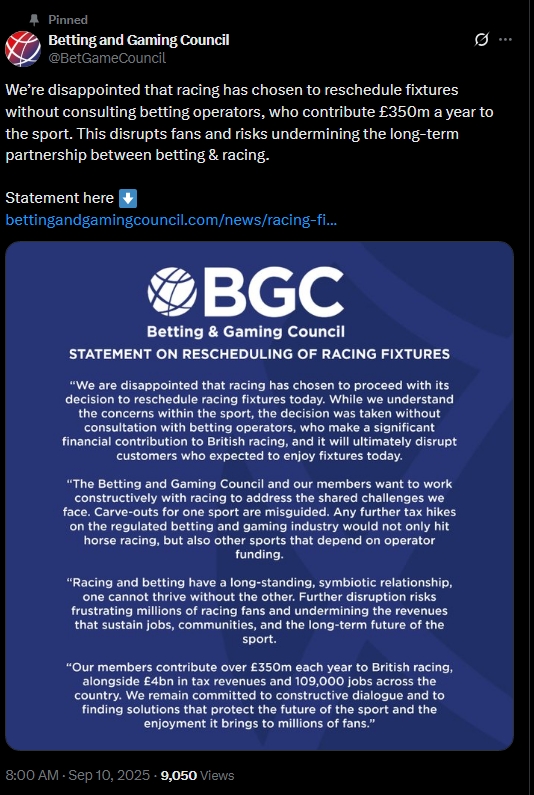
The betting industry is wary, too. Betting and Gaming Council (BGC) said the BGC will keep “taking the case to government” and warned:
“We are disappointed that racing has chosen to proceed with its decision to reschedule racing fixtures today. We remain committed to constructive dialogue and to finding solutions that protect the future of the sport and the enjoyment it brings to millions of fans.”
The BGC reinforced this stance publicly, posting on X that the strike was “disappointing” and risked disrupting fans and revenues.
A political call for differentiation
Alex Ballinger, the Labour MP for Halesowen and a member of the All-Party Parliamentary Group for Gambling Reform, told Sky News that taxing racing like online casinos would be a mistake:
“We’re very interested in reducing some of the harms of addictive forms of gambling, but there’s a clear difference I think between horseracing, a very traditional sport with quite a slow-paced form of gambling and supports a lot of jobs in the community, and online casinos, which are very gamified, very addictive and much more harmful when you look at statistics.
“We think harmonisation is the wrong thing to do and in fact we should be looking at differentiation, where more harmful forms of gambling like online casinos and online slots pay more tax.”
He added that Treasury ministers had been “very sympathetic” in discussions and that it had “not been a difficult argument to make”.
While the BGC criticised the disruption, the government sought to dial down the drama, with Dan Tomlinson, Exchequer Secretary to the HM Treasury, saying in a statement to news outlets:
“The Chancellor has been clear that speculation on tax rises, which is what this is, is not only inaccurate, but also irresponsible. We have not announced an increase in the tax on horserace betting. We know horseracing is part of the cultural fabric of the country, and we are working closely with the industry to understand any potential impacts.”
Public reaction splits opinion
Not everyone is convinced. Comments on Racing TV’s official Facebook page reflected widespread scepticism.
“Pointless on a Wednesday, should be Saturday,” wrote one.
“Let’s see if they’ll strike on a big Saturday and not another Mickey Mouse midweek day,” said another.
Others were harsher: “Horseracing is fixed and corrupt,” claimed one, while another argued, “There’s too much corruption in gambling.”
Some defended the sport: “There are a lot of people who work in racing. It’s the second most popular sport, so why should racing be punished for the badly run Labour government?”
Of course, social media sites attract their own core demographic, so reactions there are no real gauge of public opinion. While varied, these comments likely represent the loudest voices, as social platforms tend to amplify vocal minorities rather than the broader public mood. This strike deserves to be judged not by comment threads, but by its real-world impact on jobs, communities, and the cultural fabric of British sport.
The St Leger spotlight
Following the British horseracing strike, the industry now turns its attention to the Autumn Budget on 26 November, when the government will decide whether to harmonise betting and gaming duties.
The BHA has vowed to continue its #AxeTheRacingTax campaign through party conferences, while industry figures will press for either a lower racing rate or an offsetting levy uplift.
The strike comes just one day before one of racing’s crown jewels, the St Leger Stakes at Doncaster Racecourse. The main race, the Betfred St Leger, is the highlight of this event on Saturday, 13 September. Scandinavia and Lambourn lead the list of the early favourites.
Race week supports hundreds of seasonal and year-round jobs in South Yorkshire, from hospitality to stable staff, and attracts over 60,000 visitors, injecting millions into the local economy. As the world’s oldest Classic, it draws international media, owners, sponsors, and global prestige to the City of Doncaster. Undermining British racing threatens that reputation. The race has run since 1776. This is not just sport, but heritage.
The strike also lands amid wider regulatory tension, with Gambling Minister Baroness Twycross walking a tightrope between industry and public pressure, as we reported in our recent SiGMA News analysis.
British horseracing strike and what comes next
The British horseracing strike lands at a crucial moment. The UK government is under intense fiscal strain after years of austerity, financial mismanagement, and the pandemic debacle. Public services are buckling, and the Treasury is scraping every barrel it can find. Easy targets may be the first to suffer.
The strike showed rare unity. But if it is to change anything, that unity must harden into joint leadership from the British Horseracing Authority (BHA), racecourses, owners, and jockeys. Left to drift, it will splinter. Racing can’t slip back into the old habit of thinking someone else will sort it. Everyone, from breeders to betting shops, may need to take a hit now to keep the sport alive later. One powerful protest draws attention; multiple disjointed protests could alienate public and political support. This coalition needs a single voice and a strategic roadmap.
Analysis: What happens if Westminster gets this wrong
Analysts warn the first cracks could appear at the small country tracks propped up by bookmaker media rights, where losing a fixture can mean losing livelihoods. Leaders fear that if Britain stops being worth the gamble, the sport’s lifeblood, its owners, breeders and jockeys, will quietly follow the money elsewhere.
The BHA has previously warned that reduced betting on racing would cut levy receipts and undermine prize money, creating a vicious cycle where shrinking pots drive lower participation. Some economists argue that punters might turn to offshore sites with no consumer protections, weakening both the sport and Treasury receipts.
Policy specialists suggest that a lower racing-specific duty, paired with a targeted levy uplift, could protect the sport’s funding without alienating operators. They argue that the government should highlight how levy revenue supports veterinary science, jobs in deprived areas, and aftercare for retired horses, while using shared media rights, data projects, and fan engagement campaigns to lock in betting firms’ long-term commitment to the sport.
Transparency could also be key. The Horserace Betting Levy Board’s 2024 Annual Report notes that levy funding supports veterinary research, regional development and equine welfare programmes, and several industry figures have called for more transparent public reporting to counter perceptions of racing as elitist.
Opinion: Holding the line for Britain’s racing soul
If the British horseracing strike were just about money, it would not have stopped the sport in its tracks. This was about pride. About people. About the fragile threads that tie racing to Britain’s identity, and what happens when those threads are pulled too tight.
The temptation for the Treasury will be to reach for the quick fix. A clean, uniform rate, tidily filed under “revenue raising”. But racing is not a slot machine on a screen. It is an ecosystem, from Ripon to Newmarket, from Doncaster to the smallest local yard. It relies on people, place and tradition as much as on profit. Break that chain, and you will not get it back. That is what this strike was saying. And for once, almost everyone said it together.
Now they must stay together. Unity can’t stop at slogans and silks. It has to harden into a joint strategy, between the British Horseracing Authority, racecourses, trainers, bookmakers, and government, to keep Britain’s second-largest spectator sport alive without hollowing it out. If they fail, the next blank day on the racing calendar won’t be voluntary.
The strike made Westminster look. What happens next decides whether it listens.


