


A new study by the American Gaming Association (AGA) suggests that sweepstakes casinos, often marketed as legal alternatives to online gambling, are perceived by most of their users as no different from traditional real-money casinos. “Sweepstakes casinos exploit legal loopholes to operate outside regulatory oversight without consumer protections, responsible gaming standards, or accountability,” declared the AGA.
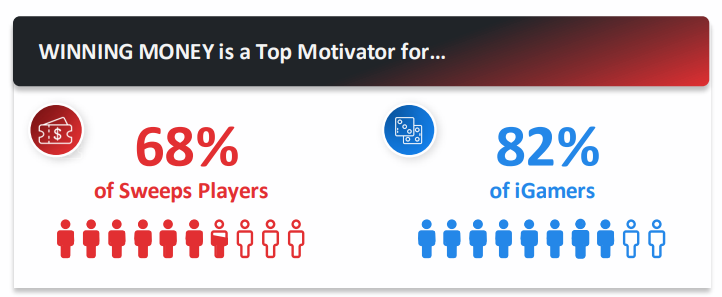
The AGA’s survey, conducted in June 2025 among 2,250 adults across the US, found that financial incentives drive the majority of sweepstakes players. When asked why they started playing, 65% said it was to “win real money or rewards,” nearly identical to the 67% of iGaming players who responded the same way. In contrast, 73% of players who use free-to-play (F2P) social casino apps cite “fun” as their main reason for playing.
Notably, 80% of sweepstakes players said they spend money on these platforms at least monthly, compared to just 50% of F2P players.
AGA calls for change
The AGA concludes from this survey that the line between iGaming and sweepstakes casinos is extremely thin, with sweepstakes operators deliberately maintaining this confusion in order to operate without being subject to the same levels of regulation. The AGA also highlights what it describes as “aggressive and unregulated advertising” by sweepstakes operators, noting that “sweepstakes casino ads account for half of all online real-money casino advertisements viewed in the US in early 2025. These ads are concentrated in populous states and those lacking clear legal guidance or enforcement against sweepstakes gambling.”
As a result of what it considers not only unfair competition for regulated iGaming operators but also a risk to players, the AGA is calling for:
- “Clear legal definitions to distinguish sweepstakes casinos from regulated gaming.
- Stronger enforcement to hold illegal and unregulated operators accountable.
- Continued efforts to inform consumers about the risks of unregulated gambling platforms.”
The AGA is not the only advocate for tighter regulation of the now multi-billion-dollar industry. BetMGM’s Chief Executive, Adam Greenblatt, recently spoke out on the issue, stating: “We believe sweeps should be considered illegal iGaming, and it’s bad for the regulated sector. It’s bad for state revenues. It’s bad for players.”
Perception as gambling
The AGA’s research reveals that sweepstakes casinos are seen overwhelmingly as gambling platforms by their users, despite legal framing that positions them otherwise.
When presented with the statement “websites or apps where you wager real money accurately describes sweepstake casinos,” 67% of iGaming players and 62% of sweepstakes players agreed.

The sentiment was even clearer when participants were asked directly if playing casino-style games on sweepstakes platforms qualifies as gambling. A majority (59%) said it was “definitely gambling,” while 31% said it was “probably gambling.” Only 10% disagreed with the classification.
Moreover, 67% of sweepstakes spenders said they were primarily interested in purchasing “Sweeps Coins” rather than free “Gold Coins,” emphasising the appeal of tokens with redeemable cash value. Of these spenders, 76% said Sweeps Coins were either “very” or “extremely important” in deciding whether to buy a package.
According to the AGA, the confusion is deliberately maintained by sweepstakes operators: “Despite operating outside the regulated marketplace, sweepstakes casinos present themselves in ways that mirror legal gaming operators. These platforms often replicate the branding, language, and functionality of licensed online casinos, contributing to widespread consumer confusion.”
Regulation drives behaviour
The legal ambiguity surrounding sweepstakes casinos may be under increased scrutiny as the AGA report shows consumer behaviour changes in response to regulatory pressure.
In states such as Connecticut, Idaho, Michigan, Washington, Nevada, New York, and Montana, where fewer than half of sweepstakes operators are allowed to operate, player numbers are significantly lower. The AGA found a 53% drop in usage among residents of these restricted states.
This suggests that limiting market access could be an effective way to curb usage in jurisdictions where sweepstakes casinos are viewed as skirting traditional gambling laws.
No difference in player profiles
The AGA also concluded that sweepstakes players and iGaming players are demographically indistinguishable. Both groups are evenly split between men and women (51% male vs. 49% female for sweepstakes players; 54% male vs. 46% female for iGaming players), and the majority fall between the ages of 21 and 50.
In terms of income and education, similarities persisted. For instance, 38% of sweepstakes players and 39% of iGaming players reported annual incomes below $50,000.
The findings may pose challenges for regulators and legislators seeking to draw distinctions between iGaming and sweepstakes platforms in policy or enforcement.
With regulators watching closely, and player behaviour leaving little ambiguity, the line between sweepstakes platforms and conventional online gambling continues to blur.


