


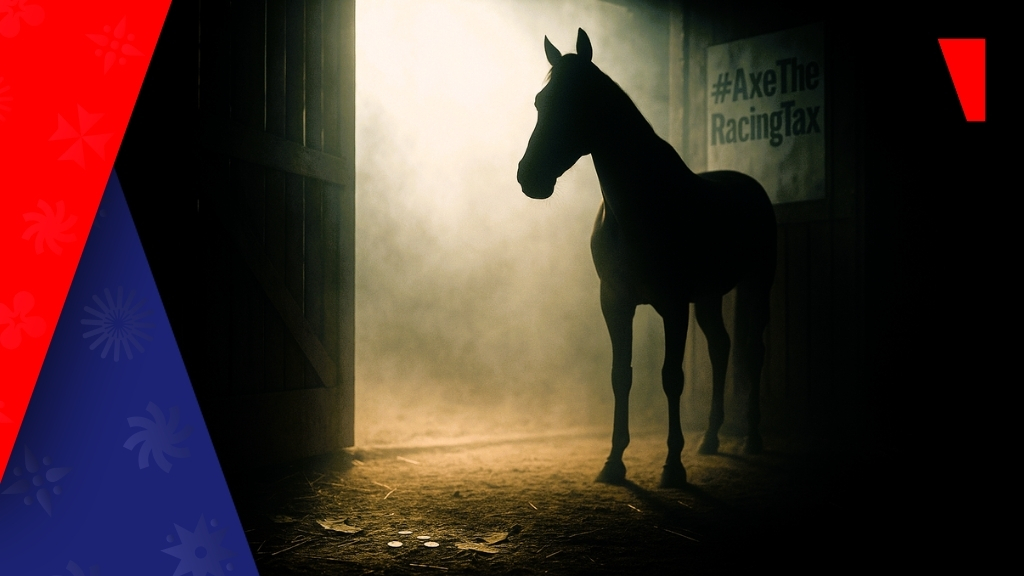
British horseracing is betting everything on the November 26 Budget. The Treasury plans to raise betting duty on racing from 15 to 21 percent. This would bring it in line with the rate already paid by online casinos. The plan forms part of the Government’s April 2025 review of remote gambling taxes. It has unsettled an industry already dealing with affordability checks, a growing black market, and the launch of the #AxeTheRacingTax campaign. Chancellor Rachel Reeves faces a fiscal shortfall of between £20 billion and £40 billion.
The government asked every department to close the gap. In the middle of it all, the British Horseracing Authority (BHA) has launched its most political campaign in decades. Under the banner of #AxeTheRacingTax, it warns that a one-size-fits-all rise could cripple rural economies. The BHA forecasts a loss of 2,752 jobs in the first year if the plan goes ahead.
Racing’s ‘Cancelled Day’ on September 10 was more than symbolic. It was a calculated show of force. The industry paused an entire sport, then used the silence to make itself heard. Within hours, MPs were fielding calls from local trainers and course owners. Lobby groups clipped headlines for Treasury inboxes. What began as a protest became political currency. The BHA proved a simple truth. In Britain, where governments crave easy wins, the threat of spoiling a good day at the races still gets Westminster’s attention.
Inside the Treasury plan that set racing alight
The Treasury sees the proposed rise in betting duty as simple arithmetic. It would put racing on the same rate as online casinos. Officials call it harmonisation, meaning one tax for all forms of remote gambling. But to the British Horseracing Authority, the proposal driving the #AxeTheRacingTax campaign feels like a grenade rolled into a fragile ecosystem.
The sport is already dealing with a triple threat of affordability checks, unresolved betting levy reform and now higher taxes. The BHA-commissioned forecast warns the change could cost the industry £330 million over five years. It also predicts 2,752 job losses in the first year.
Those losses would fall hardest in rural areas. Trainers, stable staff, feed suppliers and vets all rely on racing for work. Ministers see neat symmetry, but the industry sees damage instead. The Treasury first planned an October 2027 start, yet work on the policy has already sped up.
The real Budget test lies between the spreadsheets and the stables. How far can a government press before the sport that built betting starts to bleed jobs, hope and heritage? A recent SiGMA News analysis asked if this was racing tax or rural ruin? Either way, it is the government’s moment of truth.
How the #AxeTheRacingTax campaign changed the debate
Racing has built its campaign around what it calls a “triple threat.” Tighter affordability checks, an unresolved betting levy, and the risk of higher taxes. Together, they leave the industry fighting on three fronts at once.
The #AxeTheRacingTax movement has also changed the political tone. It now has allies across the aisle. Support for racing now spans the political divide. It includes 101 Labour MPs, former Prime Minister Gordon Brown, and senior figures from the Conservatives, Liberal Democrats and Reform UK.
The Liberal Democrats have adopted a policy to raise taxes on online gaming products. They oppose increases in sports betting, arguing that racing supports jobs in rural areas. Conservative Shadow Gambling Minister Louie French backed the campaign in his party conference speech. He repeated the hashtag on the main stage. Even Nigel Farage voiced support at Goodwood earlier this year.
The growing push for harm-based taxation
Gordon Brown and the Institute for Public Policy Research (IPPR) support higher gambling taxes. They argue the extra revenue should fund work to reduce child poverty. They also say racing needs different treatment because it supports jobs and culture.
Other think tanks have taken their own stance. The Social Market Foundation (SMF) calls for a harm-based split – a 5 percent duty for racing bets and a 50 percent duty for online slots. At that same SMF fringe, Gambling Minister Baroness Twycross warned that the issue was “complex” and said the Treasury would need to find a “safe level” of taxation to avoid driving growth in the black market – an unusually candid admission that echoed racing’s own fears.
The IPPR frames reform as a way to fund social programmes. Demos stresses the need for stable rural jobs. Together, they show a rare policy consensus: one flat rate cannot work for every gambling product.
Through the party-conference season and months of media work, the BHA has made that argument clear. The campaign turned a niche tax row into a mainstream political debate. The Treasury can no longer ignore this pressure.
How racing turned protest into political pressure
After racing’s ‘Cancelled Day‘ the campaign moved from protest to precision lobbying. The British Horseracing Authority began meeting MPs and senior officials. It used the All-Party Parliamentary Group for Racing and Bloodstock (APPG) to build support. At the same time, the BHA sent targeted briefings to the Treasury and the Department for Culture, Media and Sport (DCMS).
The BHA also launched a quiet media push. Articles appeared in the Financial Times, The Times and on Reuters. Each reached the Westminster audience the BHA wanted most. At the same time, a digital campaign placed adverts and posts across the online platforms most visited by MPs and advisers.
Under the #AxeTheRacingTax banner, fringe events at all four major party conferences kept racing in front of decision-makers. Panels, receptions and private dinners put executives and trainers face to face with MPs. They spoke about how higher taxes would hit local jobs. The message was simple. Balancing the books in London could unbalance livelihoods in the countryside.
The strategy gained pace. By early autumn, the campaign forced ministers to engage more seriously with sector-specific concerns. It had shifted from noise to influence. Emotion became access. Access became pressure.
The industry split over who should pay more
Tax harmonisation was meant to simplify the system. Instead, it has exposed divisions within the gambling industry.
Racing interests, led by the BHA and Arena Racing Company, want a carve-out that protects horserace betting duty at 15 percent. They argue that the sport’s link to betting makes it different from high-risk casino products. Supporters of the #AxeTheRacingTax campaign say treating racing the same as online casinos ignores both its rural economy and its cultural role.
Martin Cruddace, Chief Executive of Arena Racing Company, has argued that racing’s close partnership with betting means it cannot be treated like casino gaming. The BHA has framed the #AxeTheRacingTax issue as political, economic and cultural. This is a triple risk, it says, the Treasury must weigh carefully.
But other industry leaders disagree. Betting and Gaming Council Chief Executive Grainne Hurst said that “carve-outs for one sport are misguided.” She added that “any further tax hikes on the regulated betting and gaming industry would not only hit horseracing but also other sports that depend on operator funding.”
Large operators share that concern. Flutter Entertainment CEO Peter Jackson said that “setting too high a tax rate reduces competition, weakens the consumer offering and can lead to a reduction in tax revenue.” Entain CFO Rob Wood warned that “it backfires if you put taxes up too high,” pointing to the Netherlands as a cautionary example where “over half of the market goes black.”
The split is now clear. Racing sees protection as survival. Operators see it as impossible in a single connected business model.
What the November Budget means for gambling’s future
Chancellor Rachel Reeves faces an economic reckoning on November 26. At a regional investment summit in Birmingham last week, she acknowledged that Brexit and years of Conservative austerity have damaged the British economy far more than initially estimated.
The Office for Budget Responsibility (OBR) has calculated that Brexit alone will reduce long-term productivity by 4 per cent compared with remaining in the EU. Public borrowing remains at record levels, the highest outside the pandemic, and growth forecasts are slowing. Reeves is bracing for an OBR downgrade that could expose a fiscal gap of up to £30 billion.
Reeves has warned that “the choices to come are made all the harder by harsh global headwinds and the long-term damage done to our economy, which is becoming ever clearer.”
Tax rises are now a near certainty, though she has publicly committed to protecting working people from increases to National Insurance, income tax and VAT.
Inside the Treasury’s dilemma on gambling taxes
Against this backdrop of constrained finances and difficult choices, the gambling tax question sits alongside inheritance tax, capital gains tax, and property reform, all vying for revenue in a Budget where every sector is lobbying for its own exemption. For racing, the timing could hardly be worse.
Raise duty across the board and risk pushing players toward the black market. Spare racing and open the door for other sectors to demand their own carve-outs. Either way, the Budget will define how much control the Treasury is willing to trade for revenue.
For the industry, it is a warning shot. Tax policy is now a test of influence as much as balance sheets. Racing’s #AxeTheRacingTax campaign has shown how clear, targeted lobbying can shift political debate. Whether it can change Treasury policy will be decided on November 26. The next few weeks will show whether that influence can hold when the Treasury starts counting.
If the sport wins its carve-out, it will set a precedent for harm-based taxation that could reshape how every gambling vertical argues its case. If it loses, the message will be equally clear: that even a united, well-funded lobby can struggle to move fiscal policy when a government is under Treasury pressure.
Colombo’s ready for South Asia’s premier iGaming summit. Join 5,000+ delegates at SiGMA South Asia, 30 Nov – 02 Dec 2025. Network, scale, and grow in one of the world’s fastest-rising markets, where new markets meet new horizons.


