


Kalshi hits new record as NFL overtakes politics for the first time


Kalshi, the federally regulated prediction exchange, has seen its sports markets soar to record levels, with Saturday night’s football action pushing daily trading volume beyond that of a US election day.
The company’s co-founder and CEO, Tarek Mansour, said on Sunday that the platform had “officially surpassed Election Day” after clocking $260m in trading volume and 763,000 trades during the evening of 27 September. “Nothing beats football in America,” he wrote in a post on LinkedIn.
Kalshi’s contracts are open to users in all 50 states, a factor that sets it apart from traditional sportsbooks, which remain restricted by state-by-state licensing. Mansour argues this is an advantage for consumers in places where sports betting remains illegal: “Legal in all 50 states, so sports fans in places like Texas and California no longer have to resort to predatory, illegal offshore operators who don’t treat their customers properly.” The argument, however, has not gone unchallenged.
Football eclipses politics
Election night, once the benchmark for engagement on the platform, has now been overtaken by sports trading. The record was set during the NFL’s packed weekend schedule, which included marquee college football matchups and a wave of wagers tied to professional games.
Two weeks earlier, Mansour had already hinted at football’s potential to rival politics. In a LinkedIn post, he noted: “Kalshi has done $441m of volume since NFL kickoff. That’s $441m in volume in 4 days. NFL week 1 is basically equal to a US election. We keep marching.”
Growing liquidity and wider access
The company has spent the past year expanding its product range by filing with the Commodity Futures Trading Commission (CFTC) to self-certify parlay-style event contracts specifically designed for the football season. These contracts allow users to combine multiple outcomes, making them more similar to traditional sportsbook wagers while still adhering to the regulations governing event contracts.
Kalshi says the aim is to provide a transparent and federally supervised alternative to the sprawling, and often illegal, sports betting market in the United States. That positioning has resonated with traders and bettors, who have flocked to the platform in record numbers.
Four weeks ago, Mansour described the scale of activity during college football’s opening week. “Sports traders, especially professionals, are trading with significant size on Kalshi, amassing six-figure positions made possible by our liquidity,” he wrote. He added that the company now boasts “the deepest liquidity of any exchange in America, with millions of dollars on the order book now commonplace.”
Competition and challenges
Yet Kalshi’s rise is colliding with mounting public and regulatory unease. A survey by the American Gaming Association (AGA) shows that 85 percent of Americans view prediction markets not as financial instruments but as gambling products. The same research found 84 percent believe sports contracts should only be offered by state-licensed sportsbooks, not federally regulated exchanges.
“Americans are clear: sports event contracts should be treated like other forms of sports betting and fall under state and tribal regulatory authority, not federal commodities regulators,” AGA president Bill Miller said in the report.
The findings come as lawmakers and regulators wrestle with jurisdiction. The Commodity Futures Trading Commission (CFTC) and the Securities and Exchange Commission (SEC) are scheduled to hold a joint roundtable today, 29 September, to discuss event contracts and identify potential oversight gaps. Sports leagues, including Major League Baseball, have urged regulators to strengthen rules due to concerns about risks to integrity and public trust.
Kalshi’s rapid expansion has also been facing resistance from tribal gaming operators and state-level regulators. Lawsuits filed in Wisconsin and California argue that the company’s event contracts amount to sports betting, and therefore infringe on tribal gaming rights.
Billions traded and millions of users
Despite these challenges, Kalshi has pressed ahead with its strategy, pointing to surging user numbers and unprecedented liquidity as proof of demand. Kalshi has processed around $9bn in trades since launching in 2019, according to Dune Analytics, and now counts about three million users.
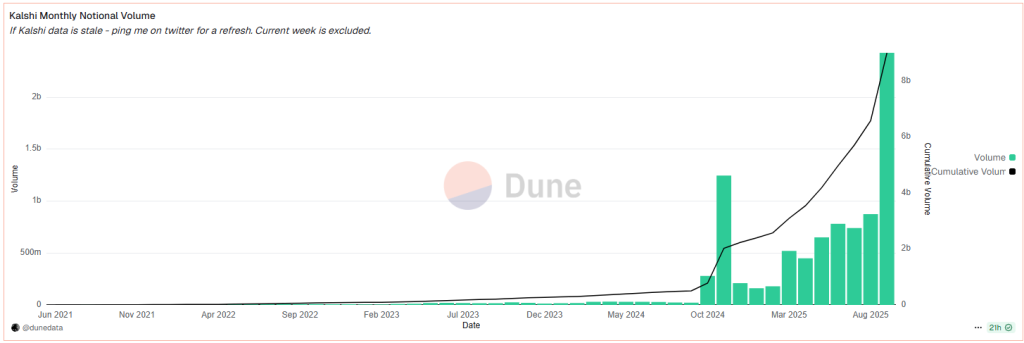
For Mansour, this is only the beginning. Earlier this month, he stated: “For the first time ever, sports fans all over the country have a level playing field, and we are still in the top of the first inning. This weekend alone, we did well over $100M. Now, we’ll work to 10x that number.”
Whether that ambition survives mounting legal challenges and a push for tighter regulation, however, is a question that will hang over Kalshi’s rapid ascent.
Subscribe HERE to SiGMA’s Top 10 News countdown and SiGMA’s weekly newsletter to stay up to date with all the latest iGaming News from the biggest iGaming community in the world and benefit from subscriber-only offers.


