



The Dutch regulator Kansspelautoriteit (KSA), responsible for licensing, supervision and enforcement in the country’s gambling market, has issued new guidance that effectively reinforces the ban on non-targeted advertising for online gambling.
KSA previously issued two official warnings to Optdeck, which operates under the Unibet brand. The violations concerned mass advertising and the unlawful provision of an autoplay feature. The new document shows that the case was not an outlier: the regulator is turning its earlier enforcement line into a stricter, more detailed framework.
What KSA now requires
The new guidance published by KSA confirms a ban on non-targeted advertising for online gambling. In practice, advertising cannot be mass-market and must not create a risk of reaching vulnerable groups.
KSA defines “vulnerable groups” not only as minors, but also:
- young adults under 24;
- people showing signs of risky gambling behaviour;
- users who have self-excluded with the operator in question.
Digital advertising is exempt from the general ban, but only if several conditions are met simultaneously:
- users must be given an option to opt out of advertising;
- the operator must apply the best available measures to exclude vulnerable groups;
- campaign reach must be verified retrospectively using the most accurate data available.
If any of these conditions is not met, KSA will consider the ban to have been breached and may impose fines and other sanctions.
The “95%” rule
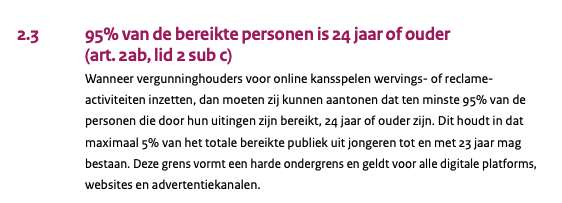
The key number in the new guidance is 95%. An operator must be able to demonstrate that at least 95% of the audience that saw an advert consisted of people older than 24. Accordingly, the share of the audience aged 23 or under must not exceed 5%. KSA stresses that this is a minimum threshold, not a target. Advertising is expected to be directed exclusively at adults aged 24+, meaning the operator’s task is not merely to remain within the permitted percentage, but to minimise contact with vulnerable groups as far as possible.
How operators must determine advertising audiences
In practice, KSA expects significantly more than setting an age filter in an ad account. It is no longer enough to claim that settings were configured correctly – the operator must support this with measurable data. The guidance sets out concrete expectations, including:
- understanding exactly where age data comes from;
- using multiple verification sources;
- maintaining an internal register for each campaign;
- documenting audience settings;
- retaining measurement results and recording deviations;
- checking whether each platform can genuinely exclude younger audiences.
If a platform or contractor does not allow the operator to prove compliance, advertising there becomes a direct risk for the licensee. In effect, the burden of proof shifts to the operator. It is not enough to say the campaign was set up correctly — the operator must provide a full campaign overview, its actual reach, and the measures that demonstrably worked. For the market, this sets a new standard: not merely compliance on paper, but compliance that can be audited after the fact.
What the regulator has already introduced
The new guidance did not come as a surprise. The Netherlands’ ban on non-targeted online gambling advertising has been in force since 1 July 2023. The country then tightened other promotional channels step by step: a ban on sponsorship of events and programmes took effect on 1 July 2024, followed by a ban on sports sponsorship on 1 July 2025. As a result, digital advertising has remained one of the few permissible acquisition channels — and that is precisely why the requirements around it have become especially strict.
KSA has also shown close attention to breaches. In December 2025, the regulator fined JOI Gaming €400,000 for advertising at a family event. The March guidance continues the same enforcement direction: the focus shifts from concerns about individual creatives to demanding an end-to-end system for controlling and proving advertising reach.
What it means for the industry
For operators and their marketing partners, KSA’s new guidance signals that the era of formal, checkbox compliance is ending. The entire chain is now in scope: platform choice, settings, data provenance, measurement methods, reporting, and the ability to intervene when reach looks questionable. Even the ability to keep advertising now depends on whether an operator can prove it meets the rules.
From a practical standpoint, the Netherlands is setting an important benchmark. KSA is not introducing a brand-new blanket ban, but it is sharply raising the evidentiary standard for the online advertising that remains permitted. For the European market, this is a telling case: the regulator is demanding data rather than assurances, and verifiable results for each campaign rather than broad brand-level policies.
This article was first published in Russian on 23 March 2026.
Stay in the loop and join the biggest iGaming Community in the world with SiGMA’s Top 10 news countdown. Subscribe HERE for weekly updates from the world’s iGaming authority and exclusive subscriber-only offers.


