


The United States has established itself as by far the largest online gambling market globally, reaching an estimated valuation of $79.8 billion in 2025, according to the latest Blask report entitled US and Canada iGaming 2025: The offshore reality.
The report describes the American industry as 7 times the size of the UK, which currently ranks as the second-largest market in the world. With 362 brands fighting for share, the report says the region offers opportunities alongside “intense fragmentation.”
The report also underscores the sheer weight of regional markets, noting that seven individual U.S. states would rank among the global top 10 if they were independent nations. This extreme concentration of volume and competition makes the U.S. the most “strategically important region” for every operator and supplier in the global industry, the report says.
Offshore brands dominance
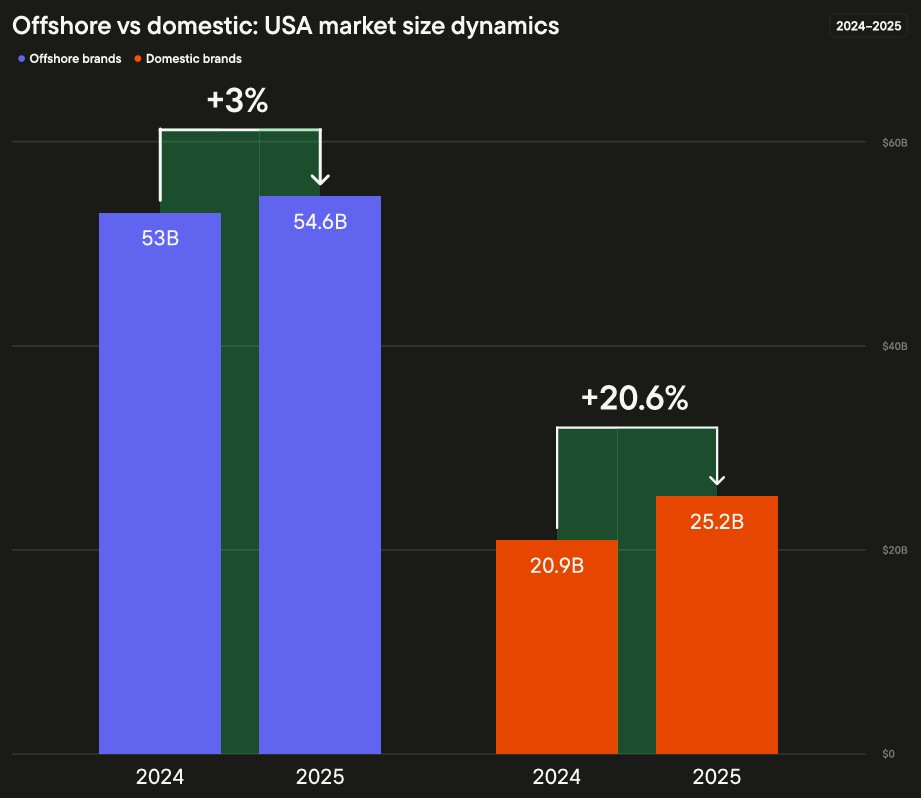
Blask’s report highlights a stark reality of the current landscape, which is that offshore still dominates the American market. Despite the momentum of local legalisation, the report says unlicensed operators control roughly two-thirds of total U.S. market volume by Competitive Earning Baseline (CEB).
The data reveals that 80 percent of all brands serving U.S. players are offshore, illustrating the scale of the unregulated sector. The brand Bovada leads the entire market, capturing a quarter more CEB than its nearest regulated competitor, FanDuel.
According to Blask’s data, Bovada’s estimated earnings alone “exceed the total market size of any country outside the U.S., UK, and Canada.” While domestic leaders FanDuel and DraftKings post double-digit year-over-year (YoY) growth, the report points out that they have yet to “shift the overall balance” of power away from the black market.

Full regulation proves effective over the long term
The report highlights that full-spectrum regulation works but takes time to yield results. In states offering both online casino and sports betting, the report says these have “tipped the balance toward licensed operators,” who now average 62 percent of the market share.
Data shows that Michigan leads at 75 percent domestic share, serving as the “clearest example of successful channelisation at scale”. New Jersey also proves that the “long game pays off,” with domestic brands capturing 73 percent of the state’s market twelve years after the first legal casino launch. The report says that these mature markets demonstrate that regulation can structurally reshape offshore dominance, provided that domestic operators are permitted to offer a complete product suite.
Betting-only states face structural market caps
In jurisdictions with online betting but no licensed casino, offshore platforms continue to fill the void. The report says that these betting-only markets average 74 percent offshore, as players seeking slots and table games are pushed offshore by default.
Of the 24 states with only legal sports betting, only Maryland and Arizona have achieved domestic CEB above 40 percent, according to the data. Without a regulated casino alternative, the report says many of these states remain structurally capped in how much demand they can channelise into legal avenues. In New York, which is the largest U.S. market by CEB, roughly 60 percent of that volume flows to offshore operators specifically because online casino remains unavailable through licensed channels.
California and Texas remain the biggest untapped prizes
California and Texas represent “arguably the biggest untapped opportunity in the global iGaming landscape”. Together, Blask says these two states represent nearly $10 billion in CEB, entirely offshore.
In California, the path to regulation is complicated by a market dominated by tribal gaming and a lack of consensus on the mobile question. In Texas, the legislature does not meet in even-numbered years, and the state has historically shown little political appetite for online gambling legalisation. The Blask report says that until these markets move toward regulation, billions in potential tax revenue and consumer protections remain uncaptured by domestic authorities.
Prediction markets emerge as the breakout vertical
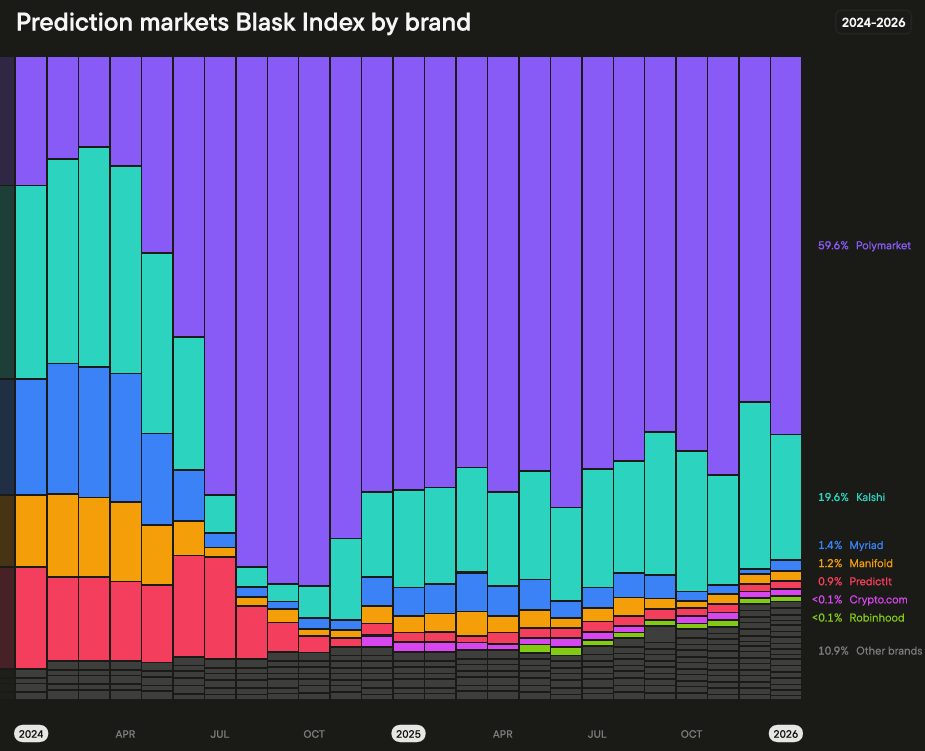
Prediction markets have established themselves as a breakout vertical, experiencing a massive Blask Index growth of 256 percent during 2025. While interest originally peaked during the 2024 presidential election, the report says that the entry of Kalshi into sports markets has “catalysed a new wave of growth.”
The space is now “rapidly consolidating around Polymarket and Kalshi,” as these platforms become a “real-time signal of collective belief”. Simultaneously, online poker remains a “concentrated, stable duopoly”. The report says that Americas Cardroom and PokerStars together account for ~50 percent of total demand, with the competitive structure remaining “broadly stable” throughout the year.
The fuse is lit in Mexico City. SiGMA North America hits Mexico City, 01–03 Sept 2026. 4,000 delegates. Three days of deals, insight, and startup sparks. The most serious stage of the Spanish-speaking sector. Lead from the front and book your spot.


