


Survey: Most Americans see prediction markets as gambling


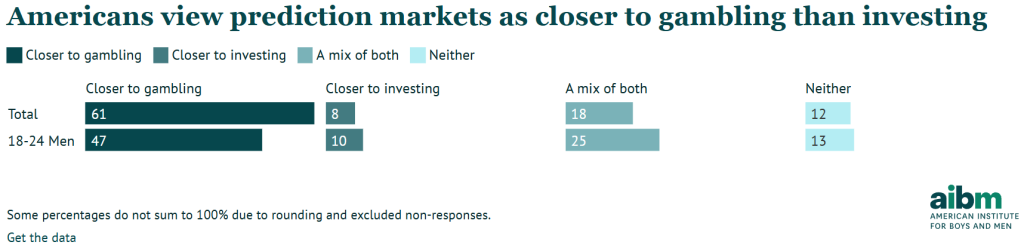
Six out of ten Americans believe that prediction markets resemble gambling rather than investing, according to a new poll conducted by the American Institute for Boys and Men (AIBM) in partnership with Ipsos, a market research firm.
The research found that 61 percent of Americans view purchasing event contracts on prediction markets as closer to gambling than investing, highlighting a clear public perception gap between how these platforms are structured and how they are understood.
Prediction markets allow users to trade contracts based on real-world outcomes, from election results to sports events. While they are regulated as financial instruments at the federal level, public opinion suggests they are seen through a different lens.
The study noted that “most Americans (91 percent) and young men (88 percent) view purchasing event contracts on prediction markets as financially risky, on par with investing in cryptocurrency and placing a sports bet.”
Familiarity remains low despite rapid growth
Despite growing market activity, public familiarity with prediction markets remains limited. The report states that only 21 percent of Americans say they are very or somewhat familiar with prediction markets, compared with 35 percent for online sports betting.
Among men aged 18 to 24, awareness is slightly higher, though still under one-third at 29 percent. Usage data reflects a similar pattern. “Most Americans are not actively betting on sports or using a prediction market, but usage is highly concentrated among younger men,” the report found.
In the past six months, the survey found that 26 percent of young men report using at least one sports betting, daily fantasy sports, prediction market, or other gambling platform, compared to 14 percent of the general public.
Among prediction market users specifically, motivations are split. “Half of prediction market users said their top reason for using the platform was entertainment, while 41 percent said they primarily used prediction markets to make money,” the report said.
Public calls for oversight rather than prohibition
The poll indicates that Americans favour regulating prediction markets within existing systems rather than creating new frameworks. According to the data, respondents show a clear preference for placing them into an existing regulatory bucket rather than inventing a new one.
Majority of the survey respondents support regulation aligned with gambling (59 percent) or financial investing (52 percent), while only 37 percent favour entirely new rules. Meanwhile, just 6 percent support no regulation at all.
Concerns about fairness and market integrity also emerged. The report found that “just 9 percent of respondents and 27 percent of prediction market users say they are confident that prediction markets could prevent individuals with non-public information from unfairly profiting on the platforms.”
The study adds that “the public is not seeking prohibition of prediction markets, but the vast majority want some type of oversight,” although uncertainty remains high, with many respondents unsure which regulatory path is most appropriate.
Few Americans see social value in prediction markets
Public attitudes towards the societal impact of prediction markets are overwhelmingly negative or uncertain. The report found that “just 4 percent of Americans and 7 percent of young men believe prediction markets are good for society.”
By comparison, only 3 percent said the same about online sports betting. A larger share described these activities as harmful, while many remained undecided.
The AIBM poll findings point to broader unease about gambling-related products. The report highlights that Americans see prediction markets as risky, closer to gambling than investing, and bad for society.
It also raises questions about the drivers behind these views, including “addiction and financial loss, sports integrity, frustration with advertising, or something else.”
Expert says markets differ from traditional betting
An industry expert argues that public perception does not fully reflect how prediction markets function. In an exclusive interview with SiGMA News in January, Alice Li, Investment Partner at Foresight Ventures, stressed that the distinction between prediction markets and betting is fundamental.
“Sports betting is primarily entertainment-driven. Prediction markets are information-driven, designed to aggregate collective intelligence and price real-world uncertainty,” Li said. “Regulators should focus less on absolute volume and more on market quality indicators.”
Lawmakers face early-stage policy decisions
The report concludes that prediction markets remain a relatively new concept for most Americans, with opinion still forming.
“The narrative around prediction markets is still largely unwritten,” the study states, adding that policymakers and industry stakeholders have an opportunity to shape how these platforms evolve.
It warns against repeating past mistakes seen in online sports betting, noting that “online sports betting expanded faster than any meaningful consumer protection framework.”
Subscribe HERE to SiGMA’s Top 10 News countdown and SiGMA’s weekly newsletter to stay up to date with all the latest iGaming News from the world’s iGaming authority, and benefit from subscriber-only offers.


