


BOS challenges Svenska Spel, ATG on Sweden bonus ban

A growing divide has opened within Sweden’s gambling industry, as ATG and state-owned operator Svenska Spel push for tighter restrictions, while the trade association BOS warns the proposals would damage consumer protection and accelerate the shift to unlicensed gambling. The debate spans bonus bans, risk-classification rules, and advertising curbs, with both sides accusing the other of jeopardising the regulated market.
Talking to SiGMA News, BOS secretary general Gustaf Hoffstedt voiced deeper concerns about Svenska Spel’s lobbying, particularly around risk-classification and advertising rules. He argued that Svenska Spel’s proposal would allow the state-owned company to benefit commercially from restrictions placed on private-sector competitors.
Bonus bans ignite industry backlash
A new point of debate has emerged in Sweden’s gambling sector after ATG and Svenska Spel called for a total ban on bonuses across the licensed market. In an op-ed published this November, their CEOs argued that removing all bonus offers would strengthen consumer protection.
In a counter-article, BOS warned that such a ban “would unilaterally benefit Svenska Spel and ATG commercially, at the cost of poorer consumer protection in Sweden.”
BOS secretary general Gustaf Hoffstedt stressed that players are already leaving the regulated market in large numbers for unlicensed platforms offering far more aggressive incentives. “The elephant in the room for consumer protection is that consumers are to such a large extent absent from the legally licensed part of the gambling market. Instead, they have chosen the unregulated, unlicensed market to an alarming extent, partly because of the very generous bonus systems offered there,” he said. “We should not have that kind of excesses with sky-high bonuses in the licensed market, but to completely ban any form of moderate bonus offer is to give up the fight of defending the licensed gambling market and its consumer protection.”
In his published op-ed, Hoffstedt argued that Svenska Spel and ATG’s approach “completely ignores that consumers are increasingly abandoning licensed gambling companies in favour of companies that operate outside the regulated gambling market.” He highlighted ATG’s own findings, noting that “the share of unlicensed online casino gambling can now account for just over 40 percent of turnover”.
He warned that removing bonuses for new customers would push still more players into the shadows. “If they get their way, we probably haven’t seen the bottom yet in how low the proportion of legally licensed gambling can fall,” he wrote, adding that the situation in the Netherlands, where more than half the market is now illegal, should serve as a cautionary tale.
Advertising restrictions raise competition concerns
“Svenska Spel wants a risk classification system, and I expect that such a system would show that lottery products are non-hazardous, whereas online casino products are hazardous,” BOS secretary general Gustaf Hoffstedt told SiGMA News. With that label, he continued, the company “advocates that additional restrictions should be placed on hazardous games, such as advertising restrictions or even advertising prohibitions for online casinos.”
Hoffstedt said this would give Svenska Spel a major competitive advantage because it is “the only gambling operator in Sweden that operates in both the monopoly market and the competitive market.” He added that the company “holds a monopoly on lottery products and uses its well-known brand and logotype in that market, yet it also competes in the open market alongside around fifty other online casino and betting operators.”
Hoffstedt also told SiGMA News that BOS’s analysis of Swelogs data provides additional context often missing from the public debate. The graph below, showing the number of problem gamblers (PGSI 3+) engaged in each gambling vertical, indicates that lotteries or numbers games are the most commonly used product among problem gamblers, exceeding even slot machines and online casino.
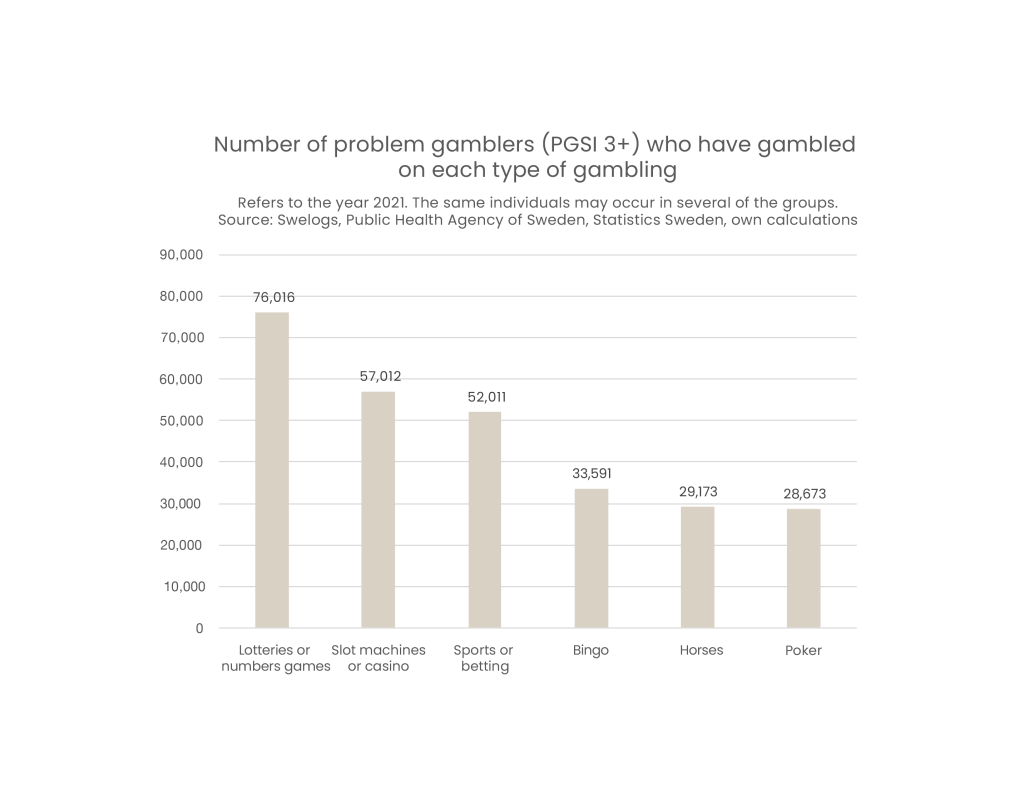
Commenting on the findings, Hoffstedt noted: “Lotteries are actually a more common choice among problem gamblers than online casino. That doesn’t mean that lotteries are more hazardous, but it means that lotteries, being a broad gambling product, also attracts problem gamblers, and to such level that it exceeds the demand for online casino.”
According to BOS, this underlines the need for evidence-based regulation rather than assumptions that certain state-run products are inherently low-risk.
The consequences, he told SiGMA News, are clear: “If Svenska Spel succeeds in securing a ban on gambling advertising in the competitive market, they would effectively have a monopoly on advertising.”
Svenska Spel pushes risk classification and tougher youth rules
The bonus dispute is only one front in a broader policy battle. In a separate op-ed published in October, Svenska Spel CEO Anna Johnson laid out 18 proposals designed, she said, to strengthen consumer protection and restore trust in the licensed market.
Johnson argued that Sweden has fallen far short of the political goal set in 2019 of 90 percent channelisation toward licensed operators. “Unlicensed operators still have a strong presence, gambling problems are increasing among young people and women, and it is in high-risk games such as online casino where almost all of the growth is taking place,” she wrote, warning that these trends “risk undermining trust in the regulated gambling market.”
Among Svenska Spel’s key proposals is the introduction of a statutory risk-classification system, under which higher-risk products like online casino would face stricter rules on marketing and consumer monitoring. Johnson wrote that “all forms of gambling are not equally dangerous,” adding that high-risk online casino games “are strongly linked to indebtedness and problem gambling.”
She also called for stronger protections for young adults, including tighter spending limits, bans on direct marketing, and faster intervention requirements for those under 25. And she reiterated Svenska Spel’s longstanding push for DNS-blocking to shut out unlicensed operators, saying such measures had worked in Denmark, Norway and Singapore.
A sector divided over how to protect consumers
Both sides insist their aim is to protect consumers and strengthen the licensed market, but the proposed fixes diverge dramatically.
For BOS and its members, restrictions that make the legal market less appealing will inevitably push more consumers towards offshore sites with no safeguards. Hoffstedt argues that Svenska Spel and ATG, despite their public-interest mandate, are acting to “defend their market share in an increasingly shrinking licence market” rather than strengthening the system as a whole.
Svenska Spel, meanwhile, maintains that stronger rules, from youth protections to blocking unlicensed sites, are essential to stop the growth of high-risk online casino gambling and reverse declining public trust.
Be part of the action at SiGMA South Asia, 30 Nov – 02 Dec 2025. Colombo becomes the heart of gaming as 5,000 delegates, 100+ speakers, and 1,000 operators gather under one roof. With high-value traffic, game-changing insights, and unforgettable networking, this is where new markets meet new horizons.


